
The Nightingale and the Jade Emperor: A Chinese Moral Tale About True Freedom
The Nightingale and the Jade Emperor
Long ago, beyond the mountains of jade and rivers that glittered like silk ribbons, there stretched the grand palace of the Jade Emperor, ruler of all Heaven and Earth. His throne was set high in a court of cloud-white marble, surrounded by silk banners and shimmering lanterns. From his palace, the Jade Emperor could see every marvel and secret of his vast world—but there was one beauty he had never known.
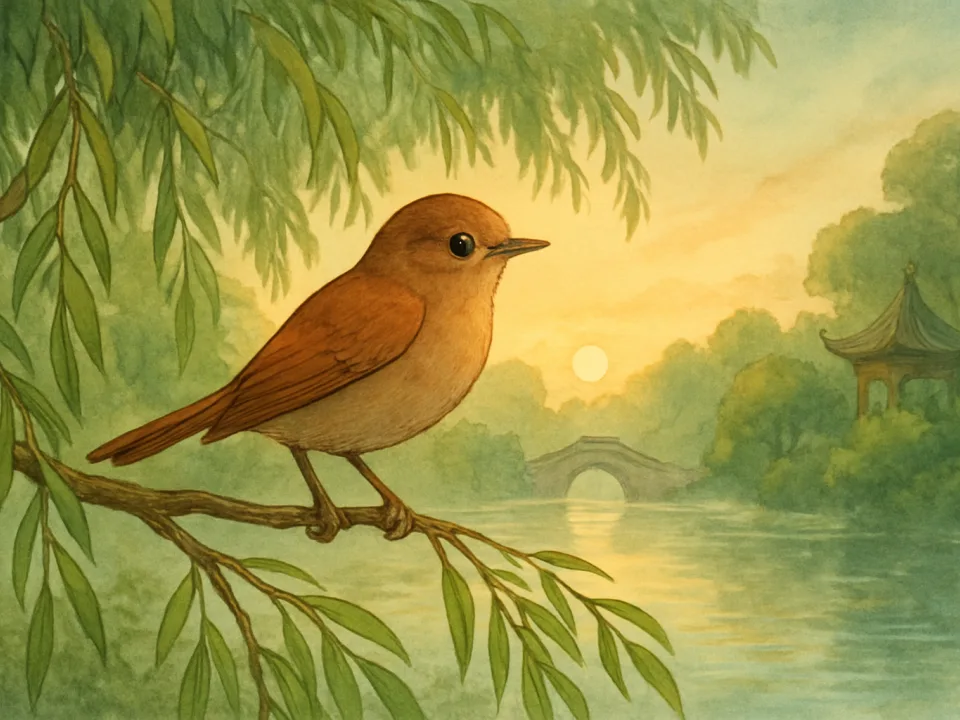
Each morning, as the mists curled over the palace gardens, something magical filled the air: a song so pure and sweet it seemed poured from silver moonlight. Servants and nobles spoke in hushed tones of its source—a humble nightingale, brown as cinnamon and quick as a lantern’s flicker, who lived among the willow trees beside the Lotus Lake.
The word of the nightingale’s song traveled upward, fluttering on the lips of ministers until it reached the Jade Emperor himself. Intrigued and longing to hear this wonder, he summoned his advisors.
“Bring this nightingale to my court,” he declared, his voice rich as thunder and soft as falling snow. “If her song is truly so fine, let her sing for me.”
The Search for the Nightingale
The Emperor’s attendants searched high and low, wandering through the dew-bright gardens, chasing the flicker of wings among the willow shadows. They listened by the murmuring streams, peered into the cool green shadows where lotus flowers floated, and asked every gardener, cook, and child if they had seen the mysterious bird. At last, beneath a graceful willow whose leaves wept into the lake, they found her—small, bright-eyed, with feathers that shimmered between copper and chestnut. When she sang, the whole world seemed to hush and listen. Her notes danced and spun, light and wild, like a breeze after rain.
Respectfully, the attendants bowed. “Nightingale, the great Emperor wishes to hear your song. Will you come and sing in the palace?”
The nightingale cocked her head. “I have never seen a palace,” she replied softly, her voice as gentle as the wind through bamboo. “But I will sing for anyone who wishes it, as long as I am free to fly where my heart leads.”
So the attendants led her to the palace, carrying her gently in a woven basket lined with silk. Word spread quickly through the palace: the nightingale would sing before the Emperor himself. Courtiers gathered in the halls, eager to witness the marvel.
The Emperor Listens
When the nightingale first sang in the grand Hall of Jade, time seemed to melt. Her song swept through the carved eaves, filled every golden chamber, and reached even the coldest heart. The Emperor’s eyes glistened. For the first time in memory, he felt joy—simple, unadorned, and true. Ministers and nobles wept openly, and even the palace cats paused to listen, tails curled in wonder.
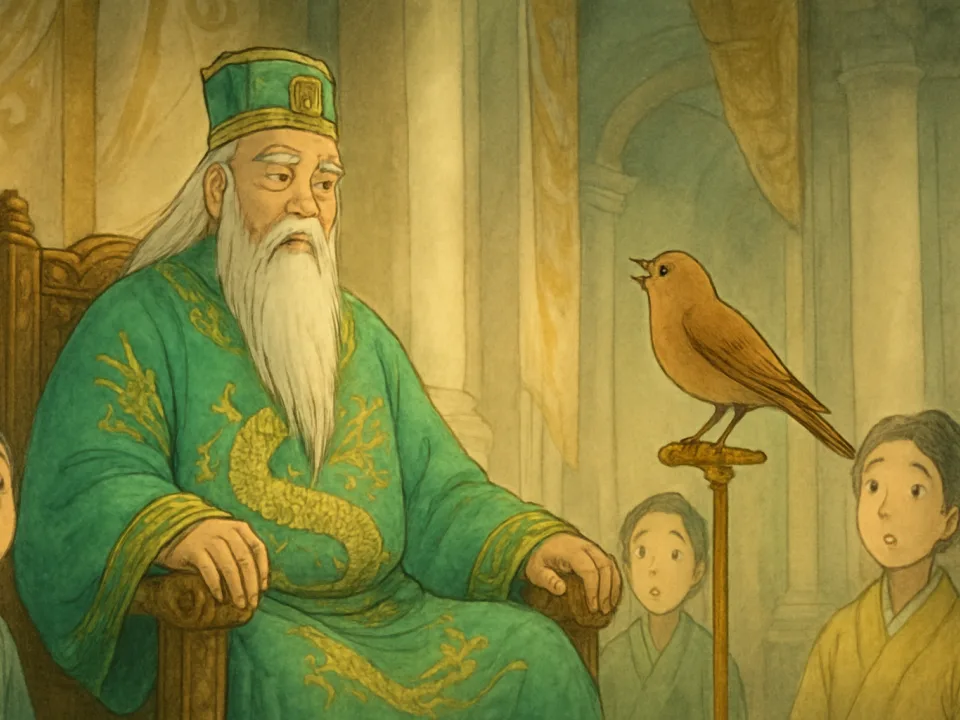
“I have never heard anything so beautiful,” the Emperor whispered. “Such music must remain in my palace forever.”
He ordered a special cage to be crafted from the finest jade and gold, inlaid with pearls and hung with silk tassels. The artisans worked day and night, carving delicate vines and blossoms into the bars. He placed the nightingale inside with bowls of the sweetest fruit and clearest water. “Sing for me every day,” commanded the Emperor gently. “You will be honored above all.”
The court rejoiced, and every morning, the Emperor would sit upon his throne, waiting for the first notes to ring out from the nightingale’s cage.
Life in the Palace
At first, the nightingale sang, and all who heard her marveled. Her melodies rose and fell like the tide, echoing through the marble halls and drifting out over the lotus ponds. The Emperor’s mood grew lighter, and he smiled more often. Artists painted the nightingale’s likeness, and poets wrote verses in her honor. She was given the finest grains and the softest silk to nest upon.
But as the days passed, she grew quiet. The nightingale gazed out from her intricate cage, her eyes following the flight of dragonflies over the gardens beyond the lattice. She missed the rustle of willow leaves, the feel of dew on her wings, and the freedom of the open sky. Her songs became softer, tinged with sadness, and sometimes she would fall silent for hours.
At first, the palace staff tried to cheer her with new treats and gentle words. The musicians played along with her, but their notes sounded hollow by comparison. Children brought her wildflowers, and the Emperor himself visited, puzzled by her silence.
“What troubles you?” he asked, perplexed. “You have everything here—why are you not happy?”
The nightingale bowed her head. “Here, I am safe and fed, but I am not free. My song is wild as the river, meant for the open sky. Without my freedom, my song cannot soar.”
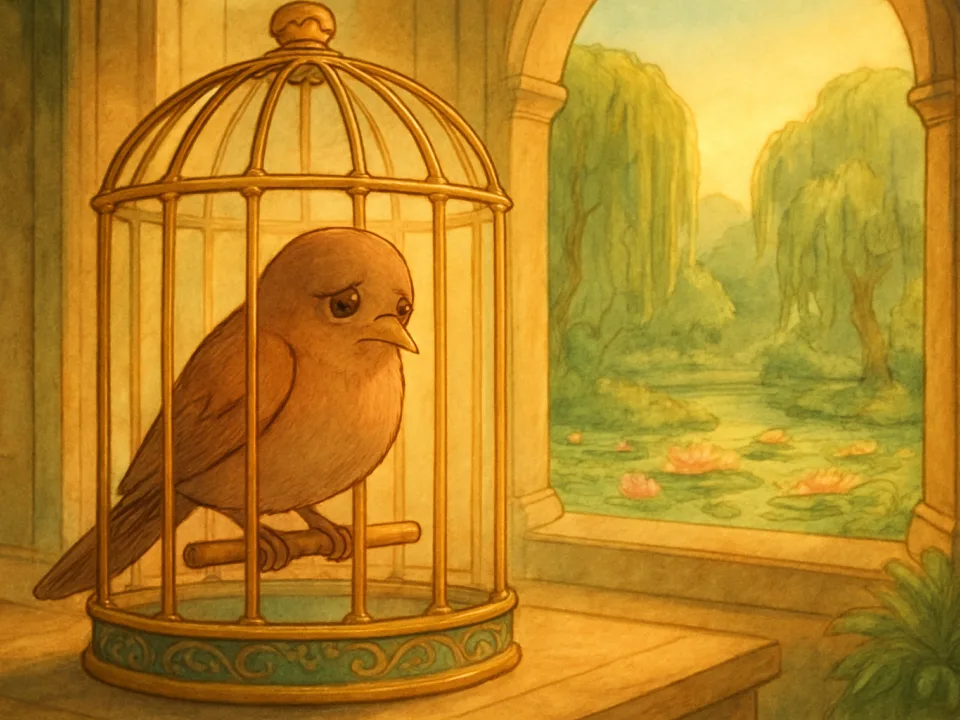
The Emperor was silent. He realized he had tried to hold onto beauty by keeping it close—but in doing so, he had dimmed the very joy that made it shine. The halls, once filled with music, now felt emptier than ever.
The Wise Counselor
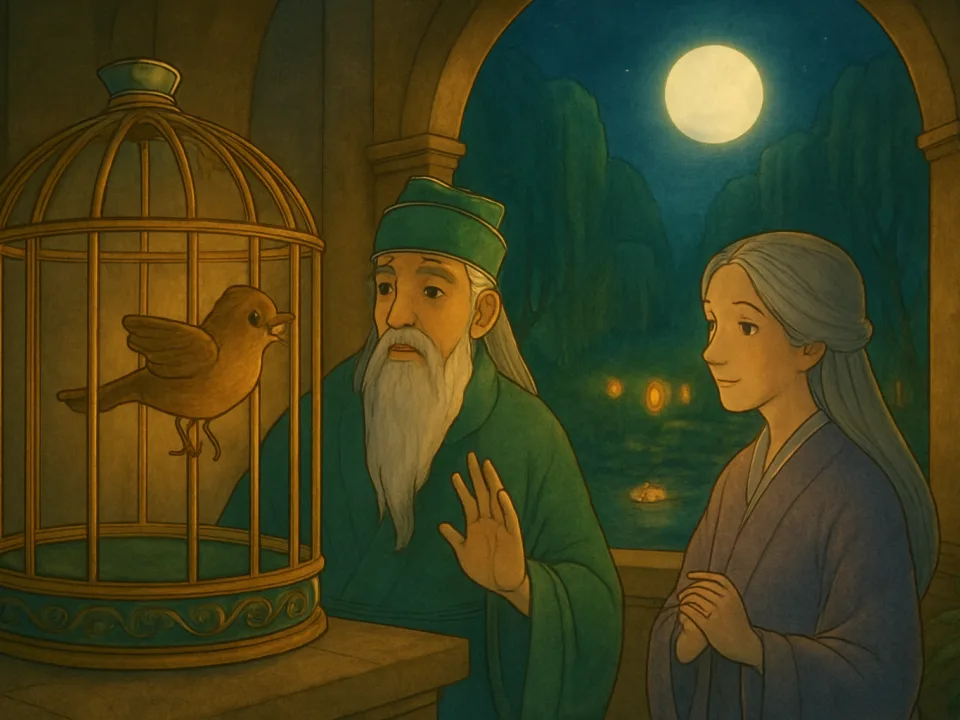
The Jade Emperor summoned his oldest counselor, Lady Ming, whose hair was silver and whose wisdom ran deeper than the Yellow River. She listened as the Emperor poured out his heart. He spoke of his longing to keep the nightingale close, his fear of losing her, and his regret that her music had faded.
“My Lord,” Lady Ming said softly, “the most precious gifts in life are those we cannot possess. True beauty, true friendship, and true happiness are found in freedom—not in cages, no matter how golden. A bird’s song belongs to the sky, not to a room, however grand.”
The Emperor thought long and hard. He remembered his own childhood, running through the wild mists and climbing cherry trees, feeling joy with every breath. That night, he walked alone to the nightingale’s cage. The moon hung low, casting silver patterns on the marble floor.
The Nightingale’s Choice
He opened the jade door, and the nightingale gazed at him—startled, yet hopeful, her heart fluttering like a leaf in the wind.
“I have kept you for my own happiness,” the Emperor confessed. “But now I see that true happiness cannot be forced. Go, little one. The world needs your song. And so do I.”
The nightingale hopped to the threshold, her eyes bright with gratitude. She looked back one last time, her voice trembling with emotion. “I will always remember your kindness,” she promised. And with a flutter, she soared into the night, her song trailing behind her—a ribbon of hope and joy on the moonlit air.
A New Understanding
Each dawn after that, the Emperor rose early, opening his windows to the gardens in hope. Sometimes, the sweet notes of the nightingale drifted through the palace, as if on the wind. She visited when she wished, singing not from a cage, but from the heart, perched on the tallest willow or the roof’s golden tiles. Her music was brighter than ever, and it brought happiness to everyone, not just the Emperor.
The Emperor learned to find happiness in letting beauty go free. He became known as a wise and gentle ruler, and his people said that all of Heaven was brighter for the song of a single nightingale, free among the willows. The palace gardens flourished, and the Emperor himself often strolled among the lilies and lotuses, listening to the laughter of children and the music of the wild birds. He had learned that the truest joy comes not from possession, but from appreciation, respect, and love.
And so, the nightingale’s song lived on, not just in the palace, but in the hearts of all who heard it, a reminder that freedom is the greatest gift of all.

Related Stories
The Golden Condor of the Andes: A South American Moral Story About Keeping Your Word
The Golden Condor of the Andes High above the lush valleys and patchwork fields of the Andes, the air sparkled with…
The Bamboo Cutter's Honest Promise: A Traditional Japanese Moral Story for Kids
The Bamboo Cutter's Honest Promise Long ago, in a quiet village nestled at the foot of Japan’s misty green mountains,…

Honest Woodcutter and the Magic Basket | Moral Story on Kindness
The Honest Woodcutter and the Magic Basket On the edge of Willow Creek, where the river flashed like silver ribbons and…

The Weaver of Oaxaca: A Latin American Folktale About Generosity and Craftsmanship
The Weaver of Oaxaca: A Latin American Folktale About Generosity and Craftsmanship In the heart of Oaxaca, where…

The Baobab Tree's Gift: An African Folk Story About Gratitude and Community
The Baobab Tree's Gift: An African Folk Story About Gratitude and Community [Long…

The Eagle and the Hummingbird: A Native American Story About Courage and Cooperation
The Eagle and the Hummingbird: A Native American Story About Courage and Cooperation [Long…
Three Little Pigs: Classic Fairy Tale Retelling
The Three Little Pigs Once upon a meadow: three pig brothers, three kinds of homes, and the famous wolf who huffs,…
Anansi and the Pot of Shared Wisdom: A West African Folktale About Humility
Anansi and the Pot of Shared Wisdom [Long ago](/blog/traditional-oral-stories-from-grandparents/), beneath the cool…