
'Kindness and Compassion' - A Tale of a Buddhist Monk
The Buddhist Monk and the Three Teasing Boys
At the edge of a quiet village, where rice fields shimmered like green silk and white cranes stepped through the water as carefully as dancers, stood a small monastery with a red-tiled roof. Every morning, before the sun had fully climbed into the sky, the temple bell rang once—low and clear—and the village seemed to wake with it.

In that monastery lived Brother Ananda, a Buddhist monk with kind eyes and a voice so gentle that even frightened animals seemed to trust him. He swept the stone path, watered the lotus pond, shared rice with hungry travelers, and listened patiently to anyone who needed comfort.
People often said, “When Brother Ananda speaks, your heart feels less heavy.”
And it was true.
But not everyone understood him.
The Boys Who Liked to Tease
Three boys—Tenzin, Rohan, and Kavi—thought Brother Ananda was a little too quiet, a little too calm, and a little too strange.
They were not cruel boys at heart. They were energetic, restless, and always looking for excitement. They raced down dusty lanes, climbed mango trees, and dared one another to do foolish things. To them, sitting still under a banyan tree with your eyes closed seemed like the most boring thing in the world.
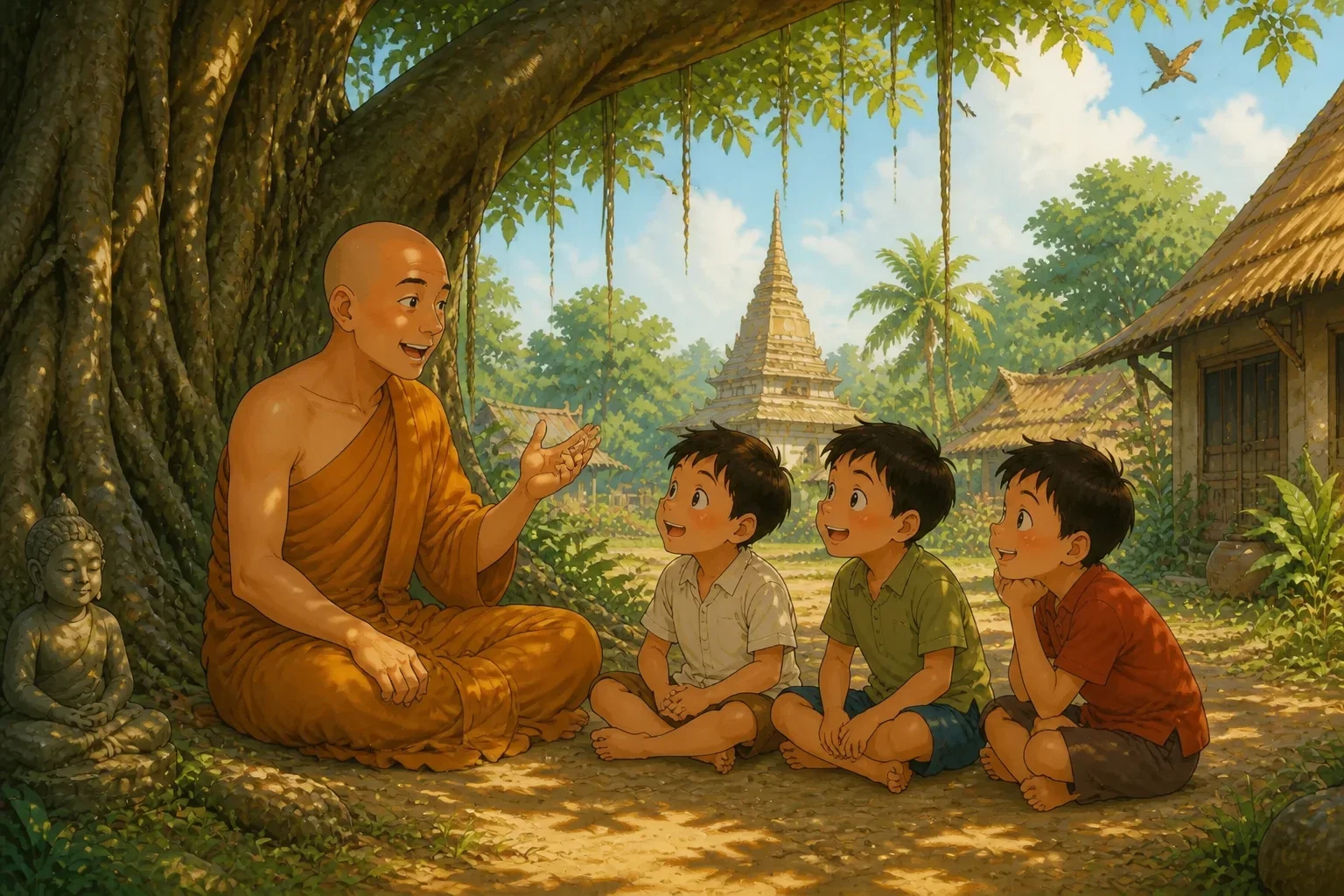
One warm afternoon, the boys spotted Brother Ananda meditating beneath the wide, whispering branches of the banyan tree near the village well.
Tenzin smirked. “Let’s see if we can make him lose his calm today.”
Rohan snickered. “Maybe he’ll finally get angry.”
Kavi picked up a pebble and tossed it—not to hurt, only to startle. It landed in the dust beside the monk.
Brother Ananda slowly opened his eyes.
The boys burst into laughter.
“Hey, Brother Ananda!” Tenzin called. “Do you ever do anything fun?”
Rohan folded his arms. “Or are you too holy to play?”
Kavi added, grinning, “Maybe you’re afraid of getting muddy!”
The banyan leaves rustled overhead. A squirrel froze on a branch. Even the village goat nearby seemed to pause.
But Brother Ananda did not scold them.
He did not frown.
He simply looked at them with the kind of attention that made them unexpectedly quiet.
Then he smiled.
“Perhaps,” he said, “you three can help me with something more interesting than sitting still.”
The boys exchanged puzzled looks.
“More interesting?” said Rohan.
Brother Ananda nodded. “Come. Walk with me.”
The Drying Stream
Curiosity is powerful, especially in children. So although they had come to tease him, the boys followed.
Brother Ananda led them past the well, beyond the vegetable gardens, and along a narrow path lined with wild jasmine. Soon they reached a small stream that curled around the far side of the village.
In the rainy season, it sang over smooth stones and carried cool water to the fields. But now the hot months had come, and the stream was thin and weak. In some places, it had broken into shallow puddles.
A woman stood nearby, staring worriedly at her empty water pot.
“My tomatoes are wilting,” she murmured.
An old farmer wiped his brow. “If this keeps up, the seedlings will die.”
The boys fell silent.
Brother Ananda crouched beside the stream and dipped his fingers into the little water that remained.
“Tell me,” he said softly, “what makes a stream?”
Tenzin shrugged. “Rain.”
“Springs in the hills,” said Kavi.
“Many drops together,” Rohan added.
Brother Ananda smiled. “Yes. A stream is not made by one mighty splash. It is made by countless small drops, each one joining the next.”
He stood and looked toward the worried villagers.
“Kindness is much the same.”
The boys said nothing.
So Brother Ananda continued.
The Monk’s Lesson
“Sometimes children think kindness must be something grand,” he said. “A treasure. A heroic deed. Something people will cheer for.”
He bent down and lifted a fallen leaf from the edge of the stream.
“But most often, kindness begins as something small. Carrying a basket. Sharing water. Speaking gently. Helping before you are asked. One small act may seem like a drop. But many drops can become a river.”
Rohan looked toward the woman with the empty pot.
Kavi stared at his dusty feet.
Tenzin tried to sound unimpressed, but his voice had softened. “And that really matters?”
Brother Ananda turned to him. “What would happen if everyone decided their one drop did not matter?”
No one answered.
The stream made a faint, tired sound over the stones.
Then Brother Ananda said, “Would you like to test it?”
The boys blinked.
“Test kindness?” asked Kavi.
“Yes,” said the monk. “For one week. Offer your small drops wherever you can. Then tell me whether they matter.”
Tenzin crossed his arms. “And if nothing changes?”
Brother Ananda’s eyes twinkled. “Then you may come back and laugh at me as much as you please.”
That made the boys grin.
“A whole week?” Rohan said.
“A whole week,” said Brother Ananda.
Small Acts, One by One
The next morning, the challenge began.
At first, the boys helped awkwardly, as if they were trying on clothes that did not quite fit.
Rohan carried a sack of grain for the baker and nearly dropped it twice.
Kavi fetched water for his grandmother without being reminded.
Tenzin helped the old farmer pull weeds from a dry patch of earth, though he complained the entire time.
By the second day, something strange happened.
The baker smiled and handed Rohan a warm sesame bun.
Kavi’s grandmother patted his cheek and said, “You made my back ache less today.”
The old farmer told Tenzin, “You have strong hands. Thank you.”
No one had ever thanked Tenzin in that way before.
On the third day, the boys noticed more things.
They noticed who struggled to lift bundles.
They noticed which younger children were left out of games.
They noticed a stray puppy whining beside the market and brought it scraps.
They noticed that the widow at the end of the lane had no one to sweep her courtyard, so they swept it for her, sending little spirals of dust dancing into the sunlight.
And every evening, when they passed the banyan tree, Brother Ananda would ask only one question:
“What drop did you add today?”
At first they answered proudly, each trying to outdo the others.
But after a few days, their answers became quieter.
“Rohan shared his lunch with Hari.”
“Kavi fixed Mina’s broken kite.”
“Tenzin helped at the stream.”
They were changing, though none of them said it aloud.
The Day It Became Clear
On the sixth day, dark clouds gathered at last over the hills. The village children ran outside, pointing upward. The air smelled of wet earth before the rain had even fallen.
Brother Ananda found the boys near the stream, where they had been helping place stones to guide the water toward the thirsty gardens.
Then the rain came—not a wild storm, but a steady, blessing sort of rain. It tapped on leaves, darkened the dust, and filled the stream until it began to murmur again.
The villagers laughed with relief.
Water ran around the stones the boys had helped place, flowing neatly into the channels beside the fields.
The old farmer raised his hands. “Look! It’s working!”
The woman with the tomato plants smiled so widely that Kavi smiled back without meaning to.
Brother Ananda stood beside the boys as the stream brightened and swelled.
Tenzin watched the water move and whispered, almost to himself, “It really is small drops.”
Brother Ananda nodded.
“Yes,” he said. “And small choices.”
Rohan looked up. “We didn’t do anything huge.”
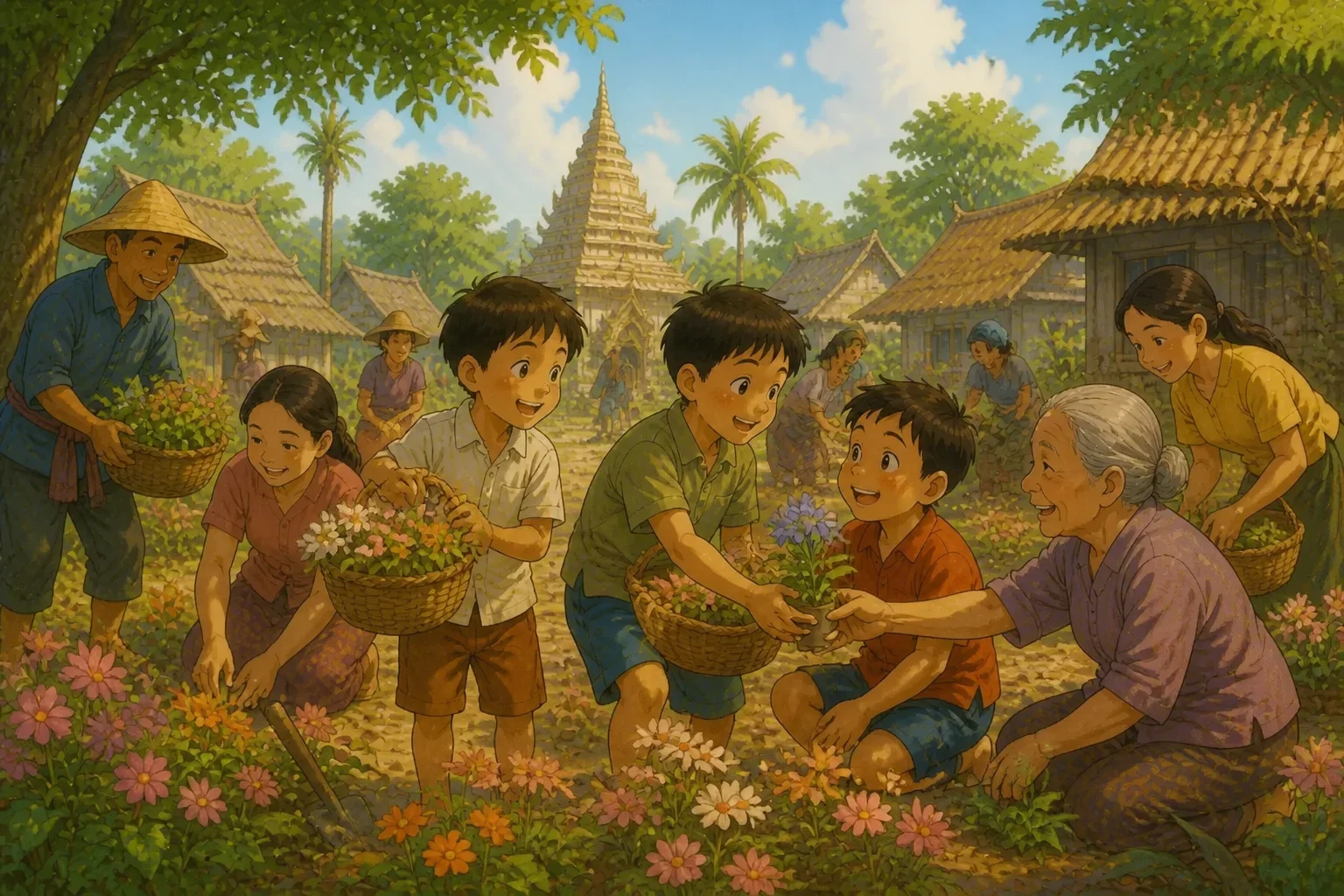
“No,” said the monk. “You did something better. You did many small good things, again and again.”
Kavi asked softly, “Is that how hearts change too?”
Brother Ananda smiled. “Often, yes.”
A Different Kind of Laughter
By the end of the week, the three boys were still lively, still muddy, still full of chatter and races and daring games.
But now they were known for something else too.
When an old man dropped his firewood, they helped gather it. When a child cried, they knelt to help. When work needed doing, they no longer vanished.
And their laughter sounded different.
It was no longer the sharp laughter of teasing someone who would not fight back.
It was the bright laughter of boys discovering that kindness did not make life dull at all.
It made life fuller.
One evening, as the sky turned orange behind the monastery roof, the boys sat beside Brother Ananda under the banyan tree.
Tenzin scratched the ground with a stick. “We were trying to make you angry that first day.”
“I know,” said Brother Ananda.
Rohan looked embarrassed. “Why didn’t you get angry?”
The monk folded his hands in his lap. “Because anger would have taught you very little. But kindness gave you something to carry.”
Kavi smiled. “A drop?”
Brother Ananda laughed softly. “Yes. A drop.”
For a while, the four of them sat listening to the evening birds.
And in the village beyond, people were helping one another in dozens of small, ordinary ways—so ordinary that they might have been missed by anyone who was not paying attention.
But Brother Ananda noticed.
The boys noticed too.
And that made all the difference.
Key Takeaways for Kids
- Kindness does not have to be big to be powerful.
- Small helpful actions can change someone’s whole day.
- Teasing and mockery can hurt, but gentleness can transform hearts.
- Compassion means noticing when someone needs help and choosing to care.
- Good habits grow stronger when we practice them every day.
Moral of the Story
Even the smallest act of kindness and compassion can grow into something powerful enough to change hearts, friendships, and an entire community.
Why This Kindness Story Stays With Children
Children often remember this moral story because it shows a simple truth in a vivid way: kindness is like water drops joining to make a stream. The boys do not change because they are punished. They change because they are guided with patience, given a chance to do better, and allowed to see the results for themselves.
That makes this a meaningful bedtime story and a memorable moral story for kids about compassion, choices, and the quiet strength of gentle wisdom.

Watch the Animated Story
Watch on YouTube
Related Stories
A Blessing in Disguise Story: The Farmer Who Found Hope
A Blessing in Disguise: The Farmer Who Found Hope After the Storm On the edge of a quiet village, where the fields…
Simple Life of Lila: A Beautiful Moral Story for Kids
The Simple Life of Lila On the edge of a quiet village, where the mornings smelled of wet earth and jasmine, stood a…
Jack and the Lost Coins: An Honest Bedtime Story for Kids
Jack and the Lost Coins On the edge of a quiet village, where white geese waddled across dusty lanes and sunflowers…

The Lion and the Mouse Story for Kids About the Power of
The Lion and the Mouse In the oldest part of the jungle, where tall trees wove a green roof over the earth and golden…
The Power of Forgiveness: A Short Moral Story for Kids
The Power of Forgiveness In a quiet village tucked between green hills and a silver stream, everyone knew James. He was…

Story of Buddha: Siddhartha’s Journey to Wisdom, Balance
The Story of Buddha for Kids Long ago, in a beautiful kingdom at the foot of the mountains, there lived a young prince…
Compassionate Teacher | School Moral Story About Kindness
The Compassionate Teacher On the first Monday of the school year, Maplewood Middle School buzzed like a beehive.…

The Cruel King Who Learned Kindness Moral Story for Kids
The Cruel King Who Learned Kindness In the kingdom of Eldoria, people lowered their voices whenever they spoke the…

King Midas and the Golden Touch Story: A Lesson About Greed
King Midas and the Golden Touch There once lived a king who had almost everything a person could wish for. His palace…

Carnival of Togetherness | Moral Story About Inclusion
The Carnival of Togetherness Long before the first drumbeat echoed through Rio de Janeiro, the city already felt as if…