
A Story of THE CRUEL KING
The Cruel King Who Learned Kindness
In the kingdom of Eldoria, people lowered their voices whenever they spoke the king’s name.

King Reginald lived in a high stone castle with silver towers and heavy gates, but his heart was harder than the castle walls. He demanded more taxes every season. If a farmer’s cart broke and he brought grain late, he was punished. If a servant spilled water in the palace hall, they trembled for fear of what would happen next.
When the king’s black carriage rolled through town, shopkeepers stopped smiling. Mothers pulled their children close. Even the dogs seemed to bark more softly.
“Why is the king so angry all the time?” children whispered.
No one had an answer.
Yet in that same kingdom lived a man named Eldrin, a gentle old villager with bright eyes, a walking stick made of ash wood, and a voice that always made people feel calmer. Children liked to sit near him beneath the great oak tree in the village square and listen to his stories.
One windy afternoon, a little girl came running to him. Her braid had come loose, and she held a cloth doll tightly against her chest.
“Eldrin,” she said, trying not to cry, “my father says we may lose our bread shop because we cannot pay the king’s tax. Can’t someone make him understand?”
Eldrin looked around the square. A cobbler was mending the same old shoe for the third time because its owner could not afford a new pair. A mother was dividing one loaf into many tiny pieces. A boy stood outside a toy stall, staring at a wooden horse he knew he would never have.
Eldrin sighed. “Sometimes,” he said gently, “a person does not change because no one has shown him what his choices truly do.”
The little girl blinked. “Will you show him?”
Eldrin gave a slow nod. “I will try.”
Eldrin Visits the Palace
The next morning, Eldrin climbed the long hill to the palace. Guards in shining armor crossed their spears at the gate.
“I have come to speak to the king,” Eldrin said.
The guards laughed. “The king does not meet old villagers with dusty shoes.”
But Eldrin stood so calmly, and his gaze was so steady, that at last the captain of the guard sent word inside.
To everyone’s surprise, King Reginald agreed to see him.
The throne room was grand and cold. Sunlight streamed through tall windows, but it did not make the room feel warm. Reginald sat on a golden throne carved with lions. His robe was dark red, and a jewel glittered on his crown.
He looked down at Eldrin. “Speak quickly.”
Eldrin bowed. “Your Majesty, your people are suffering.”
The king’s face hardened at once. “My people complain too much. A kingdom must be ruled with strength.”
“Strength is not the same as cruelty,” Eldrin replied.
A murmur ran through the court. No one spoke to the king that way.
Reginald leaned forward. “Are you accusing me?”
“I am asking you to see,” said Eldrin.
“See what?” snapped the king.
“The lives hidden behind the taxes you collect. The tears behind the silence in your streets. The fear in the eyes of children when your carriage passes.”
The king gripped the arm of his throne. “People fear me because I am powerful.”
Eldrin shook his head. “No, Majesty. They fear you because they are hurting.”
For a moment, the hall became very still.
Then the king said, “And how would you have me prove your words?”
Eldrin answered, “Come with me. Not as a king. As an ordinary man.”
The King in Disguise
At first, Reginald almost refused. But curiosity, sharp and uncomfortable, pricked at him.
That evening, he put aside his crown. He dressed in a plain brown cloak and simple boots. Without his gold and jewels, he looked like any tired traveler. Only Eldrin knew who he really was.
Together they walked down from the palace and into the town.
It was market day, but the market was not lively. The fruit seller had only a few bruised apples left. The baker’s shelves were half empty. A tailor sat with folded hands because no one had money for mending.
At a small stall, a woman was speaking to the baker.
“Please,” she said, “just one more loaf. I can pay next week.”
The baker looked miserable. “If I give away bread, my own children will go hungry.”
The king slowed his steps.
Farther on, a farmer sat beside a broken cart wheel.
“I sold my horse to pay the tax,” the farmer told another man. “Now I cannot plow my field properly. If the harvest fails, what will become of us?”
Reginald said nothing, but his jaw tightened.
Then they passed a narrow alley where two boys were playing with pebbles, pretending they were marbles.
One boy laughed, but the other said, “My mother says not to ask for toys this year. The king needs our coin more than we do.”
The words struck Reginald harder than he expected.

“The king needs our coin more than we do.”
He had heard complaints before, of course. But complaints in the throne room had always sounded distant, like rain on a far roof. Here, in the streets, they sounded different. They had faces. Thin faces. Tired faces.
Near the village fountain, the little girl with the cloth doll was sitting on the edge of the stone basin. She did not recognize the disguised king.
Eldrin sat beside her. “How is your family?” he asked.
She looked down at her doll. “Mama says we must be brave. Papa works before sunrise and after dark. But he still worries.”
“About what?” Reginald asked before he could stop himself.
The girl looked at him with solemn eyes. “About the king.”
The words were simple. That made them even heavier.
“Do you hate him?” Reginald asked quietly.
She thought for a moment and shook her head. “No. I just think maybe no one has told him how sad everyone is.”
Eldrin turned and looked at the king, but said nothing.
A Sleepless Night
When Reginald returned to the palace, the halls seemed louder than usual. The clatter of plates, the rustle of silk, the crackle of firewood in giant hearths—everything felt too rich, too easy.
He entered his chamber and stood before the tall mirror framed in gold.
He saw his crown on the table.
He saw his velvet robes.
And he saw, reflected in the glass, a man who had never bothered to ask what his power cost others.
For a long time, he did not move.
At last he whispered, “What have I done?”
That night he could not sleep. Each time he closed his eyes, he saw the empty baker’s shelf, the broken cart wheel, the little girl holding her worn cloth doll.
By morning, something in him had changed.
The King’s Promise
At sunrise, the palace bells rang. Messengers hurried through the streets announcing that the king would speak in the square.
The townspeople gathered nervously. Some expected a new rule. Others feared a punishment.
King Reginald stepped onto the platform wearing his crown once more—but his face was different. Not softer exactly, but troubled, thoughtful.
Eldrin stood nearby.
The king looked over the crowd. For perhaps the first time in his life, he truly looked.
“I have ruled without listening,” he said.
The square went silent.
“I believed fear made a kingdom strong. I was wrong.”
People exchanged startled glances.
Reginald continued, his voice clear but humble. “The taxes will be reduced. Families in need will be given relief. Harsh punishments for small mistakes will end. And every month, I will hear the concerns of my people myself.”
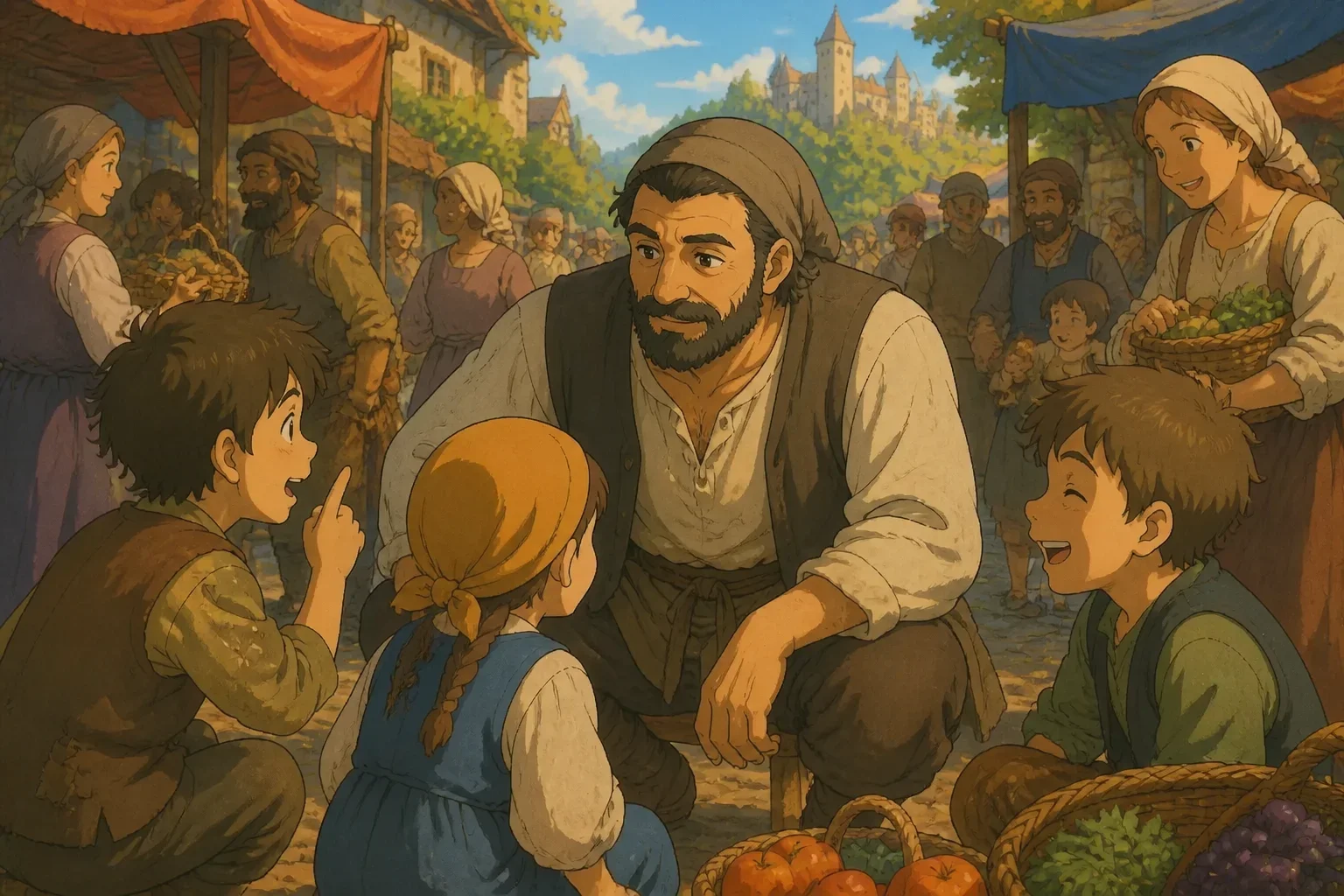
No one cheered at first. The words were too surprising.
Then the baker began to clap.
The farmer with the broken cart wheel lifted his cap.
A mother started to cry with relief.
And soon the whole square filled with sound—applause, laughter, and the kind of hopeful noise Eldoria had not heard in years.
The little girl hugged her cloth doll and smiled.
Eldrin leaned toward the king and said softly, “Now you are beginning to rule.”
A Different Kind of Strength
Change did not happen in a single day, but it did happen.
Reginald visited farms and workshops. He listened more than he spoke. He ordered grain to be shared in lean months. He repaired roads so merchants could travel safely. He made sure laws were fair, not cruel.
At first, the people watched him carefully, unsure whether this kindness would last.
But it did.
Seasons passed. The market grew lively again. Children laughed without glancing over their shoulders. Bread ovens stayed warm. Fields turned green. And when the king’s carriage rolled through town, mothers no longer pulled their children away.
Sometimes the children even waved.
King Reginald always waved back.
He never forgot the day he had walked through his kingdom in a plain brown cloak and heard the truth with his own ears.
For he had learned something no crown could teach him:
A ruler is not great because people fear him. A ruler is great because people trust him.
Key Takeaways for Kids
- Kindness is a real kind of strength. Being gentle and fair can help people far more than being harsh.
- Listening matters. When we listen to others, we understand how they feel and what they need.
- People can change. Even someone who has made unkind choices can become better if they are willing to learn.
- Good leaders care for others. True leadership means helping, protecting, and serving people.
Moral of the Story
Even a cruel heart can change when it learns to see others with empathy and kindness.

Watch the Animated Story
Watch on YouTube
Related Stories

Compassionate Teacher | School Moral Story About Kindness
The Compassionate Teacher On the first Monday of the school year, Maplewood Middle School buzzed like a beehive.…
Father Michael and the Rain of Hope | Compassion Story
Father Michael and the Rain of Hope On the edge of a small village, where green hills once rolled like soft blankets…

Brave Nurse Sarah: A Heartwarming Compassion Story for Kids
The Brave Nurse Sarah On ordinary days, Sunshine Medical Center smelled like soap, clean sheets, and the lemon candies…

Doctor Ethan Story: A Compassion Moral Story for Kids
A Tale of Doctor Ethan On the busiest street in Willow Grove, between a bell-ringing bookshop and a flower store that…

Carnival of Togetherness | Moral Story About Inclusion
The Carnival of Togetherness Long before the first drumbeat echoed through Rio de Janeiro, the city already felt as if…
Heroic Policeman and the Boy on the Swing | Kindness Story
The Heroic Policeman and the Boy on the Swing In the little town of Willow Creek, people could tell the time by Officer…
Lazy Donkey Who Finally Helped: A Moral Story on Hard Work
The Lazy Donkey Who Finally Helped In a sunny little village tucked between green hills and golden fields, there lived…

Frogs Who Wanted a King: A Memorable Aesop Fable for Kids
The Frogs Who Wanted a King On the edge of a quiet marsh, where dragonflies stitched silver lines through the air and…
The Most Loving Princess Story: A Tale of Kindness
The Most Loving Princess At the top of a green hill, where morning light touched the castle windows like melted gold,…
Thanksgiving: A Heartwarming Story of Sharing and Kindness
The True Meaning of Thanksgiving On Thanksgiving morning, the Thompson house smelled like butter, cinnamon, and…