
A Story of A Pencil
The Pencil Maker's Story
On the edge of a quiet village, where the morning mist curled around little rooftops and sparrows hopped along stone paths, there stood a tiny workshop with a blue wooden door.
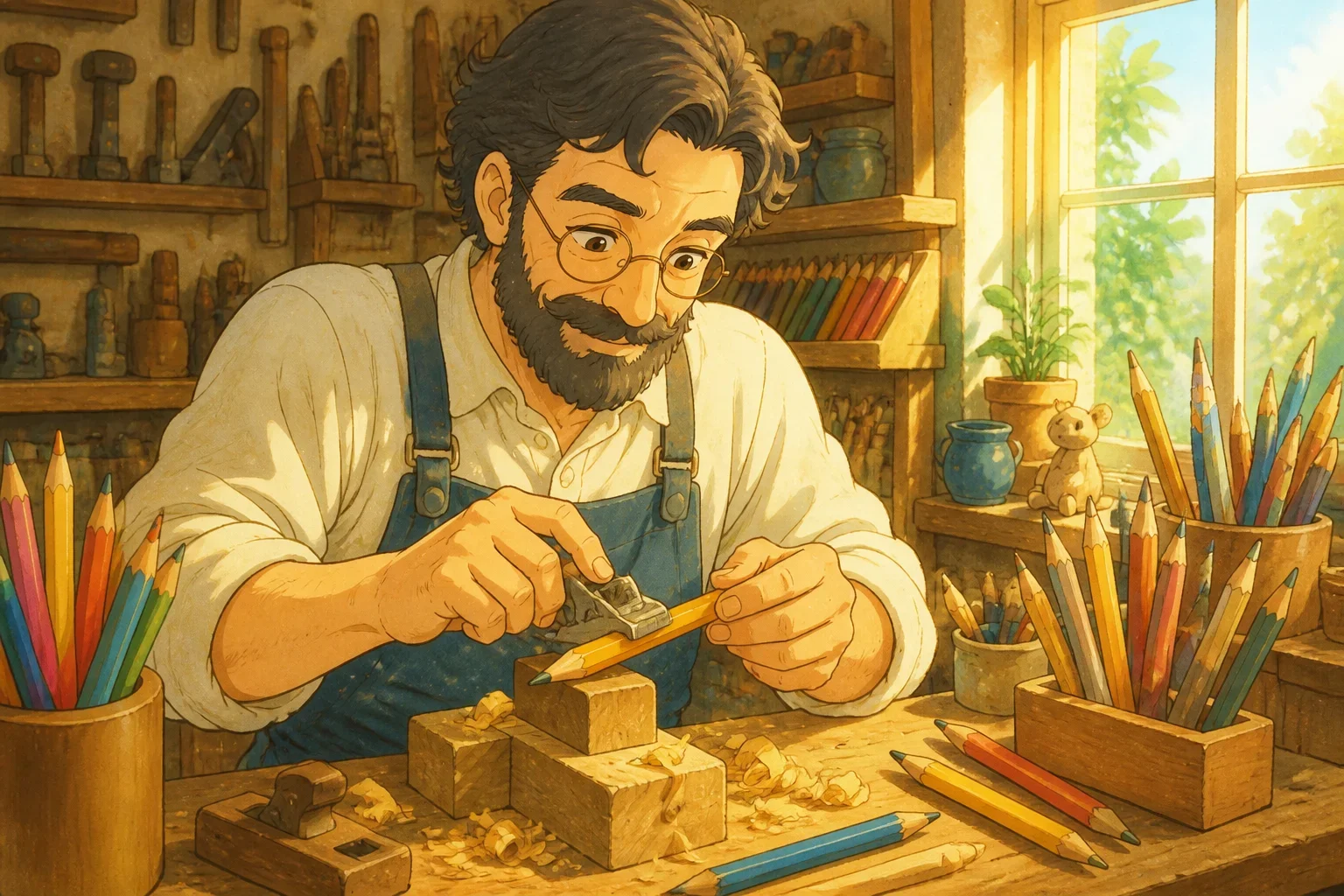
If you passed by that door, you would smell cedar shavings, warm paint, and something else too—hope.
The workshop belonged to Samuel, the village pencil maker.
Children loved to press their noses to his window and watch him work. Inside, rows of pencils rested in neat trays—some bright red, some sunshine yellow, some forest green, and some plain and simple, waiting for their turn. Samuel treated every pencil with such care that people often said, "He doesn't make pencils. He gives them a future."
One afternoon, a girl named Lily came to visit.
Usually, Lily was full of chatter and questions, but that day she walked in quietly, holding her school notebook against her chest.
Samuel looked up from his workbench and smiled. "Hello, Lily. You look as though your thoughts are heavier than your feet."
Lily tried to smile back. "May I watch you work?"
"You may do better than that," Samuel said kindly. "You may help."
Lily's eyes brightened a little.
Samuel pulled out a stool for her. Sunlight spilled across the workbench, touching piles of smooth wood, tiny pots of paint, and long thin pieces of graphite. Everything looked ordinary at first glance, but in Samuel's hands, ordinary things became something special.
"Mr. Samuel," Lily asked after a moment, "how does a pencil become a good pencil?"
Samuel held up a plain wooden piece. "Ah," he said, "that is a very important question. Sit close, and I'll show you."
The Lesson Inside a Pencil
He placed the piece of wood in Lily's palm.
"This is how every pencil begins," he said. "Simple. Unfinished. Easy to overlook."
Lily turned it over in her hand. "It doesn't look like much yet."
"Neither do many wonderful things at the beginning," Samuel replied.
He carefully shaped the wood and showed her the dark graphite center.
"This part inside," he said, tapping it gently, "is what allows the pencil to write. The outside matters, yes. But what is inside matters even more."
Lily grew quiet.
At school that week, she had made several mistakes while reading aloud. A few children had laughed. Since then, she had begun to wonder if she simply wasn't as clever as everyone else.
Samuel, as if he could hear the worry she hadn't spoken, continued softly, "People are like pencils. What is inside them—their kindness, courage, thoughts, and willingness to learn—is what truly helps them leave a mark on the world."
Lily looked down at the workbench. "What if someone makes mistakes?"
Samuel's eyes twinkled. "Then they are even more like a pencil than they realize."
The Courage to Be Sharpened
Samuel picked up a finished pencil and a small sharpener.
"Do you know what this pencil might say if it could talk?" he asked.
Lily giggled. "Probably, 'Please don't put me in there!'"
Samuel laughed. "Exactly. Sharpening can feel uncomfortable. But without it, the pencil grows dull. It cannot write clearly."
He turned the sharpener slowly. A ribbon of wood curled down onto the table.
"Growing is often like this," he said. "Practicing, being corrected, trying again after mistakes—none of it is always easy. But those things help us become better, stronger, and more useful."
Lily watched the sharpened point appear.
"So mistakes aren't the end?" she asked.
"No," said Samuel. "Very often, they are the beginning of improvement."
Lily let out a small breath, as if she had been carrying that question all day.
The Mark We Leave Behind
Next, Samuel handed Lily a pencil and a sheet of paper.
"Write your name," he said.
She did.
The letters came out a little crooked, but clear.
"Now erase it," Samuel said.
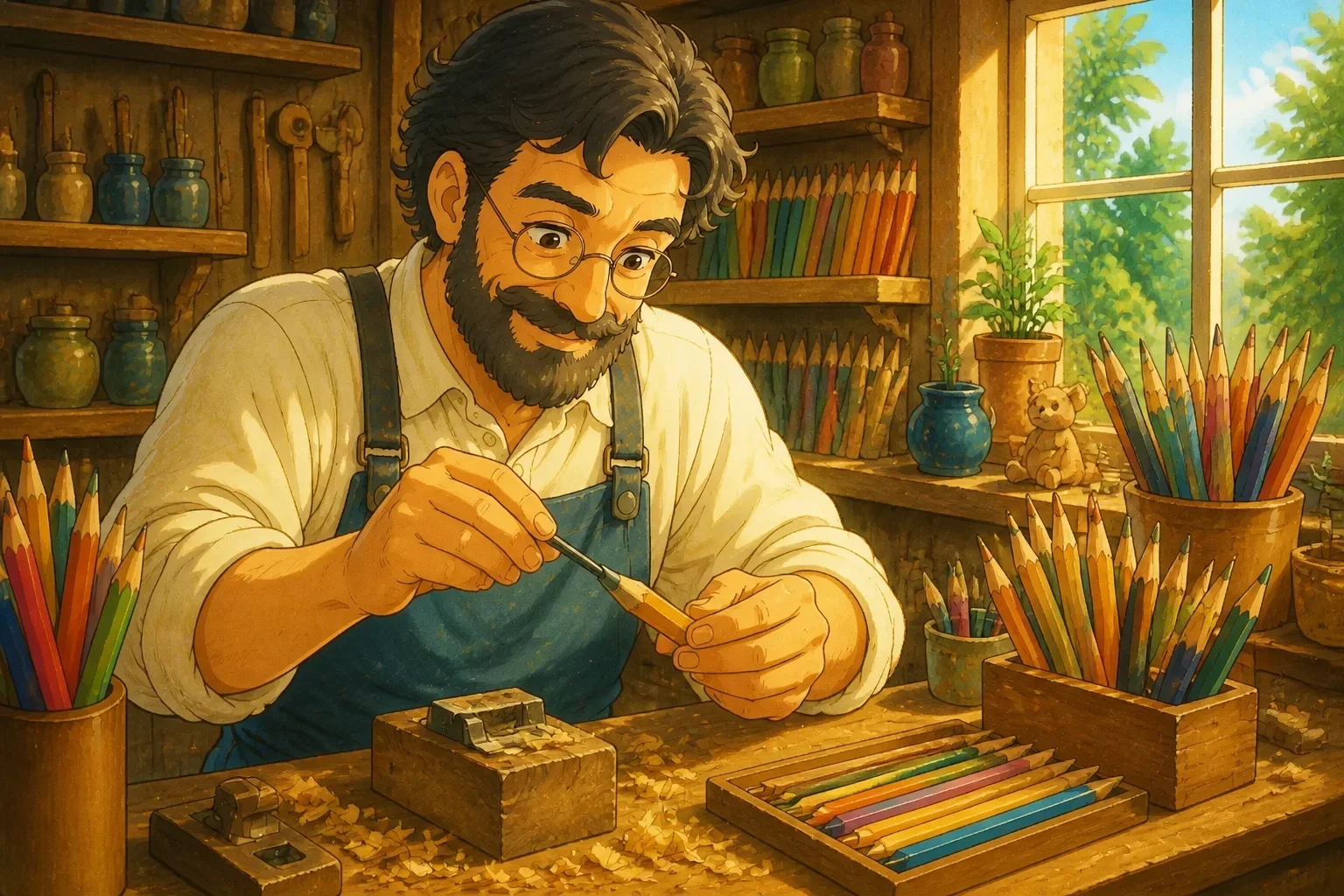
Lily rubbed the eraser over the page until the name faded.
Her eyes widened. "It's almost gone."
"Almost," Samuel said. "A pencil teaches another lesson too. We all make marks. Some can be corrected. That is a gift. If we say something unkind, make a poor choice, or get something wrong, we can try again and do better."
Lily traced the faint shadow left on the page.
"So we shouldn't be afraid of getting things wrong?"
"We should try our best," Samuel answered, "but we should never be so afraid of mistakes that we stop trying."
Those words settled warmly in Lily's heart.
Every Pencil Is Different
After that, Samuel opened a drawer filled with paints.
Lily gasped. "They're beautiful!"
There were colors like ripe cherries, deep oceans, marigold petals, rainy clouds, and silver moonlight.
"Choose one," Samuel said.
Lily picked a bright blue.
Together they painted a row of pencils. Some had stripes. Some had tiny stars. One had a golden band near the top. Another was left plain and polished smooth.
Lily pointed to the plain one. "Shouldn't all of them be colorful?"
Samuel shook his head. "Not at all. A pencil does not need to look like another pencil to be valuable. Each one has its own place, its own user, its own story."
He set the pencils side by side.
"And people are the same," he added. "One may be bold, another quiet. One may draw beautifully, another may solve hard sums, another may know just how to comfort a friend. Different does not mean less. Different often means special."
Lily smiled—this time for real.
Lily's Real Question
The workshop grew golden with late afternoon light. Outside, the birds were beginning their evening songs.
Lily finally asked the question she had been carrying all day.
"Mr. Samuel... what if I feel ordinary?"
Samuel paused and placed a newly finished pencil in her hand.
It was smooth, blue, and simple, with a clean sharp point.
"Then remember this," he said. "A pencil may look small and ordinary. But it can write a poem, solve a problem, draw a dream, sign a promise, or begin a great story. Never measure your worth by how ordinary you appear at first glance."
Lily held the pencil carefully, as though it were a tiny treasure.
Samuel continued, "You do not have to be perfect to be meaningful. You only have to keep learning, keep trying, and use what is inside you well."
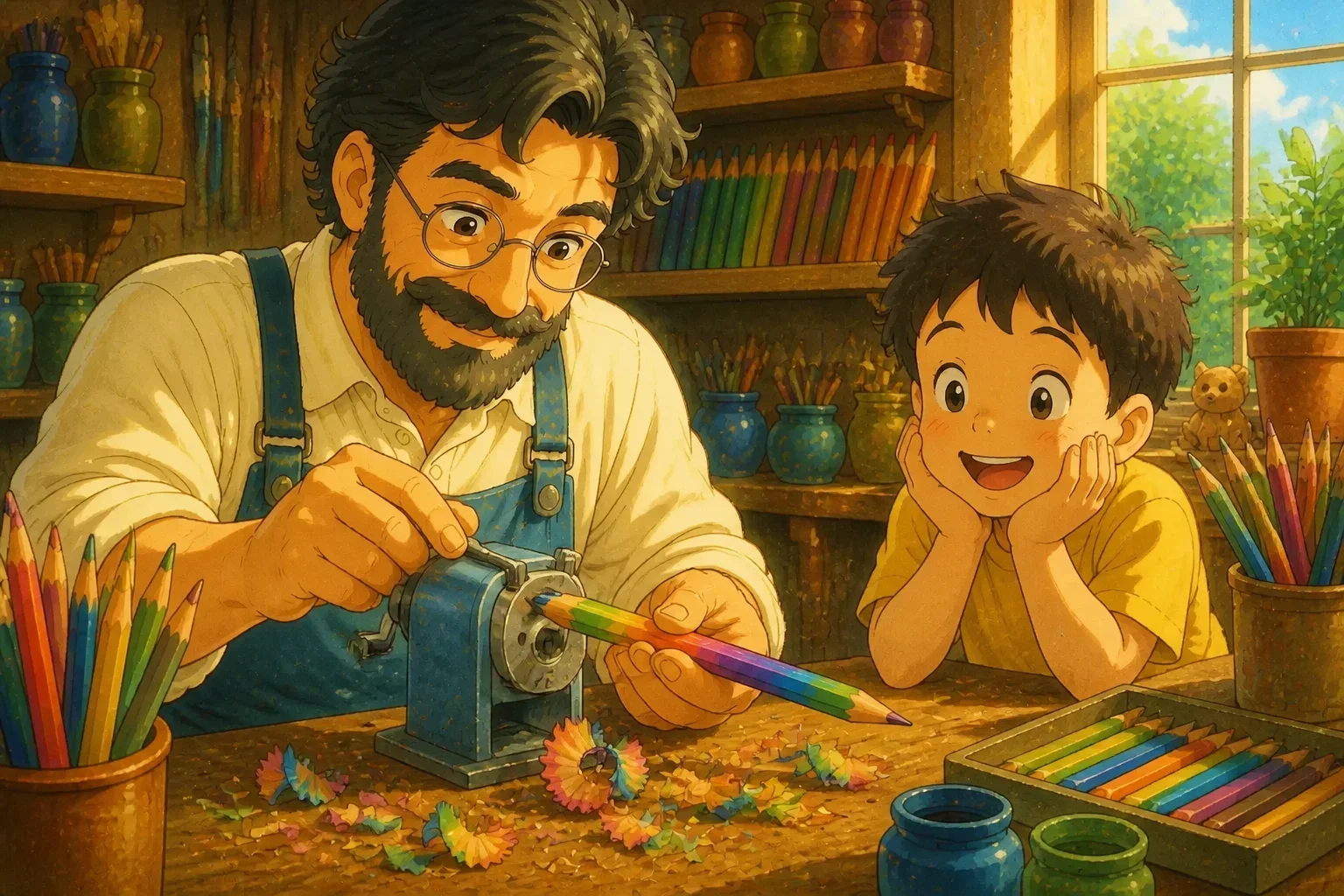
For a moment, Lily said nothing.
Then she whispered, "I think I understand now."
A New Beginning
When Lily returned home that evening, she opened her notebook again.
The same notebook she had wanted to hide.
She looked at the crossed-out words, the uneven letters, the pages with mistakes and corrections.
This time, she did not feel ashamed.
She picked up the blue pencil Samuel had given her and began to write.
Her handwriting was not perfect.
She misspelled one word and erased it.
Then she kept going.
Because now she knew something she hadn't known that morning:
A good pencil is not one that never needs sharpening.
A good pencil is one that keeps writing.
And a good life is much the same.
Key Takeaways for Kids
- What is inside you matters more than how you look on the outside.
- Mistakes can help you learn and grow.
- Being corrected or challenged can make you stronger, just like a pencil being sharpened.
- You do not need to be exactly like others to be valuable.
- You can always try again and make better choices.
Moral of the Story
Like a pencil, every person has a special purpose. With patience, learning, and the courage to keep improving, we can all leave a good mark on the world.
Why This Moral Story Connects With Kids
Children often worry about mistakes, schoolwork, or not being "as good" as someone else. This gentle pencil maker story reminds them that growth takes time, mistakes can be corrected, and every child has something meaningful inside them. It is a comforting moral story for kids, bedtime reading, classroom discussion, or family conversations about confidence and self-improvement.

Watch the Animated Story
Watch on YouTube
Related Stories
The Retiring Carpenter Story: A Powerful Moral About Doing Your Best
The Retiring Carpenter In a quiet village where morning mist curled over the fields and sparrows nested in old apple…

The Two Wolves Story: A Powerful Moral Tale About Choosing Kindness
The Story of Two Wolves On the edge of a quiet mountain village, where prayer flags fluttered in the wind and…

Emily the Celebrity| Inspiring Moral Story for Kids
Emily the Celebrity and the Girl With the Sketchbook In the city of Starville, everything seemed to sparkle. Billboards…
Thomas the Advocate | Moral Story About Truth and Justice
Thomas the Brave Advocate In a cheerful town filled with bicycle bells, market chatter, and rows of little houses with…
Lazy Donkey Who Finally Helped: A Moral Story on Hard Work
The Lazy Donkey Who Finally Helped In a sunny little village tucked between green hills and golden fields, there lived…
The Story of Socrates for Kids: A Moral Tale About Asking Questions
The Story of Socrates Under the Olive Tree Long ago, in the busy city of Athens, there lived a man who did not wear a…

Blind Man Who Taught a Village to Notice Life | Moral Story
The Blind Man Who Taught a Village to Notice Life In a little village between green hills and windy fields, there lived…
Isabella the Young Fashion Designer: A Moral Story
Isabella the Young Fashion Designer In the bright little town of Artistry, windows were painted with rainbows, flower…