
The Sign Language Secret: A Story About Deaf Culture and Finding Ways to Connect
The Sign Language Secret
Maya Carter loved the first day of school. She loved the new pencils, the smell of fresh books, and seeing what posters her teacher had taped to the walls. Most of all, Maya loved meeting her classmates. She always wondered: who would be her best friend this year?
This year, there was a new kid in her fourth grade class. His name was Lucas Paxton. He had soft brown hair, deep olive skin, and he wore a blue hearing aid tucked behind his left ear. He smiled when their teacher, Mrs. Yu, introduced him, but didn’t wave or say hello.
Mrs. Yu wrote on the whiteboard: “Welcome, Lucas! Lucas is Deaf and uses sign language to communicate. Let’s all do our best to make him feel at home.”
Maya’s heart fluttered. She didn’t know any sign language. What if she wanted to talk to Lucas? Could she ever make him laugh or play tag at recess? Questions buzzed in her mind like busy bees.
A Mystery in the Lunchroom
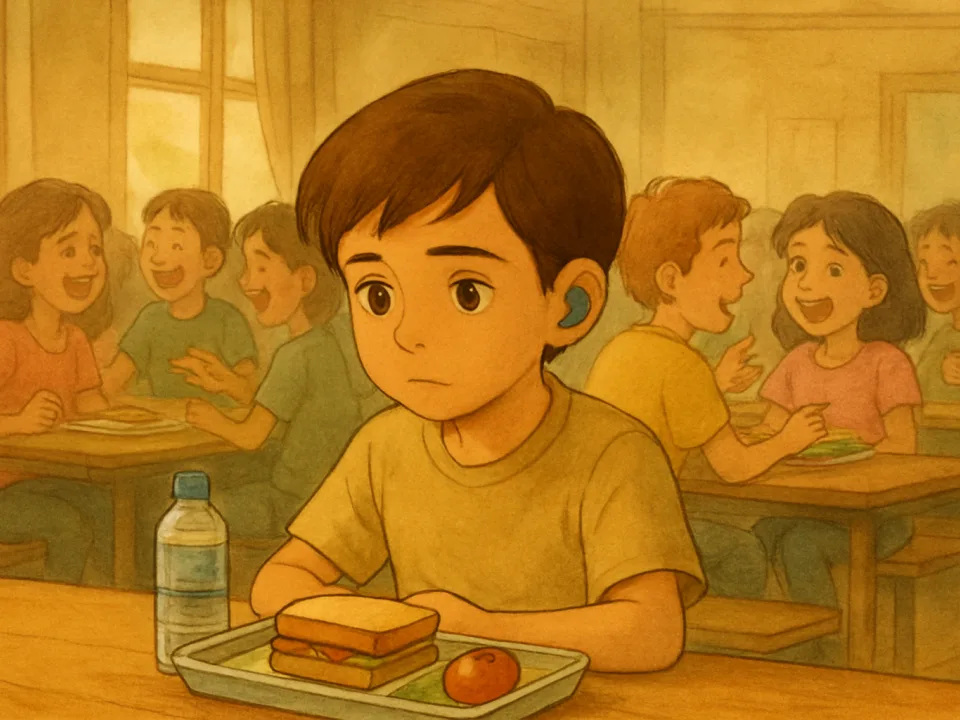
At lunch, Maya watched Lucas from across the noisy cafeteria. He sat quietly at the end of the table, his lunchbox neatly arranged: apple slices, a sandwich, carrot sticks. Sometimes he looked at the chattering kids around him, but mostly he read his book.
Maya noticed Lucas making gestures with his hands: tapping his chin, waving his fingers, drawing invisible shapes. Was he talking to himself? Maya wondered if those movements had meaning. She wished she could ask.
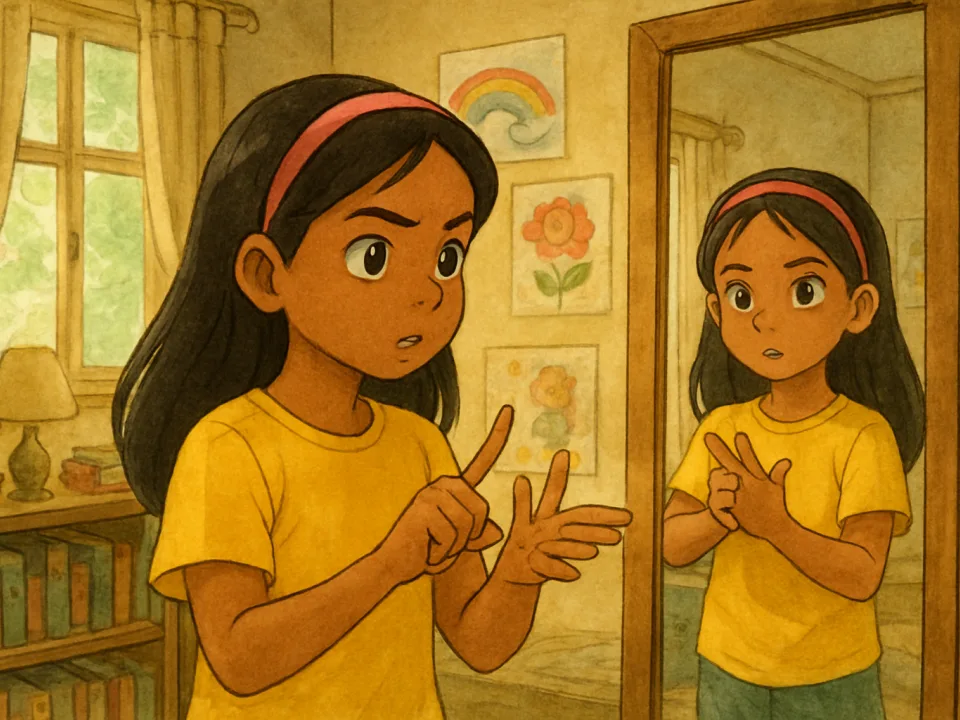
After school, Maya hurried home and asked her mom, “How do you say hello in sign language?” Her mom smiled and said, “I think it goes like this,” and she gently curved her hand and moved it in a little wave. Maya practiced in the mirror until it felt just right.
The Courage to Say Hello
The next morning, Maya’s stomach fluttered again—this time with excitement. As the class lined up for music, Maya stood quietly beside Lucas. He was looking at a piece of paper, lips moving silently, hands resting in his lap.
Maya took a breath. She caught Lucas’s eye, smiled, and signed hello the way her mom showed her. Lucas’s eyes widened in surprise, then sparkled. He signed something back—his hand motion quick, fingers fluttering.
Maya giggled, a little embarrassed. “I don’t know what that means yet,” she whispered.
He smiled, then pointed to her, pointed to himself, and made a heart shape with his hands. Maya thought maybe it meant friend. She hoped it did.
Building Bridges
That week, Maya paid close attention to Lucas. She noticed that every morning, Mrs. Yu handed out a printed page just for him. It had the day’s lessons written down, with little pictures beside the words. Sometimes, Mrs. Yu paused while speaking and used hand signs that looked official and graceful. Maya realized more and more students were trying out little signs: waving, pointing, or shaking their heads.
Maya wanted to learn more. She borrowed a beginner’s sign language book from the library. Every night, she practiced the alphabet in front of her mirror, spelling out words with her fingers. Her little brother giggled at her, but Maya kept practicing. It felt like learning a secret code.
The Soccer Game Secret
One Friday during recess, the class played a big game of soccer. Maya noticed Lucas sitting on the bleachers, watching. She hesitated, then ran over. “Want to play?” she said, then quickly tried to sign play, following the picture from her book.
Lucas grinned and nodded. He jumped off the bleachers and joined Maya’s team.
At first, the other kids weren’t sure how to talk to Lucas during the game. When someone shouted, “Pass it here!” Lucas didn’t turn. But Maya remembered a page from her sign language book—the sign for ball. She called out and signed ball, then pointed to herself. Lucas passed her the ball perfectly.
By the end of recess, kids were using signs and loud gestures, laughing as Lucas dribbled, kicked, and scored a goal. Maya and Lucas high-fived, both catching their breath, both grinning wide.
The Art Project
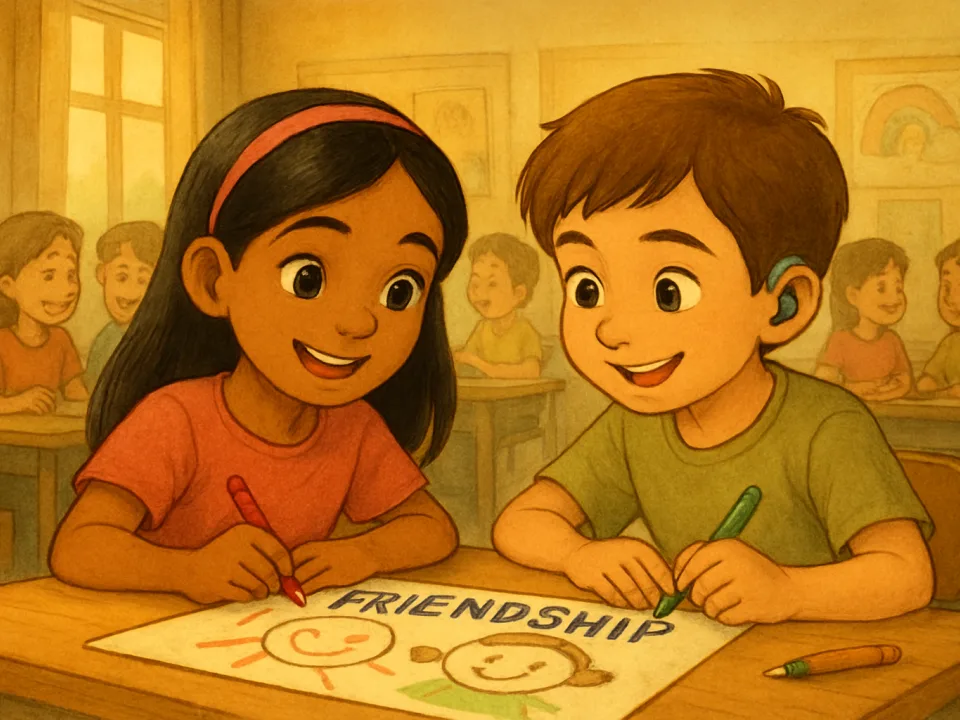
The next week, Mrs. Yu announced a friendship poster contest. “You can work with a partner,” she said. Maya immediately looked at Lucas, who looked shyly back. She signed friend, then pointed to him and herself. Lucas’s smile lit up his whole face.
They decided to draw two kids with hands reaching out, forming a bridge. Maya drew, Lucas picked colors, and both signed words like together and fun. Lucas taught Maya signs for rainbow, school, and happy, and Maya taught him how to say the words out loud.
When they finished, Mrs. Yu hung their poster at the front of the classroom. Underneath, she wrote: “Friendship needs no words—only understanding.”
The Secret Spreads
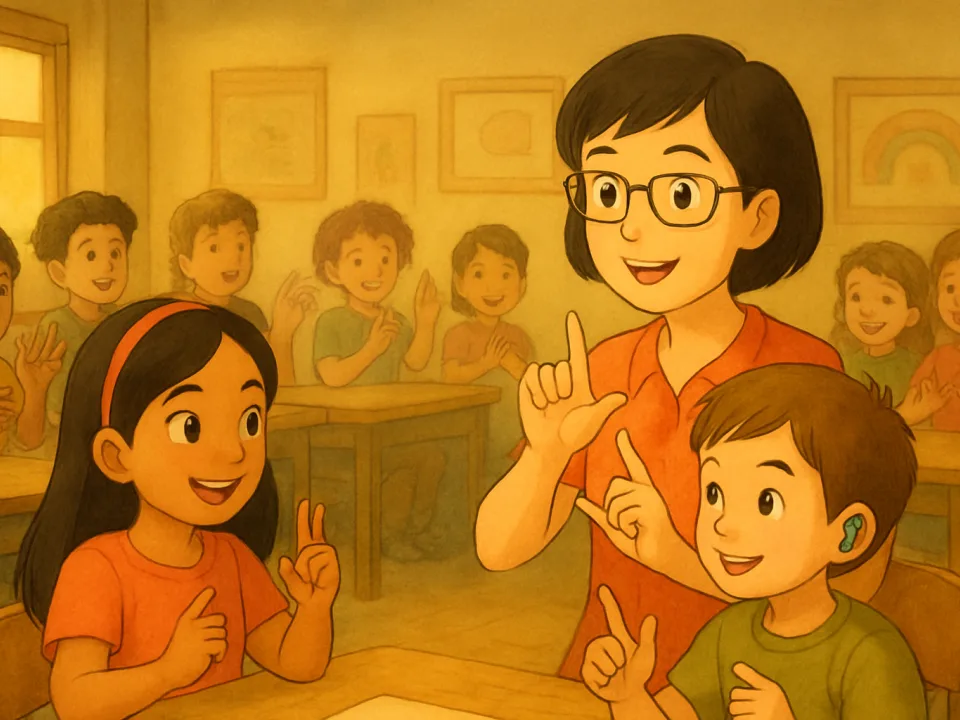
Soon, the whole class wanted to learn more signs. Maya and Lucas made little cards showing the alphabet in sign language. They taught their classmates how to sign names, animals, and even silly words for fun. During music class, the students sang and signed a song together. Lucas beamed, his hands moving with the music, his face glowing with pride.
On Lucas’s birthday, Maya signed happy birthday, and the whole class joined in—some wobbly, some perfect, all smiling. Lucas laughed, a sound almost as bright as his smile.
Understanding Means Everything
One afternoon, after school, Maya and Lucas sat on the playground swings. The world seemed quiet, except for the creak of chains and the flutter of leaves.
Maya spelled out a message on her fingers, slowly but carefully: F-R-I-E-N-D-S. Lucas nodded, then signed thank you. He pointed to Maya, made a circle above his heart, and tapped his hand to his chin—his way of saying, “You’re my friend. I’m happy.”
Maya looked up at the golden sky. She realized that connecting with someone didn’t always mean speaking the same way. Sometimes, a smile, a sign, or a brave hello was all it took to start a beautiful friendship.
Moral of the Story
True friendship isn’t about speaking the same language—it’s about finding ways to connect, understand, and include others. When we try to reach out and communicate, even in small ways, we show kindness and respect, and we can make everyone feel like they belong.
Key Takeaways for Kids
- Learning new ways to communicate helps us make more friends.
- It’s okay if you don’t know everything; trying is what matters most.
- Everyone can be included, no matter how they communicate or what makes them different.
- Small efforts, like learning someone’s language or asking how to help, can make a big difference.
Why This Story Matters
Stories like Maya and Lucas’s help us understand the importance of Deaf culture and sign language. They remind us that everyone deserves to be included and celebrated for who they are. By learning about each other and finding ways to connect, we build a kinder, more welcoming world—one friendship at a time.
Related Stories
Wheels on the Playground: A Story About Accessibility, Inclusion, and True Friendship
Wheels on the Playground The sun shone brightly over Maplewood Elementary, glinting off the newly painted monkey bars…
The Boy Who Took His Time to Speak: A Moral Story About Patience and Stuttering
The Boy Who Took His Time to Speak Lucas Moreno had always known that words came slowly to him. In the busy, chattering…
Oliver's Fast Brain: A Heartwarming Story About Friendship and Understanding ADHD
Oliver's Fast Brain Oliver Bennett liked to say his brain was a racing car. On the outside, he was just an ordinary…
Everyone Belongs on the Team: A Sportsmanship Story About Inclusion for Kids
Everyone Belongs on the Team It was a crisp Monday afternoon at Maplewood Elementary, and the playground was alive with…
Twenty-Four Paper Hearts: A Valentine's Day Story About Everyday Friendship
Twenty-Four Paper Hearts: A Valentine's Day Story About Everyday Friendship Ruby Lane admired the neat stack of pink…

The Strength of Friendship | Moral Adventure for Kids
The Strength of Friendship On the edge of Willowdale, where wildflowers nodded in the breeze and the river flashed like…