The Heart-Touching Story of Father Michael: A Tale of Faith and Compassion
Father Michael and the Rain of Hope
On the edge of a small village, where green hills once rolled like soft blankets and a silver stream used to sing over smooth stones, stood a little white church with a bell that chimed every morning.
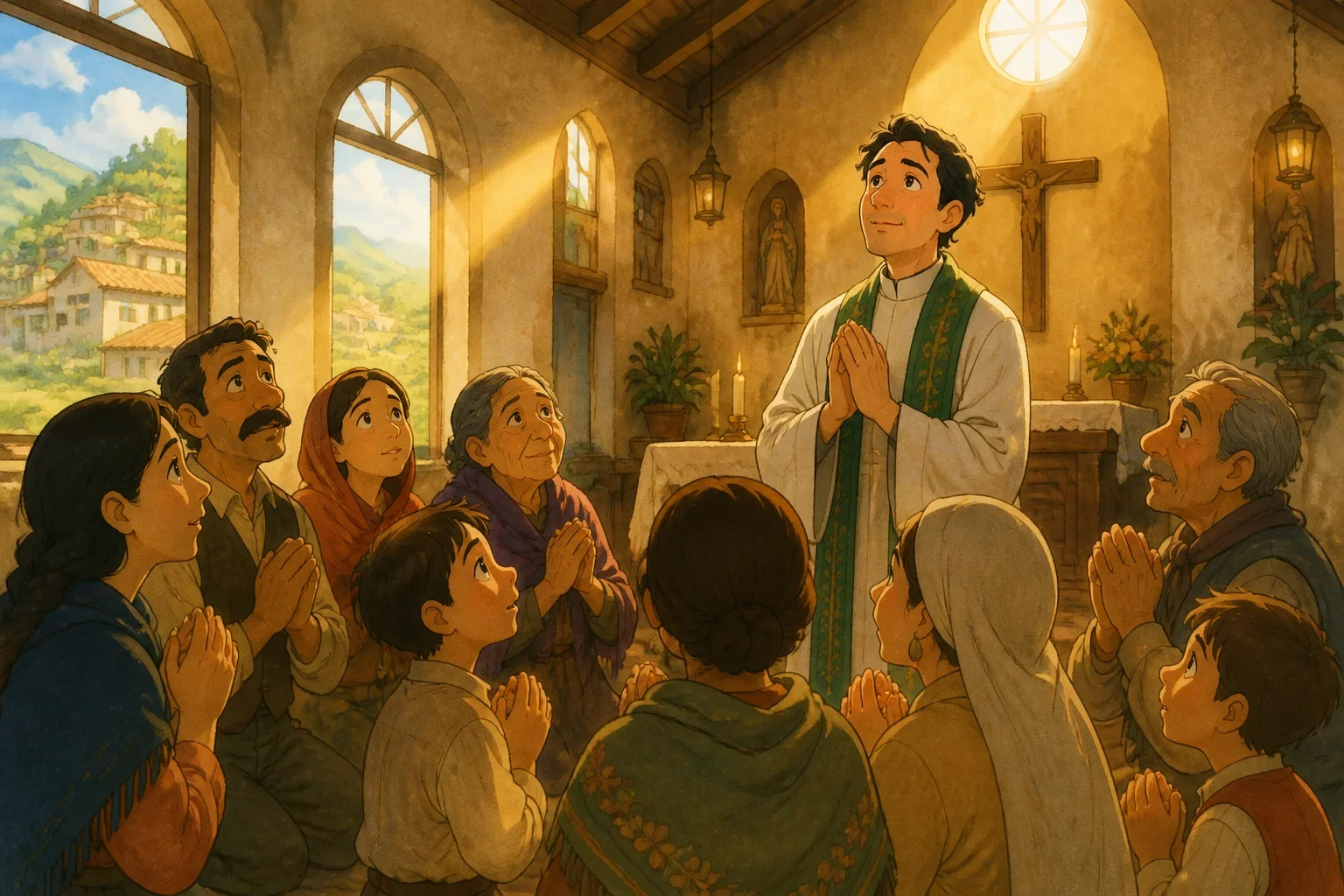
And in that church lived Father Michael.
He was not famous. He did not wear a crown. He did not perform tricks or carry bags of gold.
But everyone in the village knew one thing: if your heart felt heavy, Father Michael could make it feel lighter.
He remembered birthdays. He shared bread with hungry families. He visited the sick. He listened when people were lonely. When children argued, he helped them make peace. When grown-ups were worried, he reminded them to be brave one day at a time.
"Kindness," he often said with a gentle smile, "is never small. It grows wherever it is given."
The villagers loved him for that.
When the Rain Stopped Coming
One summer, the rain did not come.
At first, no one was too afraid. "It will rain tomorrow," the farmers said, glancing up at the sky.
But tomorrow came and went.
Then another tomorrow.
And another.
The stream shrank into a thin ribbon. The grass turned from bright green to dusty yellow. Cracks spread across the fields like lines in broken pottery. The goats bleated beside empty troughs. The vegetable gardens drooped. Even the birds seemed quieter.
Soon, the whole village felt different.
The bakery made fewer loaves because there was less grain. Mothers saved every drop of water in clay jars. Children who once raced through wet grass now walked carefully through dust.
Everywhere Father Michael went, he saw worried faces.
One evening, as the sky glowed orange and purple with a beauty that felt almost unfair, the villagers gathered inside the little church. The air was still and warm. No one spoke at first.
Then Clara, a young woman whose family farmed tomatoes and beans, stood up. Her eyes were shiny with tears.
"Father Michael," she said, her voice trembling, "what can we do? The fields are dying. We are trying to be strong, but people are frightened."
A murmur moved through the church.
"My well is nearly empty," said one man.
"Our animals are weak," whispered another.
A little girl leaned against her mother and asked, "Will the village be all right?"
Father Michael looked at them all—the farmers, the bakers, the children, the grandparents—and his kind face grew serious. He did not pretend the drought was small. He did not offer easy answers.
Instead, he folded his hands and said softly, "This is a hard time. But hard times must not turn our hearts hard too. We will pray. We will help one another. We will share what we have. And we will not let fear teach us to forget compassion."
The church became very quiet.
Then Father Michael added, "Hope is not pretending everything is easy. Hope is choosing courage, even when the sky is empty."
Samuel's Question
In the last pew sat a boy named Samuel.
Samuel was not the tallest child in the village, or the loudest, or the strongest. But he listened carefully, and his heart was full of feeling. He had watched his mother measure water cup by cup. He had seen his father come home from the fields with dust on his shoes and worry in his eyes.
That night, Samuel could not sleep.
He lay in bed listening to the dry wind tap the shutters.
At last he whispered into the darkness, "Please send rain... and please help us not give up."
The next morning, before the sun had climbed high, Samuel ran to the church.
Father Michael was outside sweeping the steps.
"Good morning, Samuel," he said. "You look as though you have a thought too big to keep inside."
Samuel nodded. "I do."
Father Michael rested the broom against the wall. "Then I should hear it."
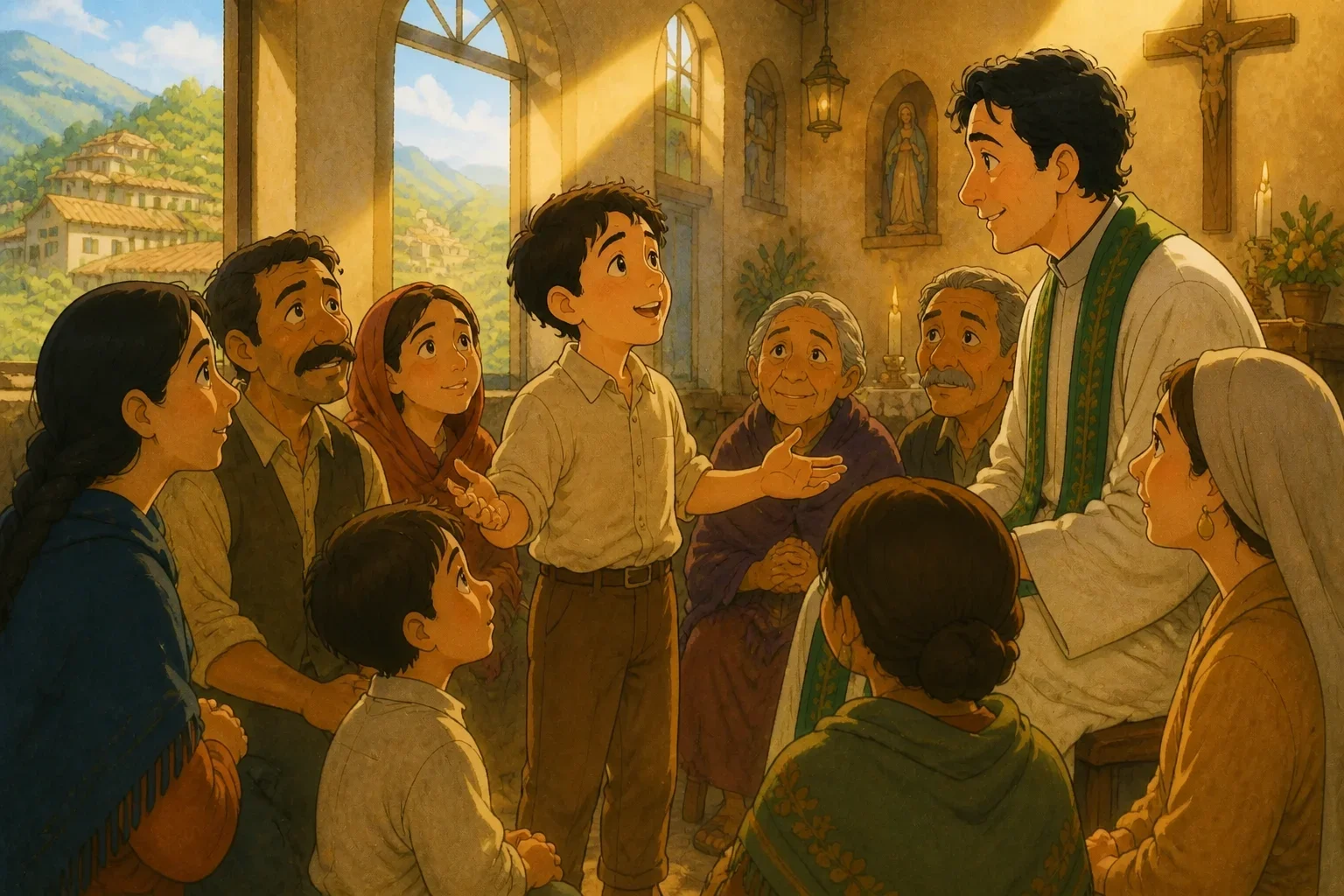
Samuel took a breath. "We prayed yesterday. But what if everyone came together again—not just to pray, but to help each other too? The strong people could carry water for the elderly. Families with extra food could share. We could all gather and ask for rain together. Maybe... maybe when people feel less alone, they can be brave longer."
For a moment, Father Michael said nothing.
Then his face lit up.
"Samuel," he said warmly, "that is a wonderful idea. Prayer and compassion belong together. Let us call the village."
A Village That Chose Compassion
By noon, the church bell was ringing.
Dong.
Dong.
Dong.
Villagers came from every lane and path. Some carried baskets of bread. Some brought beans, rice, or fruit. Some brought buckets to share water. Children carried blankets and jars. Even those who had very little brought something—a handful of onions, a few carrots, a kind word, a willing pair of hands.
Inside the church courtyard, Father Michael spoke so all could hear.
"Today," he said, "we ask for rain. But today we also become an answer to one another's prayers."
The villagers looked at one another. Slowly, worried faces softened.
Old Mrs. Elena, who lived alone, received fresh water from two teenage brothers.
Clara gave part of her remaining beans to a family with younger children.
The baker handed out small warm rolls and said, "We'll stretch the flour somehow. No one should go hungry today."
Samuel helped carry a heavy bucket nearly as big as his knees.
Father Michael smiled at him. "Careful there, brave helper."
Samuel grinned. "I'm stronger than I look."
"I believe it," Father Michael said.
When the sharing was done, the villagers gathered shoulder to shoulder. Some bowed their heads. Some held hands. Some closed their eyes tightly. Some simply looked upward.
Father Michael prayed for rain, for strength, for patience, and for hearts that would stay generous even in trouble.
Samuel prayed too.
So did Clara.
So did the baker.
So did the little girl who had asked if the village would be all right.
And though the sky remained pale and empty that day, something in the village had changed.
People were still thirsty.
The fields were still dry.
But no one felt quite so alone.
Waiting Under the Empty Sky
The next few days were not easy.
The sun still burned hot. Dust still rose from the road. The stream still barely moved.
Yet kindness began to travel through the village like a quiet song.
Neighbors checked on one another.
Children stopped complaining and started helping.
Families shared evening meals.
Father Michael walked from house to house, offering comfort.
And Samuel kept asking, "Does anyone need anything carried?"
Each night, people prayed.
Each morning, they looked at the sky.
Still no rain.
At last, one afternoon, Samuel sat on the church steps beside Father Michael and sighed.
"What if it doesn't come?" he asked.
Father Michael looked toward the fields. "Sometimes answers take time," he said.
Samuel lowered his eyes. "I was trying to be hopeful."
Father Michael nodded. "You are hopeful. Hopeful people can still feel tired. They can still ask hard questions."
Samuel thought about that.
"Then how do we keep going?"
Father Michael placed a gentle hand on his shoulder. "The same way we have been going—together."
The First Drop
That night, the air felt different.
Not cooler exactly.
But fuller.
Heavier.
The leaves on the trees turned their pale undersides to the sky. A breeze moved through the village, carrying the smell of dust and something else—something sharp and fresh, like the beginning of a secret.
Samuel woke in the dark and listened.
At first, he heard only silence.
Then—
Tap.
A tiny sound against the window.
He sat up.
Tap. Tap.
He leaped from bed and ran to the door.
"Mama! Papa!" he cried. "I think—"
Before he could finish, the sky answered.
Rain.
Real rain.
Soft at first, then faster, then rushing down in silver sheets. It drummed on rooftops, splashed into buckets, soaked the dusty ground, and filled the air with the sweet earthy smell the whole village had been longing for.
Doors flew open.
People ran outside laughing.
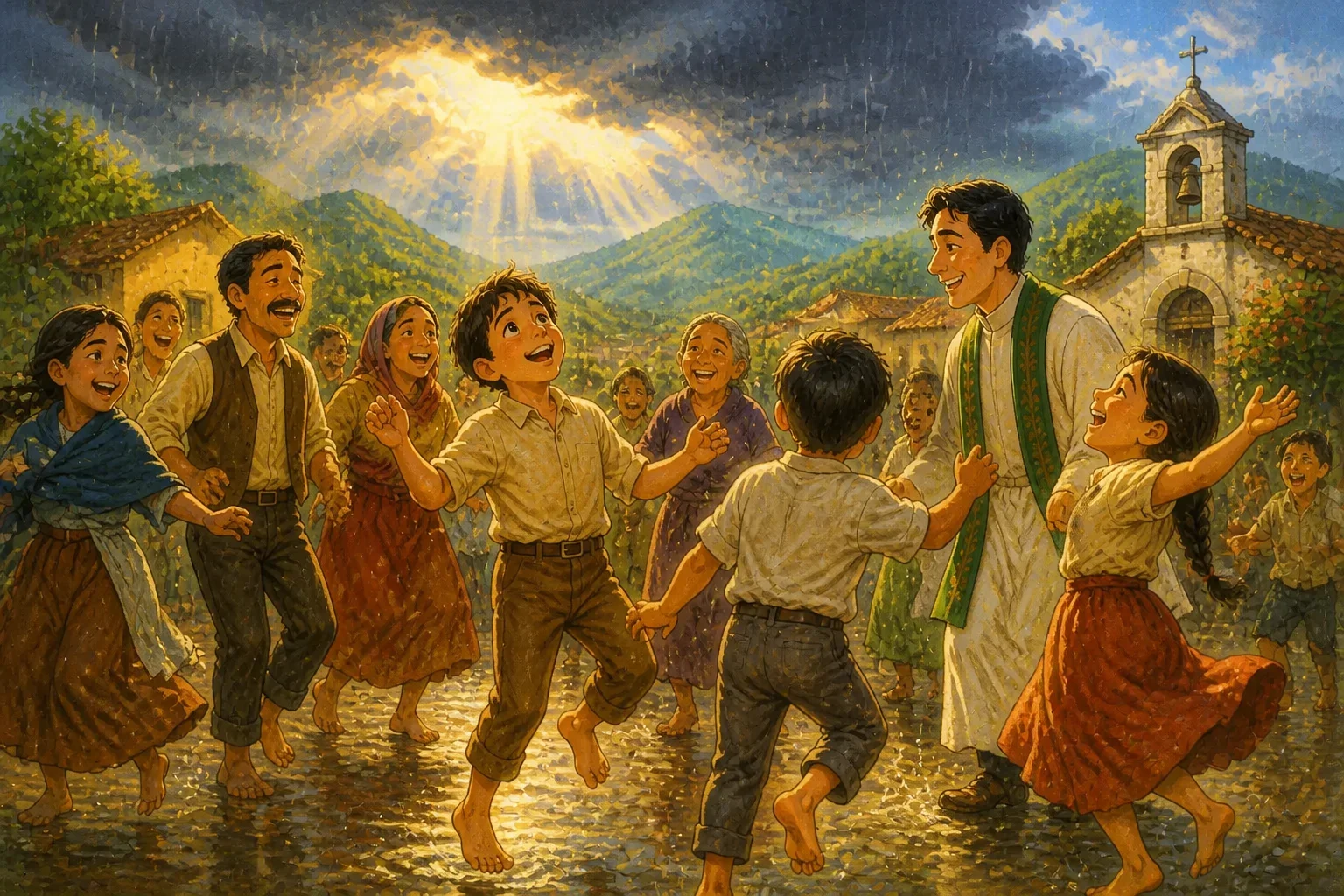
Clara lifted her face to the sky and cried tears that mixed with raindrops.
Children danced barefoot in the mud.
The baker spun in a circle with his apron still on.
Old Mrs. Elena stood under her porch, smiling so wide that her cheeks trembled.
And Father Michael stepped into the rain, his hair and robes quickly wet, his face shining with gratitude.
Samuel splashed toward him.
"It came!" he shouted.
Father Michael laughed—a deep, joyful laugh that Samuel would remember for years.
"Yes," he said, looking up at the clouds. "It came."
The church bell rang out across the stormy evening.
Dong.
Dong.
Dong.
Only this time, it did not sound worried.
It sounded like celebration.
A Miracle in More Than One Way
By morning, the stream was already fuller. The fields drank deeply. In the days that followed, tiny green shoots began to return. The village slowly came back to life.
But people remembered something even after the ground softened and the crops began to grow again.
They remembered that the rain had been a blessing.
And so had their compassion.
Because during the hardest days, when the sky gave them nothing, they had still given something to one another.
Father Michael told the village, "We prayed for help from above, and we found strength beside us too. Never forget that."
Samuel never did.
Whenever someone in the village was lonely, worried, or in need, he was often the first to knock on the door and ask, "How can I help?"
And every time the church bell rang through clear skies or stormy ones, the villagers remembered the season when hope, faith, and kindness carried them through.
Key Takeaways for Kids
- Hope means not giving up, even when things are difficult.
- Compassion matters most in hard times when people need extra care and support.
- Helping others brings people closer and makes problems easier to face.
- Faith and kindness can work together to give people strength.
Moral of the Story
When people face hard times with faith, compassion, and unity, hope grows stronger and hearts grow braver.
Why This Compassion Story Stays in Children's Hearts
Children often remember stories like this because they show that bravery is not always loud. Sometimes bravery looks like sharing bread, carrying water, saying a prayer, or helping a neighbor feel less alone. Father Michael and Samuel remind young readers that even small acts of kindness can shine brightly in difficult times.
If you're looking for children's moral stories, compassion stories for kids, or a gentle bedtime story about hope and kindness, this tale offers both comfort and an inspiring message.
Watch the Animated Story
Watch on YouTube
Related Stories

The Cruel King Who Learned Kindness Moral Story for Kids
The Cruel King Who Learned Kindness In the kingdom of Eldoria, people lowered their voices whenever they spoke the…
Brave Nurse Sarah: A Heartwarming Compassion Story for Kids
The Brave Nurse Sarah On ordinary days, Sunshine Medical Center smelled like soap, clean sheets, and the lemon candies…
Doctor Ethan Story: A Compassion Moral Story for Kids
A Tale of Doctor Ethan On the busiest street in Willow Grove, between a bell-ringing bookshop and a flower store that…
Compassionate Teacher: A School Story About Kindness and
The Compassionate Teacher On the first Monday of the school year, Maplewood Middle School buzzed like a beehive.…
Carnival of Togetherness: A Heartwarming Moral Story for
The Carnival of Togetherness Long before the first drumbeat echoed through Rio de Janeiro, the city already felt as if…
Girl and the Jinni: A Compassion Moral Story for Kids
The Girl and the Jinni: A Tale of Compassion In a sunlit desert city, where copper lanterns glowed in the market and…
Lazy Donkey Who Finally Helped: A Moral Story on Hard Work
The Lazy Donkey Who Finally Helped In a sunny little village tucked between green hills and golden fields, there lived…
Heroic Policeman and the Boy on the Swing | Kindness Story
The Heroic Policeman and the Boy on the Swing In the little town of Willow Creek, people could tell the time by Officer…
The Retiring Carpenter Story: A Powerful Moral About Doing
The Retiring Carpenter In a quiet village where morning mist curled over the fields and sparrows nested in old apple…
The Most Loving Princess Story: A Tale of Kindness
The Most Loving Princess At the top of a green hill, where morning light touched the castle windows like melted gold,…