
SELF DISCIPLINE STORY
The Power of Self-Discipline
On Monday morning, Alex was supposed to be finishing his homework.

Instead, he was building a pillow fort.
His math notebook lay open on the floor. One shoe was under the bed, the other was near the door. A half-finished drawing of a rocket ship hung crookedly on the wall. His basketball leaned in the corner, waiting. Outside his window, children laughed in the street, and somewhere in the kitchen, cookies were cooling.
Everything seemed more interesting than the thing he was meant to do.
Alex was not lazy. He was curious, energetic, and full of ideas. He wanted to do well in school. He wanted to become better at basketball. He wanted to read more books, draw amazing pictures, and maybe one day build real rockets.
But wanting something and working for it every day were not the same.
"Alex," his mother called gently from the hallway, "did you finish your homework?"
There was a pause.
"Almost!" Alex answered.
It was not exactly true.
His father peeked into the room and smiled at the fort, the mess, and Alex’s hopeful face. "Big dreams need strong habits," he said kindly. "Self-discipline is what helps dreams grow."
Alex nodded, but the words slid past him. Strong habits sounded important, but also a little boring.
That afternoon, Alex went to the park with his basketball tucked under one arm. The sun was warm, the grass smelled fresh, and the swings squeaked back and forth in the breeze. Near the old oak tree sat Mr. William, the town’s favorite storyteller. He wore a soft brown hat, polished shoes, and a long white beard that fluttered when he laughed.
Mr. William always seemed to know when a child was carrying a question too heavy to hold alone.
"You look troubled, Alex," he said, patting the bench beside him.
Alex sat down with a sigh. "I want to do lots of things," he admitted. "I want to be good at school and basketball and everything. But I keep getting distracted. I start one thing and then do another. Then I feel bad."
Mr. William nodded as if Alex had told him something very important.
"Then perhaps," he said, "it is time for a story."
Alex’s eyes brightened. "A good one?"
Mr. William smiled. "The kind that stays with you."
The Tale of Mark and Tom
"In a town not far from here," Mr. William began, "lived two best friends named Mark and Tom. They both loved basketball so much that they dribbled on sidewalks, in driveways, and sometimes even in the kitchen when their parents weren’t looking."
Alex grinned.
"One summer," Mr. William continued, "a big youth basketball tournament was announced. The winning team would receive a shining gold trophy and the chance to play in the city championship.
Mark and Tom were both thrilled.
On the first day of practice, Mark came early. He tied his shoes carefully, ran warm-up laps, and practiced free throws until his arms ached. He made a plan for himself: thirty minutes of dribbling, thirty minutes of shooting, and time each evening to stretch and rest.
Tom loved basketball too, but he liked doing whatever felt fun in the moment. One day he practiced a little. The next day he played video games for hours. Another day he said, 'I’ll practice later,' and later never came.
When Mark invited him to train, Tom often replied, 'Don’t worry. I’ll be fine. There’s still time.'"
Mr. William paused and looked at Alex. "Have you ever said that?"
Alex stared at the ground. "Maybe."
Mr. William’s eyes twinkled. "Most people have."
Practice Days
"As the tournament drew closer," he continued, "the difference between the boys began to show.
Mark was not perfect. Some mornings he felt sleepy. Some afternoons he wanted to skip practice and eat snacks instead. But he had made a promise to himself, and he kept it even when he didn’t feel like it.
That is one of the quiet secrets of discipline: it matters most on the days you are not in the mood.
Tom, meanwhile, kept choosing what was easy now instead of what would help later. He stayed up late. He scrolled, played, and said, 'Tomorrow I’ll get serious.' But tomorrow kept moving away from him like a kite in the wind."
Alex listened closely now.
Tournament Day
"At last, tournament day arrived.
The gym was loud with bouncing balls, squeaking sneakers, and cheering families. Bright banners hung from the walls. Players stretched nervously. Coaches called instructions. The air felt full of excitement.
Mark took a deep breath and stepped onto the court. He was nervous, yes—but underneath his nerves was something steady. He had practiced for this. His feet knew where to move. His hands knew how to control the ball. His mind stayed calm.
Tom stepped onto the court too, but his stomach felt tight. He had talent, but talent alone did not make him ready. He missed passes he should have caught. He rushed shots. He grew frustrated with himself.
In the final minutes, the game was close. Mark remembered all the hours he had spent practicing free throws after everyone else had gone home. When he was fouled and sent to the line, he bounced the ball twice, focused, and shot.
Swish.
Then another.
Swish.
His team won.
The crowd cheered. Mark’s teammates lifted him up. Tom clapped for his friend, but inside he felt a heavy ache—not because Mark had won, but because he knew he had not given his own best.
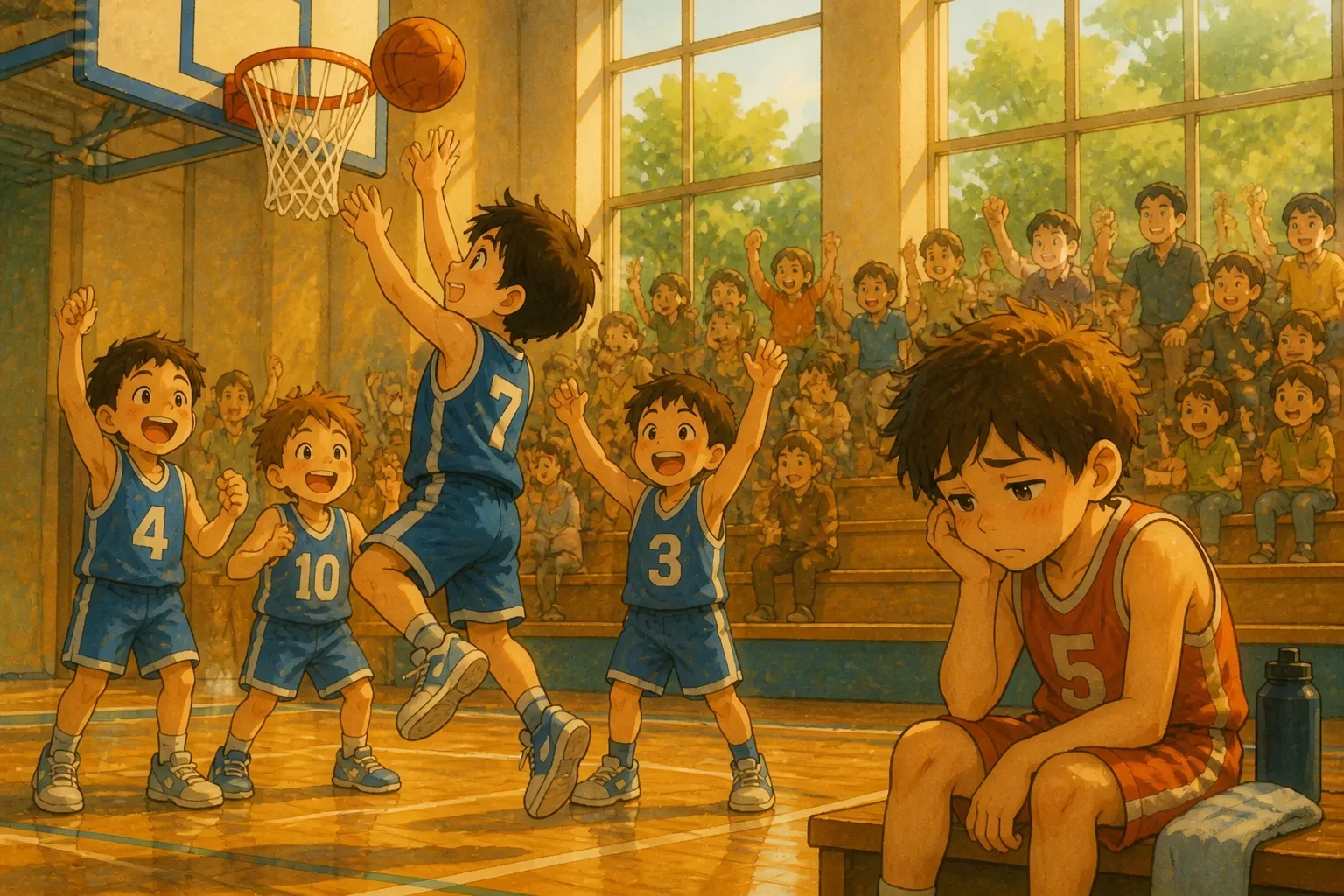
Later, sitting on the bleachers, Tom said quietly, 'I thought I had more time.'
Mark sat beside him and replied, 'You still do. Just not for yesterday.'"
Mr. William let the words settle between them.
A Lesson That Landed
Alex was very still.
The park around him seemed quieter now, even though children were still playing nearby and leaves were still rustling overhead.
"So Tom failed?" Alex asked.
"Tom learned," said Mr. William. "And learning can be the beginning of something wonderful—if you choose to change. Discipline is not about being harsh or never having fun. It is about teaching yourself to do what matters, little by little, even when distractions whisper your name."
He picked up an acorn from the bench and placed it in Alex’s hand.
"This tiny thing can become an oak tree," he said. "But not in a day. Good habits grow the same way. Small actions. Repeated often."
Alex closed his fingers around the acorn.
For the first time, discipline did not sound boring.
It sounded powerful.
Alex Chooses a New Path
That evening, Alex stood in the middle of his messy room and looked around.
The old Alex might have said, "I’ll clean it later."
But Alex picked up one shirt.
Then one book.
Then one toy.
Soon the floor appeared. His desk was clear. His basketball was back on its shelf. He taped a bright piece of paper above his desk and wrote in big letters:
My Small Steps
- Finish homework before games
- Practice basketball for 20 minutes
- Read 10 pages
- Put things back where they belong
- Get ready for tomorrow before bed
His mother stopped at the door and blinked in surprise. "Well," she said softly, "something important happened today."
Alex smiled. "I met an acorn."
His father laughed. "That sounds serious."
"It is," Alex said.
Not Perfect, But Better
The next few days were not magical.
On Tuesday, Alex wanted to skip reading and race outside.
On Wednesday, he nearly dropped his homework to start a new game.
On Thursday, he groaned at the sight of his goal chart and flopped dramatically across his bed.
But then he remembered Mark at the free-throw line. He remembered Tom on the bleachers. He remembered the acorn in his pocket.

So he got up.
He did the next small thing.
That was all.
And somehow, that changed everything.
The Strength of Small Habits
Weeks passed.
Alex began finishing his schoolwork on time. His room stayed cleaner. He felt less rushed in the mornings because he packed his bag the night before. On the basketball court, his dribbling became steadier and his shots more accurate.
But the biggest change was inside him.
He trusted himself more.
When he made a plan, he followed it more often. When something felt difficult, he didn’t give up as quickly. He discovered that self-discipline was not a punishment.
It was a kind of strength.
One afternoon at practice, his friend Liam asked, "How did you get so much better?"
Alex bounced the ball once and smiled. "I stopped waiting to feel ready. I just started doing small things every day."
Liam frowned thoughtfully. "That sounds hard."
"Sometimes," Alex said. "But it gets easier."
Across the court, Coach blew the whistle. Alex ran to join the others, feeling light and strong.
In the stands, his parents watched with proud smiles—not because he was the best player on the court, but because he was learning how to guide himself.
And tucked safely inside Alex’s desk drawer at home was the acorn, a reminder that big dreams grow from small, steady choices.
Key Takeaways for Kids
- Self-discipline means doing what matters, even when you feel distracted.
- Small daily habits can lead to big results over time.
- You do not have to be perfect to improve. You just have to keep trying.
- Getting ready, staying focused, and practicing regularly build confidence.
- Every good choice is like planting a seed for your future.
Moral of the Story
Self-discipline helps children turn dreams into reality, one small choice at a time.
Why This Story Matters
Many children's moral stories teach kindness or honesty, but this self-discipline story for kids shows something just as important: learning how to guide yourself. For children, discipline does not mean losing joy or fun. It means creating habits that make room for success, confidence, and peace of mind.
If your child enjoys moral stories for kids, bedtime stories with life lessons, or inspiring stories about focus and perseverance, Alex’s journey offers a warm and memorable reminder that strong habits can shape a bright future.

Watch the Animated Story
Watch on YouTube
Related Stories

The Last Leaf | Moral Story of Hope and Friendship
The Last Leaf Story for Kids On a narrow street in Greenwich Village, where old brick buildings leaned close as if…
Timmy and the Snack Cart | Moral Story on Self-Control
Timmy and the Snack Cart Surprise In the little village of Wholesome Foods, mornings smelled like warm bread, ripe…
The Retiring Carpenter Story: A Powerful Moral About Doing Your Best
The Retiring Carpenter In a quiet village where morning mist curled over the fields and sparrows nested in old apple…

The Honest Woodcutter | Moral Tale About Honesty
The Honest Woodcutter: A Moral Story About Honesty, Hard Work, and Wisdom At the edge of a quiet village, where the…

Emily the Celebrity| Inspiring Moral Story for Kids
Emily the Celebrity and the Girl With the Sketchbook In the city of Starville, everything seemed to sparkle. Billboards…

Thomas the Advocate | Moral Story About Truth and Justice
Thomas the Brave Advocate In a cheerful town filled with bicycle bells, market chatter, and rows of little houses with…

The Pencil Maker | Moral Tale About Growth and Purpose
The Pencil Maker's Story On the edge of a quiet village, where the morning mist curled around little rooftops and…
Lazy Donkey Who Finally Helped: A Moral Story on Hard Work
The Lazy Donkey Who Finally Helped In a sunny little village tucked between green hills and golden fields, there lived…

Corrupt Politician: A Moral Story About Honesty and Courage
The Tale of the Corrupt Politician Every Saturday morning, the bell in Willowbrook’s clock tower rang nine bright…

The Two Wolves Story: A Powerful Moral Tale About Choosing Kindness
The Story of Two Wolves On the edge of a quiet mountain village, where prayer flags fluttered in the wind and…