
THE MISER AND HIS GOLD
The Miser and His Gold
At the edge of a quiet village, where smoke curled from chimneys each evening and children chased one another along dusty lanes, stood a crooked little cottage with shuttered windows and a gate that always stayed locked.
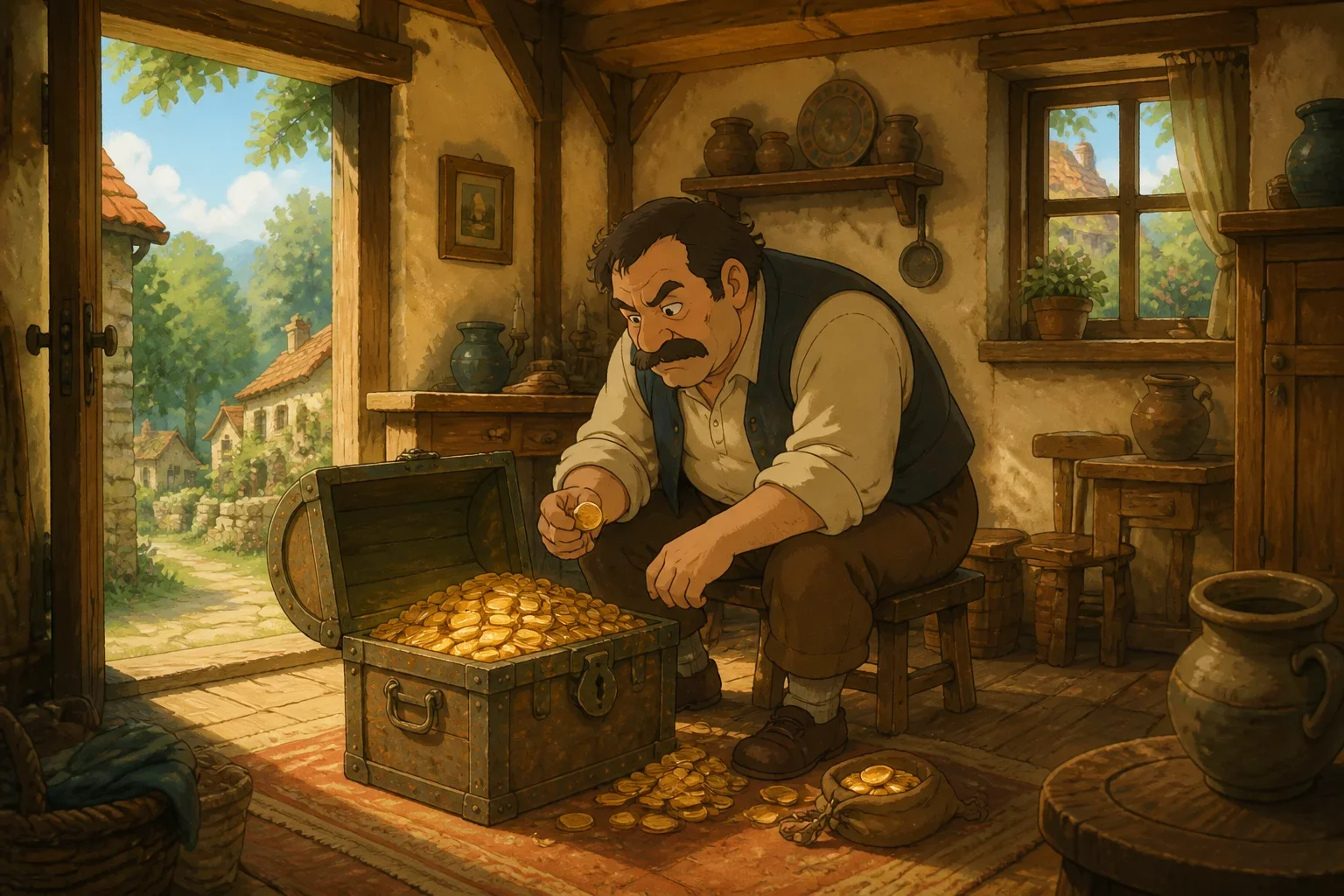
Inside lived a miser.
His name was Mr. Grumbleton, and people said he trusted no one—not the baker, not the blacksmith, not even the cheerful milkman who waved at everyone before sunrise. But there was one thing Mr. Grumbleton loved with all his heart.
Gold.
Not bread fresh from the oven. Not the smell of rain on the fields. Not company by the fire.
Gold.
Every night, when the village lamps began to glow, Mr. Grumbleton would creep into his garden with a candle lantern and a rusty spade. Beneath a flat gray stone, under the roots of a thorny bush, he had buried a heavy pot filled with shining gold coins.
He would dig it up, lift the lid, and stare.
The coins gleamed like tiny suns.
He never spent them. He never shared them. He only counted them.
“One hundred and one… one hundred and two… one hundred and three…” he whispered, rubbing each coin between his fingers as if touch alone could make him happier.
Then he would bury the pot again, pat the earth flat, and sneak back inside with a satisfied little smile.
But it was a strange kind of satisfaction—thin and cold, like a blanket with holes in it.
A Rich Man With a Poor Heart
Mr. Grumbleton’s coat was patched at the elbows. His shoes let in rain. His supper was often no more than a crust of bread and weak soup, though he had enough gold to buy warm blankets, sweet fruit, and a roof without leaks.
Still, he refused.
“What if I need it later?” he muttered whenever he passed the market. “What if someone tries to take it?” “What if I run out?”
So he kept everything and enjoyed nothing.
The villagers shook their heads.
“What a pity,” said the baker. “He owns gold, but it does not warm him,” said the tailor. “And it certainly does not make him pleasant,” whispered the children.
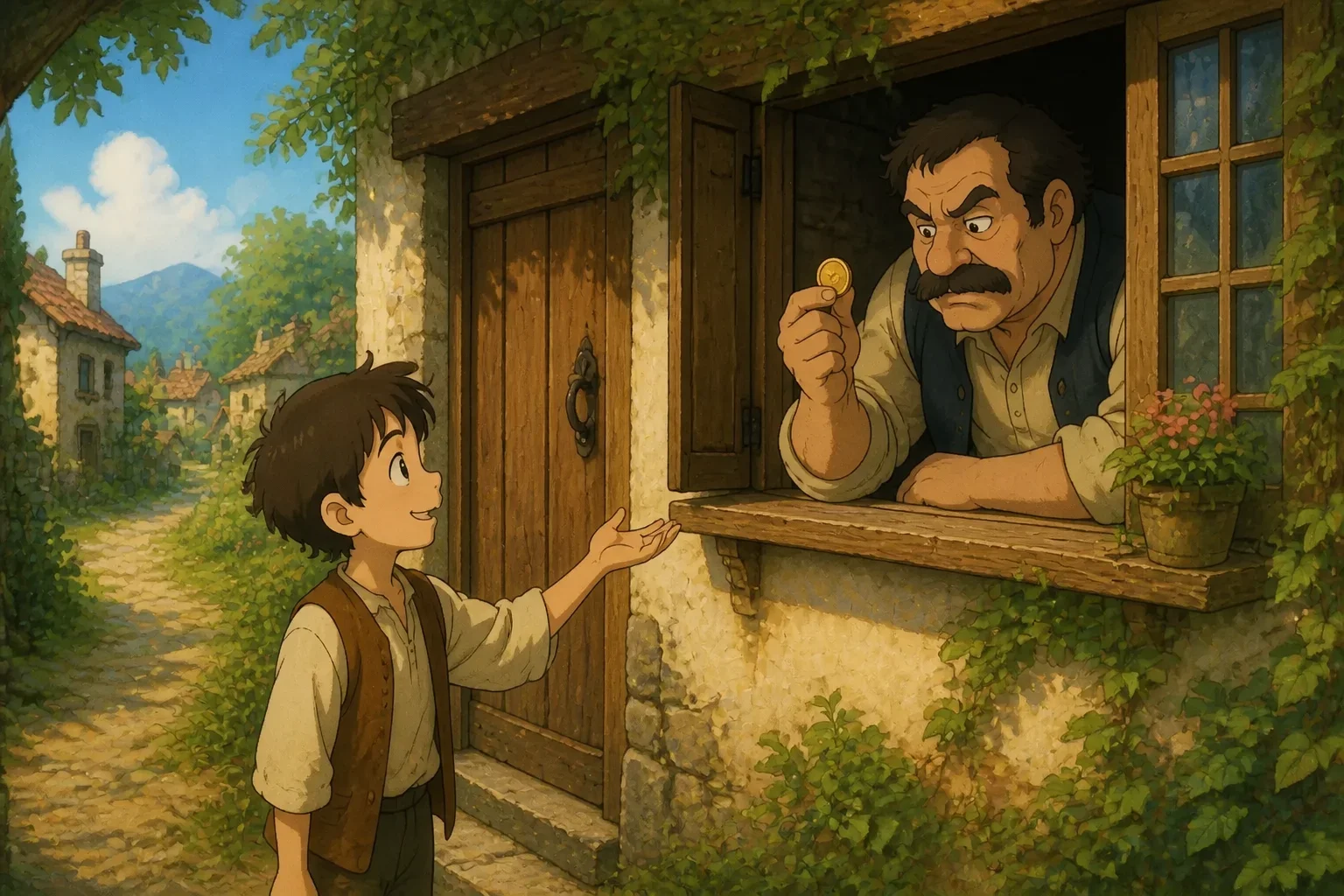
One afternoon, as a sharp wind rattled the fence posts, a boy named Tommy stood at Mr. Grumbleton’s door. Tommy’s cheeks were pink from the cold, and he twisted his cap nervously in his hands.
He knocked once. Then twice. Then a third time.
The door creaked open just enough for one suspicious eye to peer out.
“What do you want?” grumbled Mr. Grumbleton.
Tommy swallowed. “Sir, my family has no bread today. Could you spare just one coin? Only one. My mother says she will repay it when she can.”
Mr. Grumbleton’s face hardened at once.
“One coin?” he snapped. “One coin becomes two, and two becomes ten! No, no, no! Be off with you!”
Tommy’s voice grew small. “We are very hungry.”
“That is not my concern,” said the miser, and he slammed the door so hard the windows shook.
Outside, Tommy stood still for a moment, staring at the wood grain of the closed door. Then he pulled his cap back on and walked away through the wind.
Inside, Mr. Grumbleton leaned against the door, breathing fast, as if he had defended a castle.
Then, as always, he went to check on his gold.
He dug up the pot. He opened it. He counted the coins.
But that evening the gold did not seem quite as bright.
For the first time, the cottage felt terribly quiet.
The Stormy Night
A few days later, dark clouds gathered over the hills. By sunset, the sky had turned the color of iron. The wind moaned through the trees, and rain began to lash the village in silver sheets.
Doors were bolted. Fires were stoked. Families huddled indoors.
Mr. Grumbleton, however, could think of only one thing.
My gold.
What if the ground floods? What if someone steals it during the storm? What if—
Lantern in hand, he rushed into the garden, rain soaking his coat in seconds. He knelt in the mud and clawed at the earth above the buried pot.
Thunder cracked. The thorn bush whipped in the wind. The lantern flame shivered.
At last his fingers struck metal.
“My gold!” he cried, dragging the pot free and hugging it to his chest.
At that very moment, a blinding flash split the sky.
CRACK!
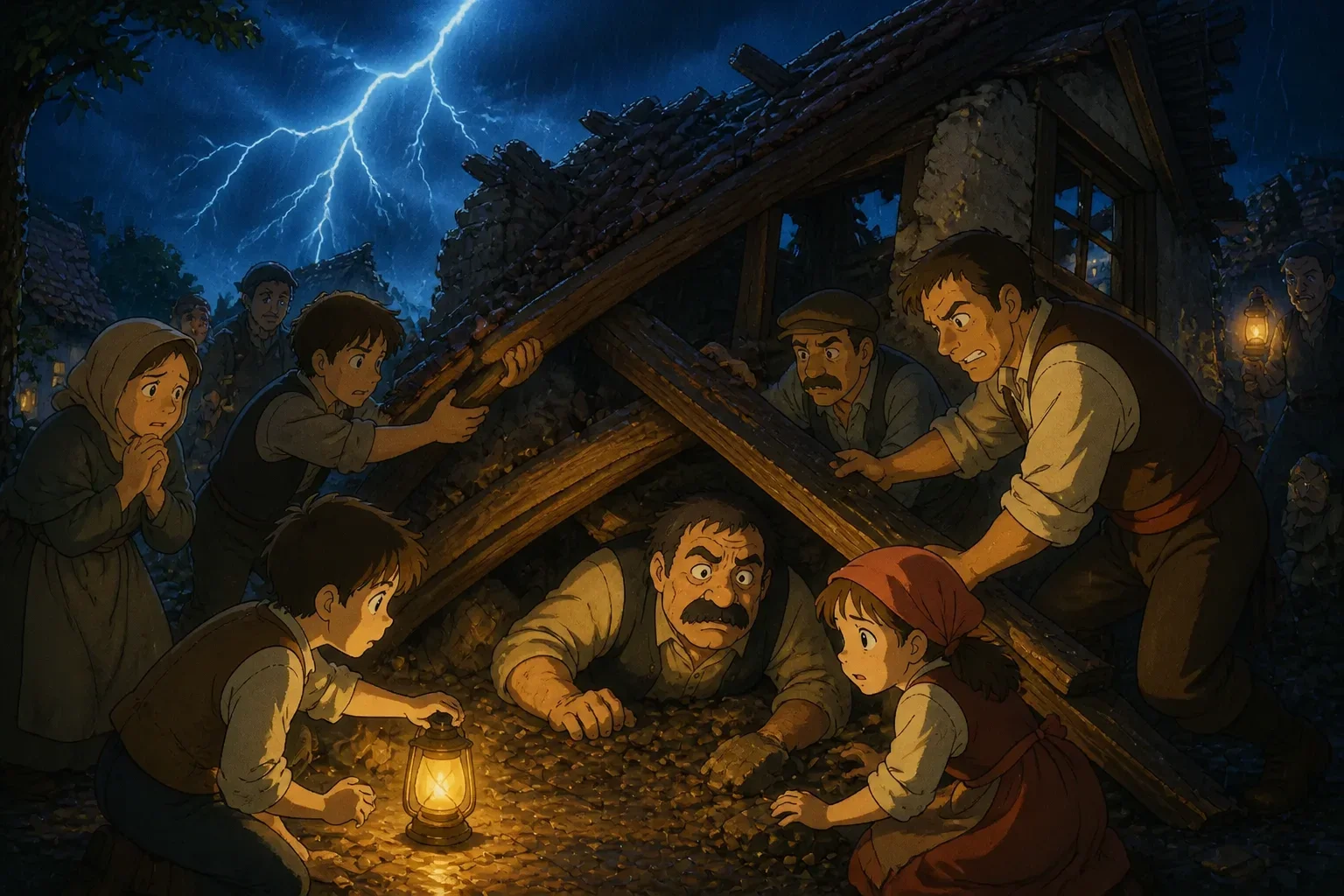
Lightning struck the old tree beside his cottage. With a groan like a giant waking from sleep, the tree toppled onto the roof.
Mr. Grumbleton stumbled backward. The pot flew from his hands. Coins burst across the mud, flashing in the storm like scattered stars.
Then part of the roof caved in with a crash, pinning his leg beneath broken beams and wet thatch.
He gasped in pain.
All around him lay his precious coins.
But not one coin could lift the timber. Not one coin could call for help. Not one coin could hold his hand in the dark.
For the first time in many years, Mr. Grumbleton felt something stronger than greed.
Fear.
And beneath it, something sadder still.
Loneliness.
The Help He Did Not Deserve—But Received Anyway
The storm carried his weak cries across the village.
“Help!” he shouted. “Please! Somebody help me!”
Soon lantern lights bobbed through the rain.
Villagers came running—men in heavy boots, women with shawls over their heads, even older children carrying ropes and blankets.
Tommy was there too.
“That way!” someone called. “He’s trapped!” cried another.
Together they pushed the fallen branches aside. They lifted broken boards. They worked in mud up to their ankles while rain streamed down their faces.
At last they pulled Mr. Grumbleton free.
He sat trembling beneath a blanket, staring at the people around him.
The baker had scraped his hands on the wood. The blacksmith’s sleeve was torn. Tommy’s knees were muddy.
They had all come.
Even after the way he had treated them.
Mr. Grumbleton looked down at the coins half-buried in the mud. They seemed small now. Dull. Useless.
Then he looked at Tommy.
The boy was shivering, but he still managed a kind little smile.
“Are you hurt badly, sir?” Tommy asked.
Mr. Grumbleton opened his mouth, but for a moment no words came out.
At last he whispered, “I am more ashamed than hurt.”
The rain softened to a drizzle.
“I spent so many years guarding my gold,” he said, his voice shaking, “that I forgot to guard my heart from becoming hard. You helped me when I gave you no reason to.”
Tommy said nothing, but his eyes were gentle.
Mr. Grumbleton bowed his head. “I am sorry.”
What True Treasure Looks Like
The next morning, the village woke to a surprise.
Mr. Grumbleton’s gate was open.
Wide open.
He stood outside his cottage with a washed face, a borrowed cane, and the heavy pot of gold beside him.
The villagers gathered, curious.
Mr. Grumbleton cleared his throat.
“All this time,” he said, “I thought my treasure was in this pot. But yesterday, when I was trapped, my gold did nothing for me. The people I pushed away were the ones who saved me.”
He turned to Tommy and placed several coins in the boy’s hands.
“For bread,” he said softly. “And for my unkindness.”
Tommy’s eyes widened. “Thank you, sir.”
Mr. Grumbleton nodded, then faced the rest of the village.
“If anyone needs help, I will help where I can. And if anyone will forgive an old fool, I would like to learn how to be a better neighbor.”
There was a long silence.
Then the baker stepped forward first.
“Well,” he said, smiling, “a better neighbor ought to start with a proper loaf of bread.”
The blacksmith laughed. “And a stronger roof.”
Soon others joined in. One brought soup. Another offered blankets. Someone promised to mend the gate.
For the first time in years, laughter rose from Mr. Grumbleton’s yard.
And something wonderful happened.
The more he shared, the lighter he felt.
He helped Tommy’s family through the winter. He bought sturdy shoes instead of letting his feet freeze. He repaired his cottage and invited neighbors in for warm tea. Children no longer hurried past his gate. Sometimes they even stopped to wave.
Mr. Grumbleton still kept a few coins for what he truly needed.
But he no longer buried his happiness in the ground.
Because he had discovered a treasure far greater than gold:
friendship, kindness, and a generous heart.
Key Takeaways for Kids
- Greed may fill your pockets, but it can leave your heart empty.
- Money and treasure are only useful when they are used wisely.
- Kindness from others is a gift, and sharing what you have brings real happiness.
- It is never too late to change and become a better person.
Moral of the Story
True wealth is not in the gold we hoard, but in the kindness, generosity, and love we share with others.
Why This Moral Story Stays With Children
This classic children's moral story is memorable because it shows an important truth in a simple way: things cannot comfort us the way people can. Children easily understand the image of shiny coins scattered in the mud while the villagers—not the treasure—save the miser. It is a powerful reminder that generosity makes life warmer, happier, and far less lonely.

Watch the Animated Story
Watch on YouTube
Related Stories

The Fisherman and His Wife Story for Kids About Greed
The Fisherman and His Wife On the edge of a windy little village, where the sea whispered all day and thundered all…
The Greedy Farmer Story: A Powerful Moral Tale About Greed
The Greedy Farmer In a quiet village wrapped in green hills, there lived a farmer named Thomas. He was not poor, and he…
Bees and the Beetles: A Moral Story About Hard Work
The Bees and the Beetles On the edge of a bright summer garden stood a tall old hive, golden in the afternoon sun. From…
Ass and His Masters: A Classic Aesop Story for Kids
The Ass and His Masters In a dusty little village at the edge of wide brown fields, there lived an ass who was never…
The Clever Cat and the Mice | Moral Story About Trust
The Clever Cat and the Mice: A Lesson in Trust and Caution On the edge of a cheerful village, where laundry flapped on…
The Ass in the Lion’s Skin: A Moral Story About Being Yourself
The Ass in the Lion’s Skin On the edge of a golden field, where tall grass swayed like waves and crickets sang in the…
Lazy Donkey Who Finally Helped: A Moral Story on Hard Work
The Lazy Donkey Who Finally Helped In a sunny little village tucked between green hills and golden fields, there lived…
The Retiring Carpenter Story: A Powerful Moral About Doing Your Best
The Retiring Carpenter In a quiet village where morning mist curled over the fields and sparrows nested in old apple…