
The Clever Cat and the Mice
The Clever Cat and the Mice: A Lesson in Trust and Caution
On the edge of a cheerful village, where laundry flapped on clotheslines and bread cooled on sunny windowsills, stood an old red barn with a crooked door. Beneath its wooden floor, in a snug little nest lined with straw and thistledown, lived a family of mice.
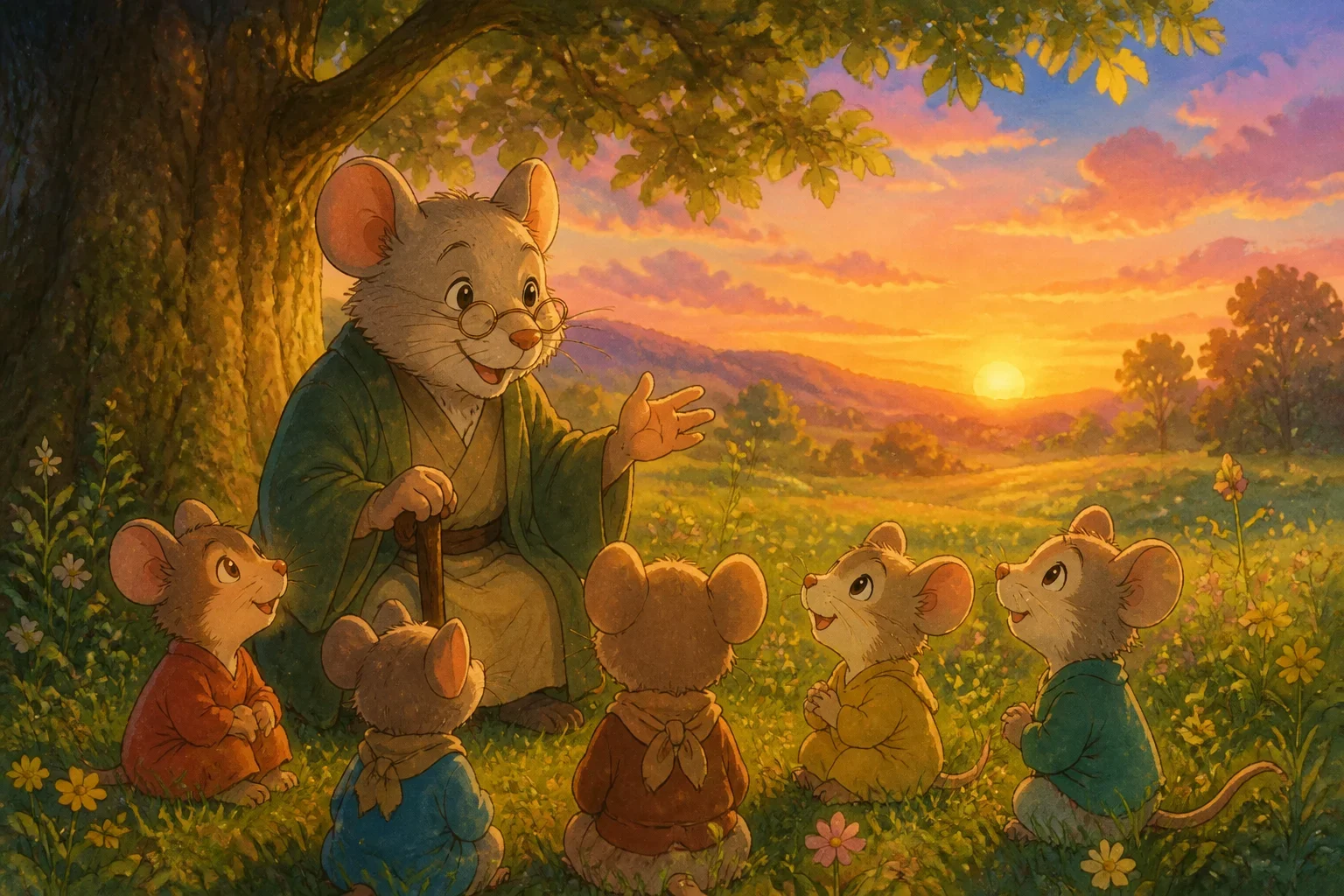
They were busy mice—quick-footed, bright-eyed, and always whispering important mouse things.
“Winter will come before you know it,” said their leader, Mr. Squeaks, smoothing his whiskers. He was small and gray and no longer as fast as the younger mice, but his eyes were sharp, and his mind was sharper. “Gather grain. Save crumbs. And keep one ear open for trouble.”
The younger mice nodded, though some nodded more seriously than others.
For trouble, in that part of the village, had a name.
Whiskers.
Whiskers the cat was famous for his soft paws, silent steps, and clever tricks. His fur shone like polished chestnuts in the sun, and his green eyes glittered as if they always knew more than they were saying. He could lie as lazily as a sleepy cloud one moment and pounce like a spring the next.
Every mouse in the barn knew one thing:
When Whiskers looked peaceful, it was often the moment to be most careful.
A Strange Offer
One bright afternoon, the mice were carrying seeds, crumbs, and bits of oats back to their nest. Pip, the youngest of the gatherers, struggled proudly with a crust almost bigger than his head.
“Look at me!” he squeaked. “I found enough for three days!”
“Or enough to trip over,” teased his sister Tilly.
Just then, a smooth voice floated across the yard.
“Oh, little neighbors,” it called. “What hard workers you are.”
Every mouse froze.
There, stretched across a warm flat stone, was Whiskers. His tail flicked once. His eyes were half-closed. He looked harmless.
That, Mr. Squeaks thought at once, was the most dangerous kind of looking.
“Stay back,” he murmured.
Whiskers laid a paw dramatically on his chest. “Must you always think the worst of me?” he asked. “I only wished to speak.”
“No one asked you to,” said Tilly under her breath.
Whiskers pretended not to hear.
“I have changed,” he announced. “Truly. I am tired of chasing and sneaking and all that tiresome nonsense. I have discovered something wonderful—a secret stash of crumbs and grain in the old barn. More than I could ever eat myself.” He sighed as if generosity had made him noble. “I thought perhaps… we could share it.”
The younger mice stared.
“Share?” whispered Pip.
“With us?” asked another.
Mr. Squeaks narrowed his eyes. “And why,” he said slowly, “would a cat share food with mice?”
Whiskers gave a sad little shrug. “Because peace is pleasant. Because I wish to be trusted. Because one grows wiser with age.”
At that, Mr. Squeaks almost laughed.
But Pip stepped forward just a little. “If it’s true,” he said, “that would help us a lot. Winter is coming.”
Whiskers turned to him at once, warm and smooth as honey. “Exactly, brave little one. You understand.”
Mr. Squeaks lifted his paw. “Honeyed words,” he said quietly, “can hide sharp claws.”
Whiskers blinked innocently. “Then come and see for yourselves. At dusk, in the old barn. I’ll be waiting beside the hay bales. If I meant harm, would I invite all of you?”
Before anyone could answer, he leaped down from the stone and strolled away, tail high, as if he had done something kind.
The yard buzzed with whispers.
“Maybe he means it.” “Maybe he really found food.” “Maybe cats can change.”
Mr. Squeaks said nothing for a long moment. Then he turned and led the mice back under the floorboards.
Mr. Squeaks Has Doubts
That evening, while the sky turned peach and gold, the mice gathered in a circle.
Pip could hardly sit still. “What if it’s real? What if there’s enough food for everyone?”
“And what if it isn’t?” asked Tilly.
Pip’s ears drooped. “We can’t be afraid forever.”
“No,” said Mr. Squeaks gently. “But being brave does not mean being careless.”
The little nest grew quiet.
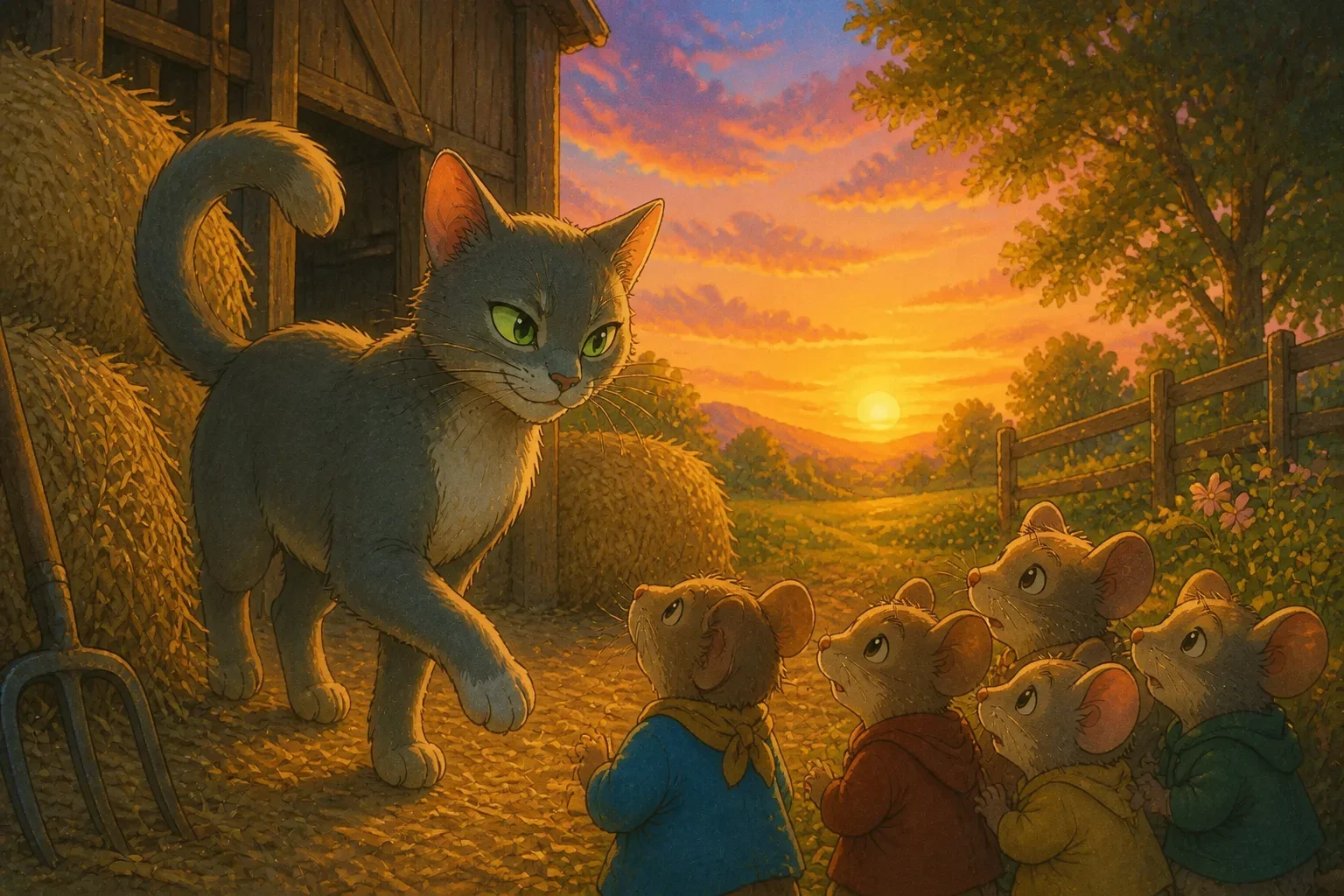
Mr. Squeaks looked around at their small faces. “Trust is precious,” he said. “It should not be handed over just because someone speaks sweetly. A person—or a cat—who has fooled you before must earn trust through actions, not promises.”
Pip stared at the floor. He wanted the feast to be real. He wanted, just once, for the world to offer something easy and good.
At last he asked, “Then what should we do?”
Mr. Squeaks’ whiskers twitched. “We use our eyes. We use our minds. And we stay together.”
The Barn at Dusk
When dusk settled over the village, the mice crept toward the old barn.
The place smelled of hay, dust, and old wood. Moonlight slipped through the cracks in silver lines. Somewhere above, an owl called once, low and far away.
Whiskers sat near a stack of hay, wearing an enormous smile.
“Welcome, friends!” he purred. “You came. How wonderful. The food is just behind those bales. Plenty for all.”
The younger mice leaned forward eagerly.
But Mr. Squeaks did not move.
He looked carefully around the barn.
No crumbs lay scattered. No grain sacks were open. No smell of fresh food drifted through the air. And the hay bales were stacked in a narrow corner with only one way in—and one way out.
A trap.
Whiskers’ tail gave a tiny twitch.
Mr. Squeaks stepped in front of the others. “If there is food,” he said calmly, “why hide it where we must squeeze into a corner to reach it?”
Whiskers’ smile thinned.
“And if you wished to share,” Mr. Squeaks continued, “why is there not a single crumb in sight?”
The younger mice looked around. Now they noticed it too.
The barn was empty.
Whiskers rose slowly to his feet. “You are a suspicious little fellow,” he said.
“I am a careful one,” replied Mr. Squeaks.
For a moment, no one moved.
Then Whiskers’ green eyes flashed.
He sprang.
But the mice were ready.
“Run!” cried Mr. Squeaks.
They scattered like dry leaves in the wind—left, right, under a cracked bucket, through a gap in the boards, over a fallen rake handle. Pip dashed so fast his paws barely touched the ground. Tilly zipped behind him. Whiskers swiped and missed, his claws catching only dust and straw.
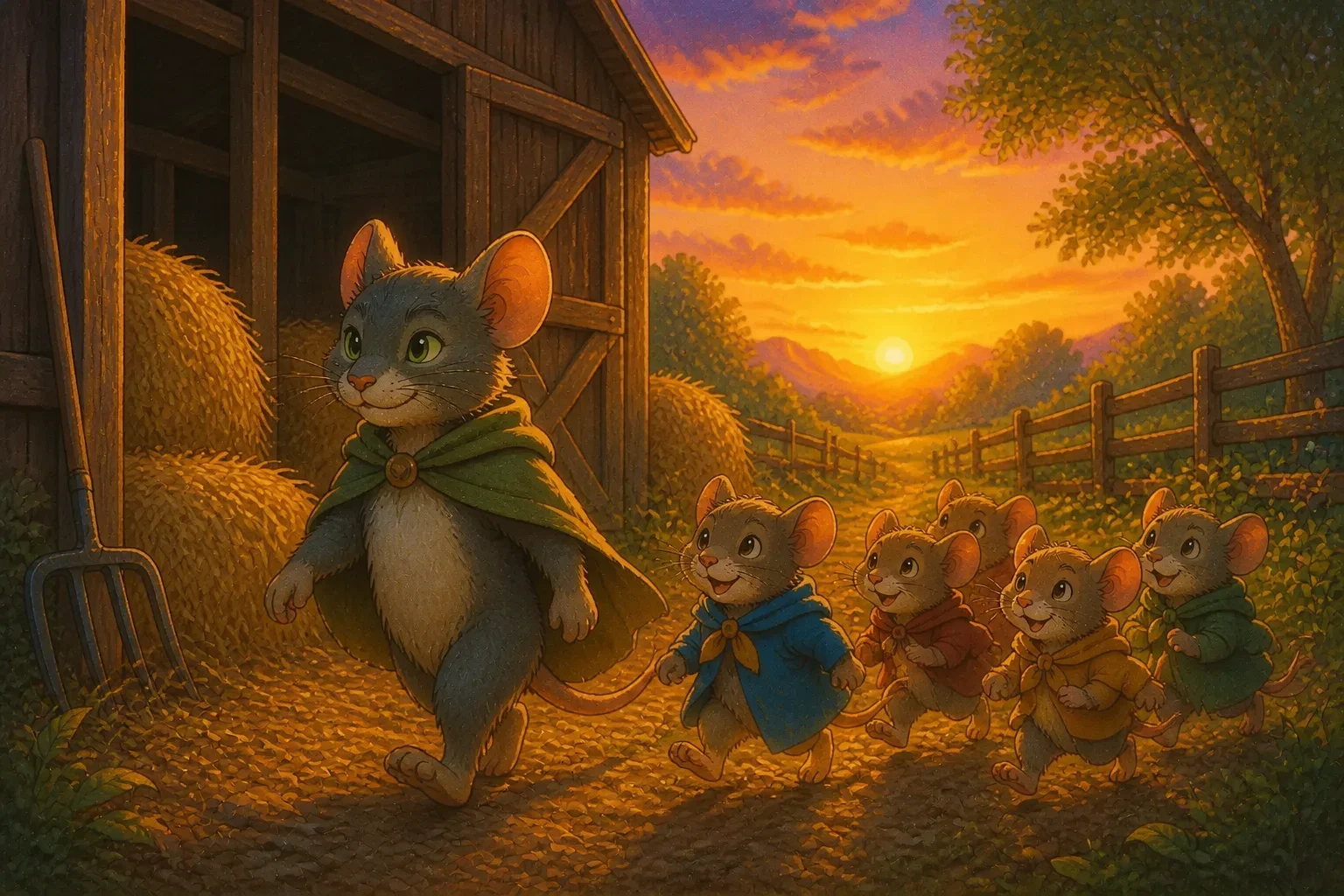
In seconds, the mice were gone.
Whiskers skidded to a stop, glaring into the darkness beneath the floorboards.
Foiled.
Again.
A Lesson Pip Never Forgot
Back in their nest, everyone spoke at once.
“It was a trick!” “I knew something felt wrong!” “He almost had us!”
Pip was breathing hard. His little chest rose and fell quickly.
“I wanted to believe him,” he admitted at last.
Mr. Squeaks rested a paw on his shoulder. “That does not make you foolish,” he said. “It means you are hopeful. Hope is good. But hope must walk beside wisdom.”
Pip looked up. “So trusting someone isn’t wrong?”
“No,” said Mr. Squeaks. “Trust is a good thing. But real trust is built slowly. It is earned by honest actions, again and again—not by clever words in a hungry moment.”
The mice nodded.
Outside, the wind rustled the grass around the barn, and somewhere in the yard, Whiskers gave one annoyed flick of his tail before stalking off into the night.
From then on, whenever the younger mice heard a promise that sounded too easy, they remembered the empty barn, the hidden corner, and the cat with the honey-sweet voice.
And they remembered something even more important:
Being kind is good. Being trusting can be good. But being careful is wise.
Key Takeaways for Kids
- It is important to think carefully before trusting someone.
- Sweet words do not always mean honest intentions.
- Wise advice can help keep us safe.
- Being brave is not the same as being careless.
- Trust should be earned through actions.
Moral of the Story
Always be cautious with those who have a history of trickery. Trust should be given wisely, not blindly.
Why This Moral Story Matters
This classic-style children's moral story helps kids understand an important life lesson in a simple, memorable way: not everyone who sounds friendly can be trusted right away. Through the clever cat and the careful mice, children can learn to balance kindness with caution, especially when something seems too good to be true.
If you enjoy moral stories for kids, bedtime stories, and animal tales with meaningful lessons, this story is a wonderful reminder that wisdom often keeps us safe.

Watch the Animated Story
Watch on YouTube
Related Stories
Bees and the Beetles: A Moral Story About Hard Work
The Bees and the Beetles On the edge of a bright summer garden stood a tall old hive, golden in the afternoon sun. From…
The Ass in the Lion’s Skin: A Moral Story About Being Yourself
The Ass in the Lion’s Skin On the edge of a golden field, where tall grass swayed like waves and crickets sang in the…
The Loyal Dog Max: A Heartwarming Friendship Story for Kids
The Loyal Dog Max On the edge of a small, peaceful town stood a little yellow house with a crooked fence, a vegetable…
Ass and His Masters: A Classic Aesop Story for Kids
The Ass and His Masters In a dusty little village at the edge of wide brown fields, there lived an ass who was never…
Lazy Donkey Who Finally Helped: A Moral Story on Hard Work
The Lazy Donkey Who Finally Helped In a sunny little village tucked between green hills and golden fields, there lived…
Timmy the Brave Kitten | Courage Moral Story for Kids
The Adventure of Timmy the Brave Kitten On the edge of a cozy little village, where chimneys puffed soft clouds into…
The Tortoise and the Hare Moral Story: An Aesop Fable
The Tortoise and the Hare On the edge of a sunlit meadow, where daisies nodded in the breeze and dragonflies skimmed…
The Beggar’s Blessing: A Moral Story About Kindness for Kids
The Beggar’s Blessing In a lively little town where market bells rang each morning and the smell of fresh bread drifted…