
The Last Tree on Elm Avenue: An Earth Day Moral Story for Kids About Protecting Nature
The Last Tree on Elm Avenue
Ruby’s sneakers squeaked on the wet sidewalk as she dashed past the neat rows of houses on Elm Avenue. In her hand, she clutched a flyer she’d made at school: “Happy Earth Day! Plant, Protect, Preserve!” She wanted to hang the flyers on every door, but mostly she wanted to show her friends the giant oak tree at the end of the street—the very last tree on Elm Avenue.
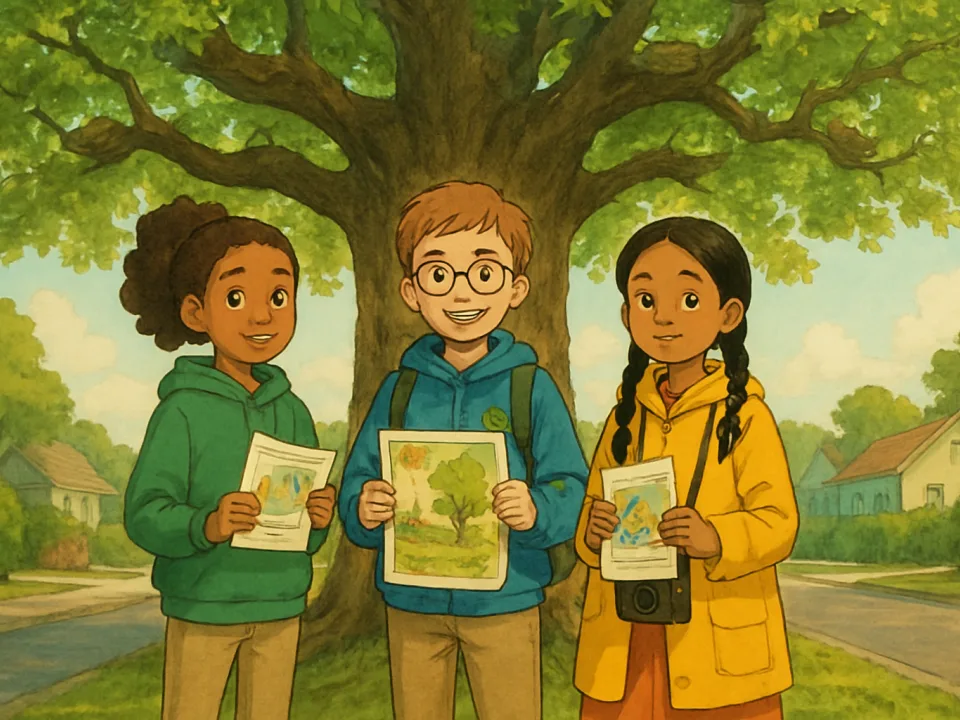
Every other tree had disappeared over the years, replaced by driveways and lawns. But the little group of friends loved the old oak. Its branches reached so far, they made a green tunnel above the sidewalk. Ruby could almost hear the tree whisper as the wind rustled its leaves, telling stories of all it had seen on Elm Avenue: children learning to ride bikes, neighbors waving hello, birds fluttering from branch to branch.
After school, Ruby met her best friends, Lucas and Maya, at the base of the tree. Lucas, with his green backpack covered in frog stickers, was the first to spot the problem. “What’s that?” he asked, pointing to a bright orange ribbon tied around the trunk. Maya, always curious with her camera slung over her shoulder, peered at the sign posted nearby. It read: “Tree Removal Scheduled. April 23.”
All three gasped. Only two days until Earth Day, and the last tree was about to be cut down!
Ruby felt tears prick her eyes. “This can’t happen! Where will the birds go? What about the squirrels? And the shade? This tree is special!"
Lucas frowned. “We have to do something. We can’t let them take away our tree.”
Maya was already snapping photos. “Let’s show everyone what the tree means to us—and to the whole neighborhood!”
The friends hurried home to gather supplies. Ruby made more flyers with pictures of the tree, writing, “Please Save Our Tree!” Lucas researched why trees are important: they clean the air, provide homes for animals, and keep the city cooler in summer. Maya printed her photos. Soon, their living rooms were filled with posters, markers, and hopeful energy.
Ruby’s parents helped her print more flyers, and Lucas’s little brother eagerly colored tree pictures while Maya’s grandma shared a story about how the oak was already full grown when she moved in as a child. The whole neighborhood seemed to have a memory or a story about the old tree.
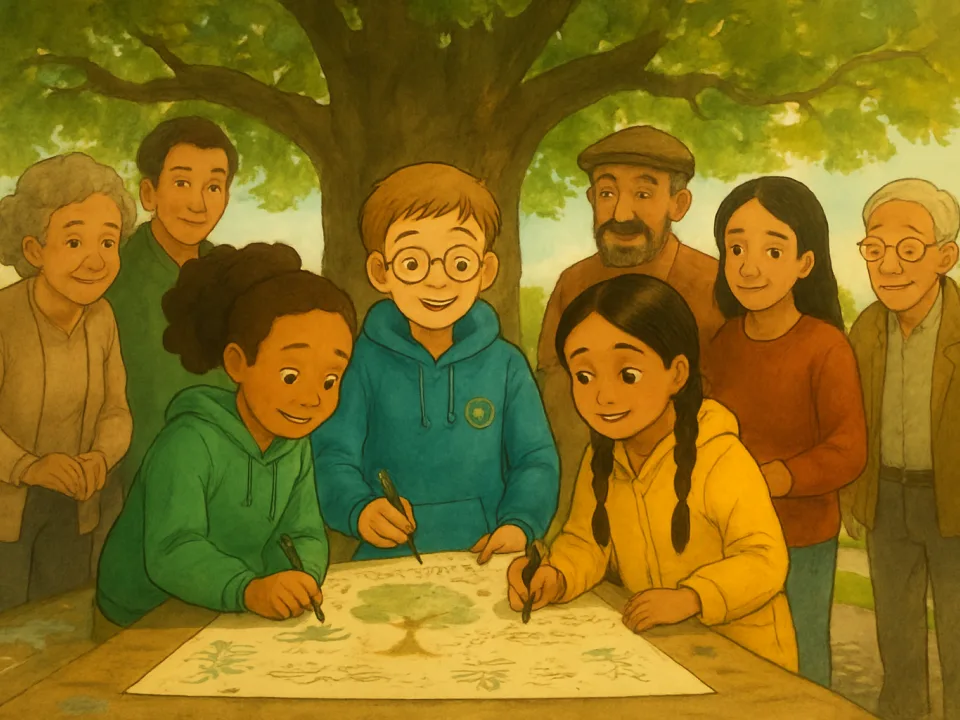
That evening, the friends knocked on neighbors’ doors. At first, they were nervous. What if the grown-ups didn’t care? But they soon found many neighbors did care. Mrs. Chan, who walked her dog under the branches every morning, remembered how her kids used to climb it. Mr. Rivera, who’d recently moved in, liked the way the tree’s shadow fell across his porch. The mail carrier told them that in the hottest days of summer, the old oak’s shade made her route bearable.
Other neighbors shared stories, too. An older man named Mr. O’Donnell said he’d planted a time capsule under the tree when he was a boy. “That tree’s watched over us for generations,” he said, his voice thick with emotion. Even people who hadn’t thought much about the tree before began to imagine Elm Avenue without it, and realized it would be a sadder, emptier place.
As the sun set, the friends stood beneath the tree. “What if it’s not enough?” Ruby whispered. Her voice trembled as she looked up at the old branches, now silhouetted against a purple sky.
Lucas squeezed her hand. “We have to try. Even if we’re kids, we can make people listen.”
The next morning, on Earth Day, the friends set up a table by the tree with their flyers, photos, and a big sheet of paper that said, “Why We Love Our Tree.” Neighbors stopped by, adding memories and drawings: picnics, secret forts, nests of baby robins. Even the mail carrier scribbled, “Best climbing tree ever!”
Children in the neighborhood brought their chalk and decorated the sidewalk with colorful drawings of trees, birds, and animals. Someone brought lemonade, and as the sun warmed the block, the scene by the oak filled with laughter and hope. Ruby felt a spark of excitement—maybe they really could save their tree.
Mid-morning, a work truck pulled up. The tree removal crew looked surprised to see so many people gathered. The leader, a tall woman named Ms. Kelly, stepped out. “We don’t want to upset anyone, but the city got complaints about roots cracking the sidewalk. We have to follow the order.”
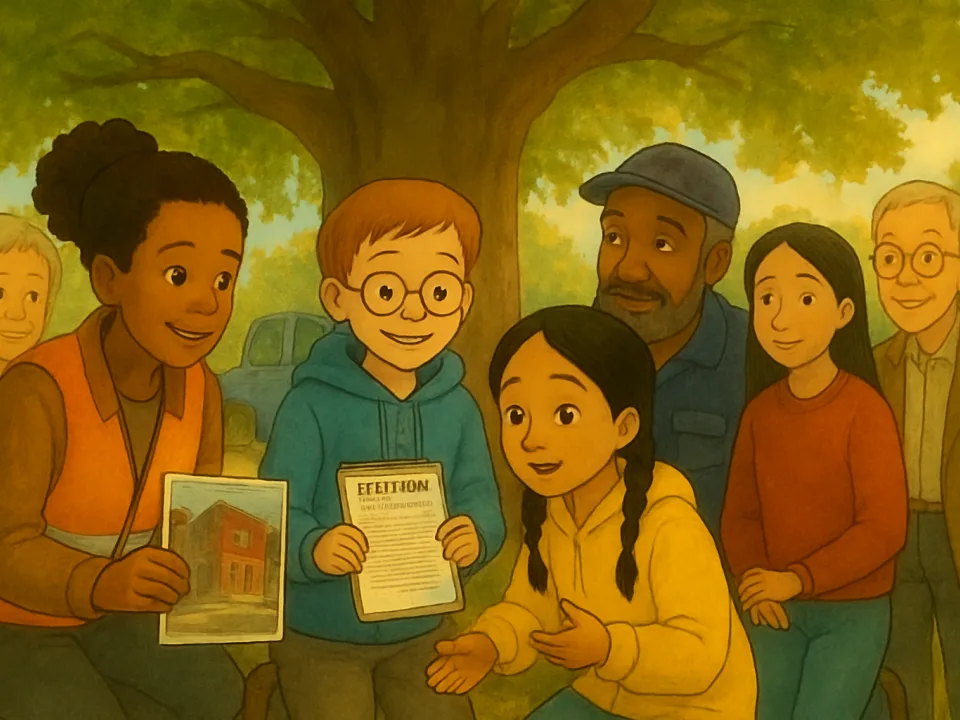
Lucas handed her the petition. “Please, can we try to find another way?”
The crowd waited. Some children clung to the rough bark. Maya showed Ms. Kelly her photos. Ruby explained how birds nested here every spring, and how the tree felt like part of the family. Lucas talked about the science: how trees help clean the air and cool the city, how losing the tree would make the street hotter and less friendly for animals and people.
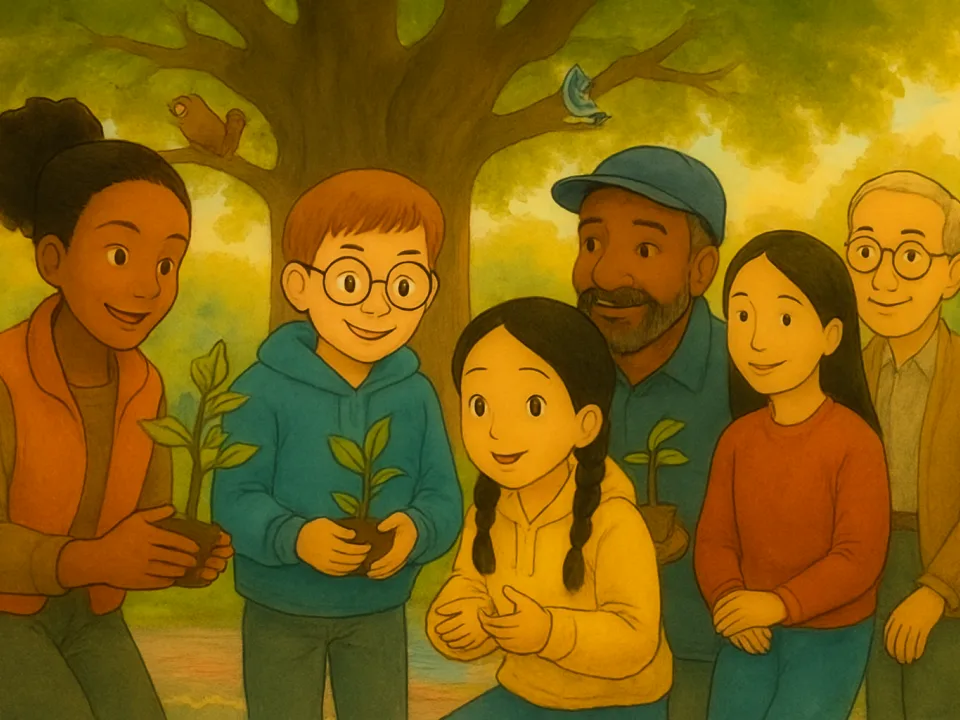
Ms. Kelly listened carefully. She looked at the chalk drawings, the posters, the faces of the children and neighbors all around her. She promised to call the city’s parks department and see if there was another solution.
As the grown-ups talked, more neighbors joined in. Some brought potted plants and promised to care for any new trees that were planted. Others shared their favorite tree memories. The children organized a little parade, waving their “Save Our Tree!” signs and chanting, “Trees are treasures!”
By lunchtime, the parks department sent a city worker named Mr. Reed. He admired the artwork and read all the stories the neighbors had written. “You kids did something amazing,” he said. “You reminded everyone how important this tree is. Maybe we can fix the sidewalk without removing it.”
The crowd cheered! Mr. Reed called a tree specialist, who came to inspect the roots and suggested a special path could curve around them. The city agreed to the new plan. The tree would stay.
Ruby hugged Lucas and Maya. “We did it! We saved the last tree!”
That Earth Day, the children were local heroes. A reporter from the town newspaper took their photo beneath the leafy canopy, with birds flitting above and a squirrel chattering in the branches. The story spread, and soon more neighbors planted new saplings along Elm Avenue. By the end of summer, tiny leaves unfurled where there had once been bare grass. Kids took turns watering the new trees, and neighbors started noticing more butterflies and birds returning to the block.
The old oak tree stood prouder than ever. Some evenings, Ruby liked to sit at its roots and listen. The tree still whispered, but now it seemed to hum with laughter, memories, and the promise that one person—or three determined friends—could make a real difference for nature, right in their own neighborhood.
And every spring after that, the story of the last tree on Elm Avenue was remembered and retold—how a few kids, with courage and teamwork, helped their community choose hope and nature over convenience. Elm Avenue became a street where people cared for the world around them, planting flowers, picking up litter, and cherishing every green thing, big or small.
To Ruby, Lucas, Maya, and all their friends, the old oak wasn’t just a tree—it was a symbol of what could be accomplished when hearts and voices came together for something good. And as the seasons turned, the children grew, but the tree remained, stronger and more beloved than ever.
Related Stories
Leo and the Glowing Screen: A Moral Story About Screen Time Balance for Kids
Leo and the Glowing Screen Leo Martinez had always been a boy bursting with curiosity and boundless energy. His…
Sneakers or Savings? A Moral Story for Tweens About Peer Pressure and Smart Money Habits
Sneakers or Savings? A Moral Story for Tweens About Peer Pressure and Smart Money Habits Jaden Martinez walked through…
The Viral Prank: A Moral Story for Tweens About Digital Footprints and Consequences
The Viral Prank It was the Friday before Spring Break at Maple Hill [Middle…
When the Likes Stopped: A Modern Moral Story About Social Media Validation for Tweens
When the Likes Stopped: A Modern Moral Story About Social Media Validation for Tweens Ella Roberts wasn’t the most…
The Rumor in Hallway B: A Middle-School Story About Gossip, Truth, and Loyalty
The Rumor in Hallway B The first bell at Lincoln [Middle School](/blog/back-to-school-stories-about-making-friends/)…
Value of Time | Moral Story About Family and Priorities
The Father, the Piggy Bank, and Five Minutes of Sunset In the shining city of Silverstone, people often said that Elias…