The Boy Who Cried Wolf 🐺
The Boy Who Cried Wolf: A Powerful Moral Story for Kids
High on a green hillside above a quiet village, a shepherd boy named Leo spent his days watching a flock of sheep. From far away, it sounded like a lovely job. The wind hummed through the grass, little white clouds drifted across the sky, and the sheep cropped clover with soft, steady munching sounds.
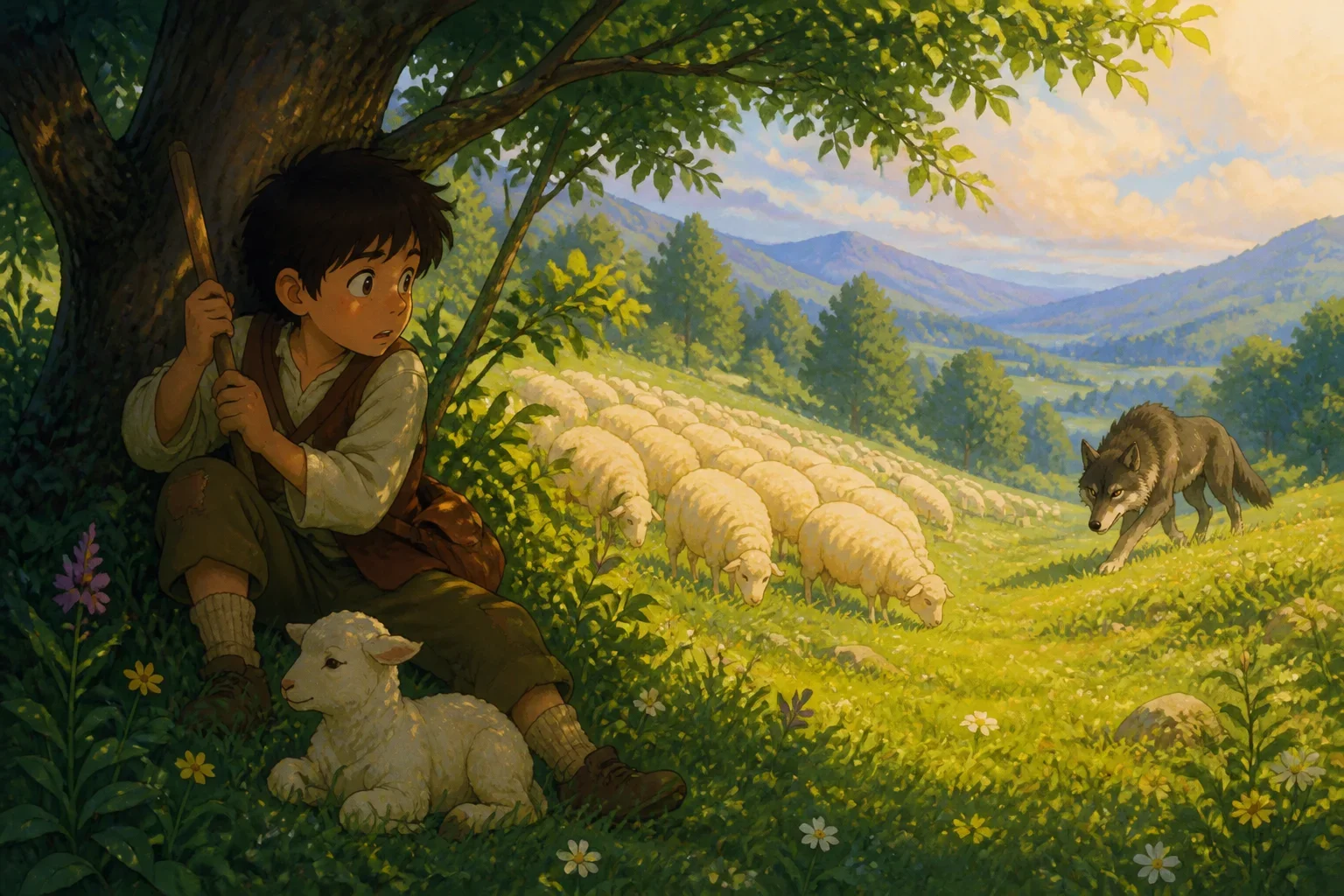
But to Leo, the days felt long.
Very long.
He would lean on his wooden staff, squint at the road below, and watch the villagers hurrying about their busy lives. Bakers carried warm bread. Farmers called to one another in the fields. Children laughed near the well. Meanwhile, Leo sat on the hill with only sheep for company.
"If only something exciting would happen," he sighed.
At first, he tried to entertain himself by whistling tunes, tossing pebbles, and naming the sheep. But by afternoon, even that felt dull. A mischievous idea began to grow in his mind.
He stood up suddenly, cupped his hands around his mouth, and shouted as loudly as he could:
"Wolf! Wolf! Help! A wolf is after the sheep!"
Down in the village, people froze.
Then they ran.
Mrs. Jenkins came hurrying with flour still dusting her hands. Old Mr. Thompson grabbed a rake. Two farmers raced uphill, panting. Even the miller left his cart in the road.
"Where is it?" cried Mrs. Jenkins. "Where's the wolf?"
Leo doubled over laughing.
"There is no wolf!" he said. "I just wanted to see you all run!"
The villagers stared at him in disbelief. No one laughed.
Mr. Thompson's face turned stern. "That is not a joke," he said. "When you cry for help, people come because they care. Do not waste their trust."
But Leo only shrugged. The warning slid past him like rain off a roof.
A few days later, the hillside felt quiet again. The sheep wandered. The bees buzzed. Leo grew restless.
And once more, he shouted:
"Wolf! Wolf! Please help!"
Again the villagers rushed up the hill, out of breath and alarmed.
Again they found no wolf.
Again Leo laughed.
This time, the villagers were not only angry. They were hurt.
"You made fools of us," said one farmer.
"What if someone truly needs help while we are chasing your lies?" said Mrs. Jenkins.
Leo's smile faded for a moment, but pride kept him from apologizing. He turned away and poked the ground with his staff as the villagers walked back down the hill, shaking their heads.
After that, something changed.
When Leo looked toward the village, fewer people waved.
The hill seemed lonelier than ever.
The Day the Wolf Really Came
One late afternoon, the sky turned the color of pale gold, and long shadows stretched over the meadow. The sheep were grazing near the edge of the woods, where the trees stood dark and still.
Then Leo heard it.
A rustle.
Not the light skipping sound of a rabbit.
Not the soft wind in the leaves.
This sound was heavier. Slower.
Leo turned.
At the edge of the trees stood a wolf.
Its coat was gray and rough. Its eyes were sharp and fixed on the flock. It moved low to the ground, silent and certain.
For one frozen second, Leo could not breathe.
Then he grabbed his staff and screamed:
"Wolf! Wolf! Please! Please help! It's real this time!"
His voice cracked with fear.
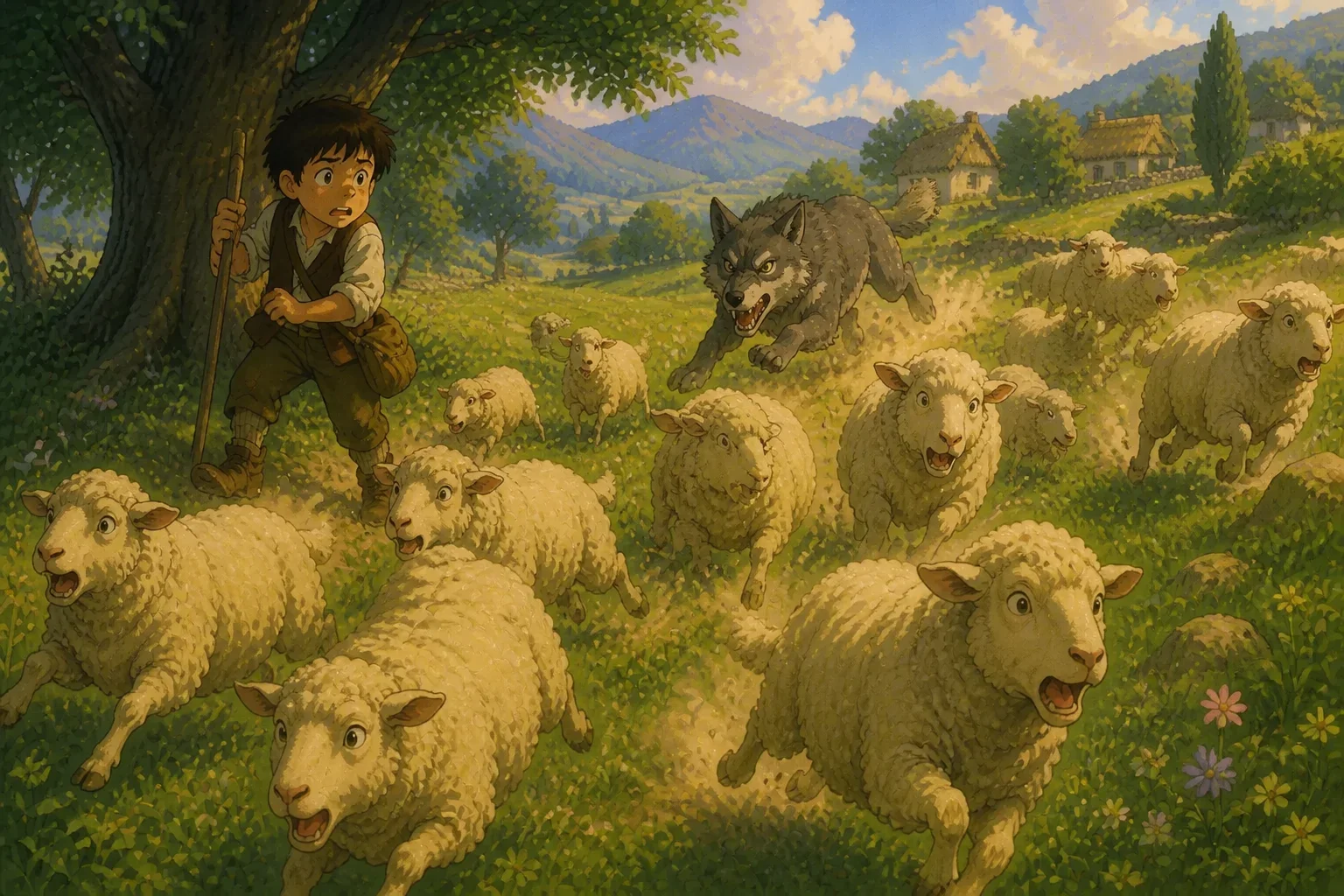
The sheep scattered in panicked bursts of white. Some bolted uphill. Others huddled together, bleating in terror.
Leo ran after the wolf, waving his staff wildly.
"Go away! Leave them alone!" he shouted.
But he was only one boy, and the wolf was not frightened by words.
Down in the village, people heard him.
They paused.
Mrs. Jenkins looked up from her doorstep.
Mr. Thompson stopped beside the well.
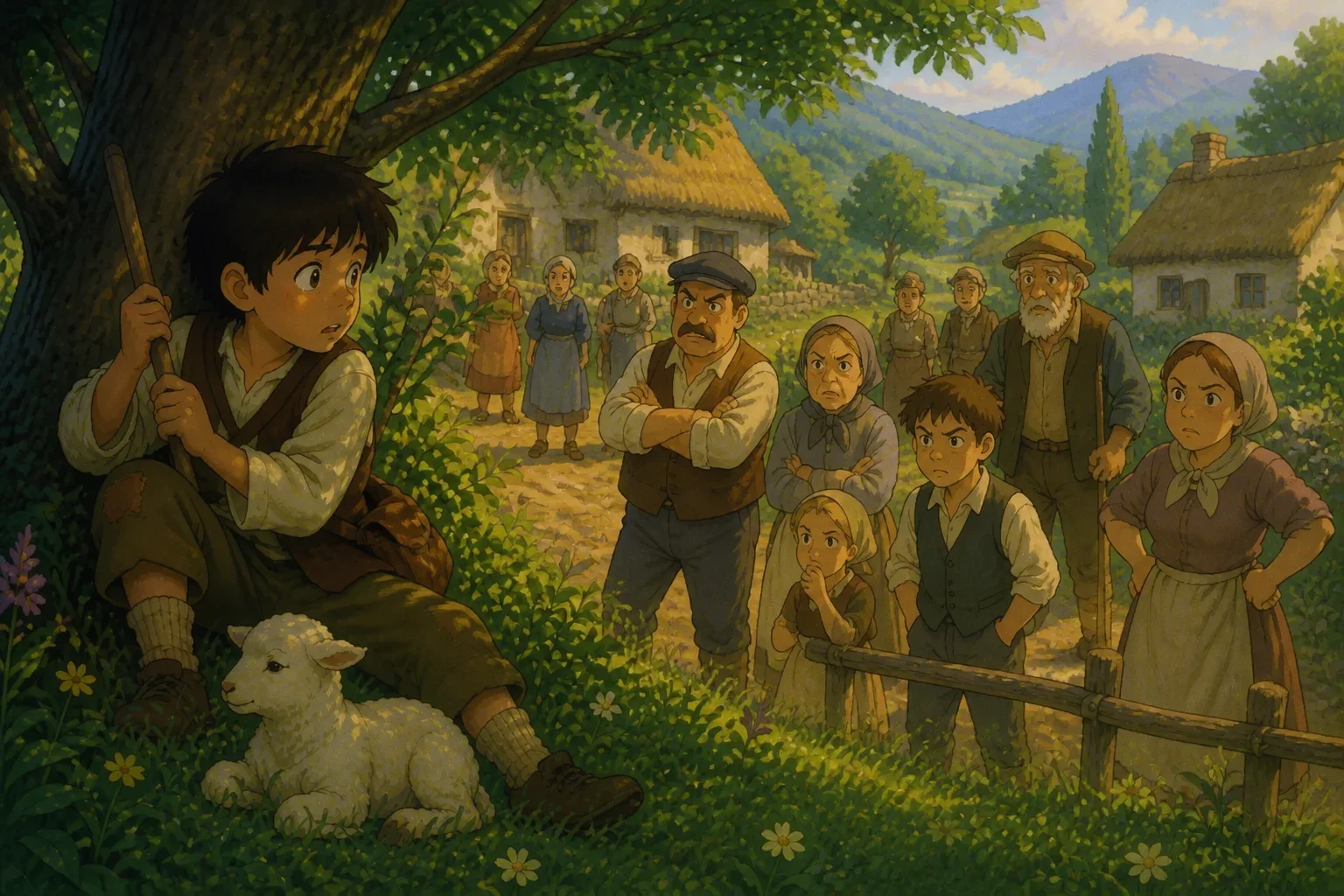
A farmer sighed and said, "It's another trick. Let him shout."
So no one came.
On the hill, Leo kept crying until his throat burned.
But the meadow answered only with frightened bleats, pounding hooves, and the terrible silence of no footsteps coming to help.
By the time the wolf vanished back into the forest, some of the flock were gone, and the rest trembled in a frightened cluster around Leo.
The boy dropped to his knees in the grass.
He had wanted excitement.
Now his chest ached with regret.
A Hard Lesson
When Leo finally led the remaining sheep back to the village, his face was pale and streaked with tears. The villagers gathered around and understood at once that something dreadful had happened.
"There really was a wolf," Leo whispered.
No one scolded him at first. That made him feel even worse.
At last, Mr. Thompson spoke gently. "Leo, this is why truth matters. When lies are spoken again and again, people stop believing even the truth."
Leo looked down at the ground. "I know," he said. "And it's my fault. I thought it was funny. I didn't think about what trust meant until I lost it."
From that day on, Leo changed.
He did not change all at once with a grand speech or a single promise. He changed in the quiet, difficult way that real people do.
He rose early. He watched the sheep carefully. He spoke honestly. He helped the villagers without being asked. And when he made mistakes, he admitted them.
At first, people were cautious. Trust does not return as quickly as laughter disappears.
But little by little, the villagers noticed. Leo no longer played tricks. He no longer chased attention with lies. He had learned, through sorrow, the value of being believed.
In time, the villagers trusted him again.
And Leo never forgot the lonely sound of calling for help when no one came.
Key Takeaways for Kids
- Telling lies can make people stop believing you.
- Trust is precious and can be hard to rebuild once it is broken.
- Jokes that frighten or mislead others can cause real harm.
- Being honest, even after a mistake, is the first step toward making things right.
Moral of the Story
No one believes a liar, even when they tell the truth.
Why This Story Still Matters
The Boy Who Cried Wolf remains one of the most memorable moral stories for kids because it teaches an important lesson in a simple, powerful way: honesty builds trust, and trust keeps us connected to others. For children, it opens conversations about truth, responsibility, and why our words matter.
If you're looking for children's moral stories, bedtime stories with life lessons, or classic honesty stories for kids, this timeless tale is a meaningful one to read and discuss together.
Watch the Animated Story
Watch on YouTube
Related Stories
The Tortoise and the Hare Story: Slow and Steady Wins
The Tortoise and the Hare On the edge of a green woodland, where clover scented the breeze and bees hummed over…

The Fox and the Crow: A Clever Aesop Fable for Kids
The Fox and the Crow On a warm golden afternoon, when the forest leaves shimmered like tiny green mirrors, a crow flew…
Ant and Grasshopper Story for Kids: A Famous Aesop Fable
The Ant and the Grasshopper On the brightest edge of summer, when the meadow hummed like a song, a tiny ant hurried…
The Thirsty Crow Story: A Clever Aesop Fable for Kids
The Thirsty Crow The sun hung over the fields like a golden fire, and by midday even the wind seemed too tired to move.…
The Goose That Laid the Golden Eggs Story: A Moral
The Goose That Laid the Golden Eggs On the edge of a quiet village, where smoke curled from chimney tops each evening…
The Fox and the Grapes Story: Aesop’s Famous Moral Tale
The Fox and the Grapes On a hot afternoon, when the fields shimmered and even the crickets sounded sleepy, a hungry fox…