The Beggar's Blessing - A Short Moral Story
The Beggar’s Blessing
In a lively little town where market bells rang each morning and the smell of fresh bread drifted through the streets, there lived a boy named Morris.
Morris was the sort of child who noticed everything. He noticed the cat that slept on the baker’s windowsill, the shoemaker who whistled while he worked, and the way the sunset turned the rooftops golden in the evening. He was curious, quick to smile, and always asking questions.
But there was one thing Morris had not yet learned to notice well: the quiet sadness hidden in plain sight.
One afternoon, while weaving through the busy town square, Morris slowed his steps. Near the old fountain, where pigeons pecked at crumbs and people hurried by with baskets and bundles, sat an old man on a faded mat.
His coat was patched at the elbows. His shoes were worn thin. Beside him rested a small tin cup with only two dull coins inside.
Most people passed without looking.
Morris did not.
He stood still for a moment, clutching the small coin in his pocket. He had been saving it for a sweet bun with honey on top. He glanced around. A few older boys were nearby, laughing loudly. For a second, Morris felt shy.
Then the old man looked up.
His face was lined and tired, but his eyes were calm and kind.
"Hello, sir," Morris said, stepping closer.
The old man blinked in surprise, as if he had not expected anyone to stop. Then he smiled. "Hello, young friend."
"What is your name?" Morris asked.
"Jonas," the man replied. "And yours?"
"Morris."
There was a small pause. The square buzzed around them—cart wheels rattling, merchants calling, children running—but somehow the little space beside the fountain felt quiet.
Morris looked at the cup, then back at Jonas. "Are you hungry?"
Jonas gave a soft chuckle. "Some days more than others."
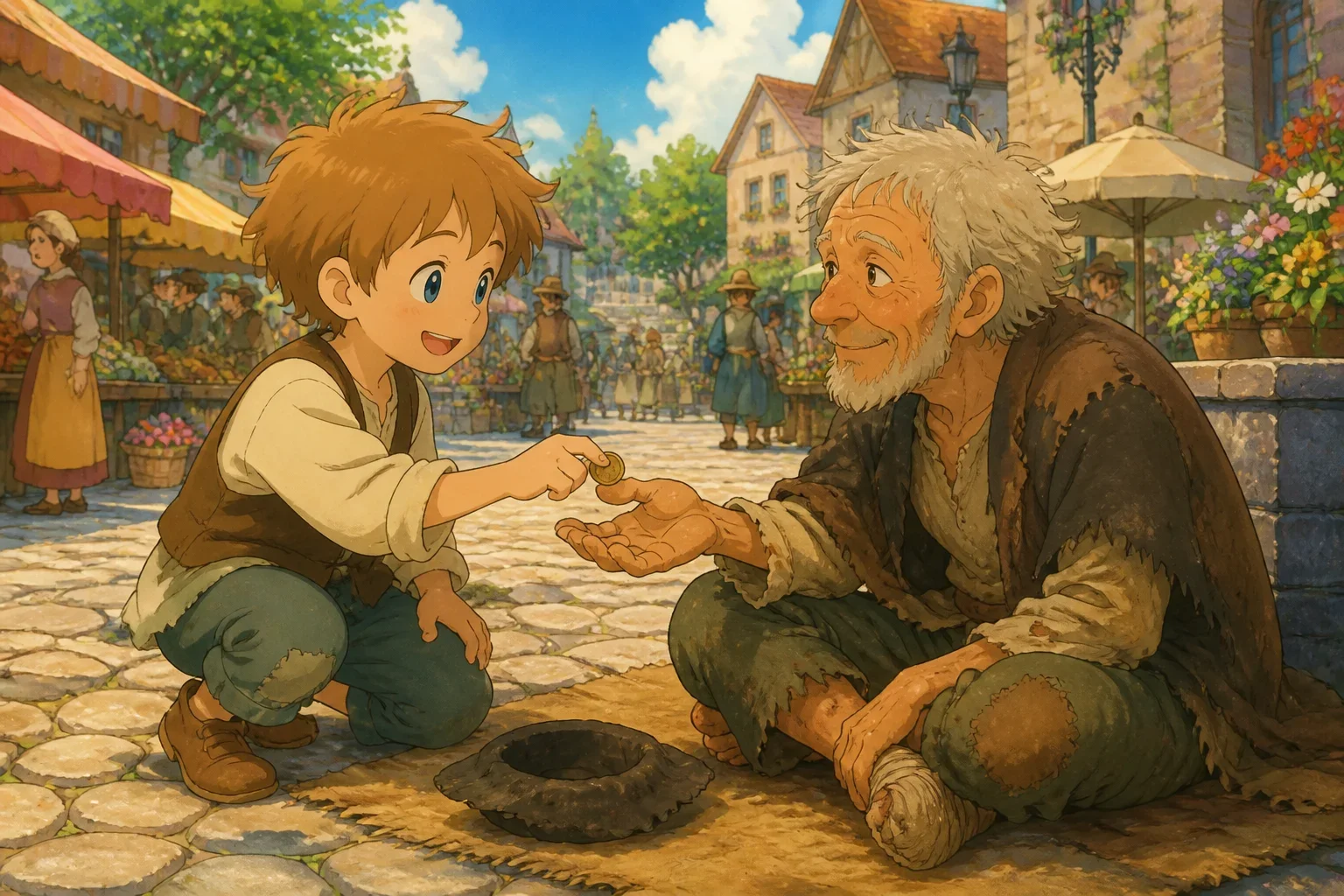
Morris reached into his pocket and pulled out his coin. It gleamed in his palm. He stared at it for the briefest moment, thinking of the honey bun.
Then he dropped it into the cup.
Clink.
Jonas’s eyes widened. "That is very generous," he said gently.
Morris shrugged, suddenly embarrassed. "It’s only a coin."
Jonas shook his head. "No, my boy. A coin given with kindness is never only a coin."
Those words stayed with Morris all the way home.
A Different Kind of Gift
The next day, Morris returned.
This time he carried a small cloth bundle with a piece of bread, an apple, and half a wedge of cheese his mother had helped him wrap.
Jonas was sitting in the same place near the fountain, warming his hands in the afternoon sun.
"You came back," Jonas said, sounding truly pleased.
"I said I might," Morris replied, trying to sound casual, though he was secretly glad Jonas remembered him.
He handed over the bundle.
Jonas accepted it carefully, as though it were something precious. "Thank you."
Morris sat down beside him on the stone edge of the fountain.
At first, they spoke only a little. But little by little, their conversations grew.
Morris talked about everything—his favorite climbing tree, the time he nearly fell into the mill pond, the stray dog he wanted to adopt, and his dream of one day seeing mountains taller than clouds.
Jonas listened with real interest, nodding and smiling.
Then, when Morris had finally run out of stories for the day, he asked, "What about you?"
Jonas looked toward the far end of the square, as if peering into years long gone.
"When I was young," he said, "I traveled from village to village with my brother. We crossed rivers on wooden bridges, slept beneath stars bright as lanterns, and once got chased by an angry goose nearly the size of a donkey."
Morris burst out laughing. "A goose?"
"A very determined goose," Jonas said solemnly.
From then on, Morris visited often.
Sometimes he brought food. Sometimes he brought only himself.
And Jonas always seemed just as grateful either way.
The Boy Who Began to See
As the days passed, Morris noticed things he had never paid much attention to before.
He noticed how many people looked away from Jonas as if he were invisible.
He noticed how cold the stone ground must feel in the morning.
He noticed that loneliness could hurt just as much as hunger.
One windy afternoon, Morris arrived with a crusty loaf and found Jonas rubbing his hands together for warmth.
Without thinking, Morris untied the wool scarf from around his own neck.
"Here," he said.
Jonas frowned kindly. "You’ll be cold."
"I can run home fast," Morris said. "You can’t sit fast."
Jonas laughed so suddenly that even a nearby flower seller turned to smile.
He wrapped the scarf around his shoulders. "You have a clever heart, Morris."
Morris sat beside him, feeling oddly proud.
After a while, he asked the question that had been growing in his mind.
"Jonas… were you always poor?"
Jonas was quiet for a moment.
"No," he said at last. "Life changes in ways we do not expect. I had work once. I had a home. I had family close by. Then came hard seasons, illness, and loss. One by one, things slipped away."
Morris lowered his eyes. "I’m sorry."
Jonas gave him a gentle look. "Do not be sorry to hear the truth. Be kind because of it. Every person you pass is carrying a story you cannot see."
Morris thought about that for a long time.
The Richest Hour
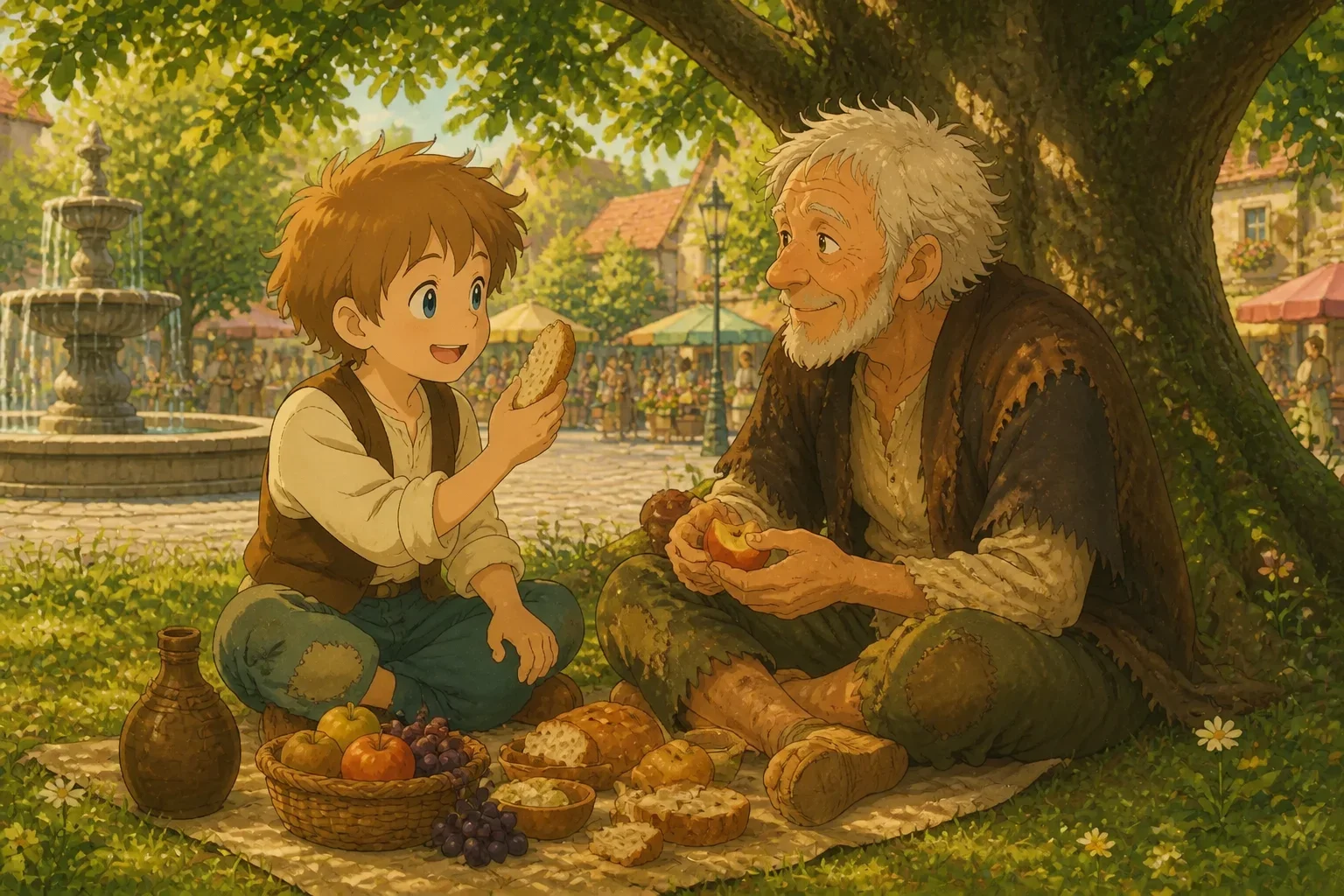
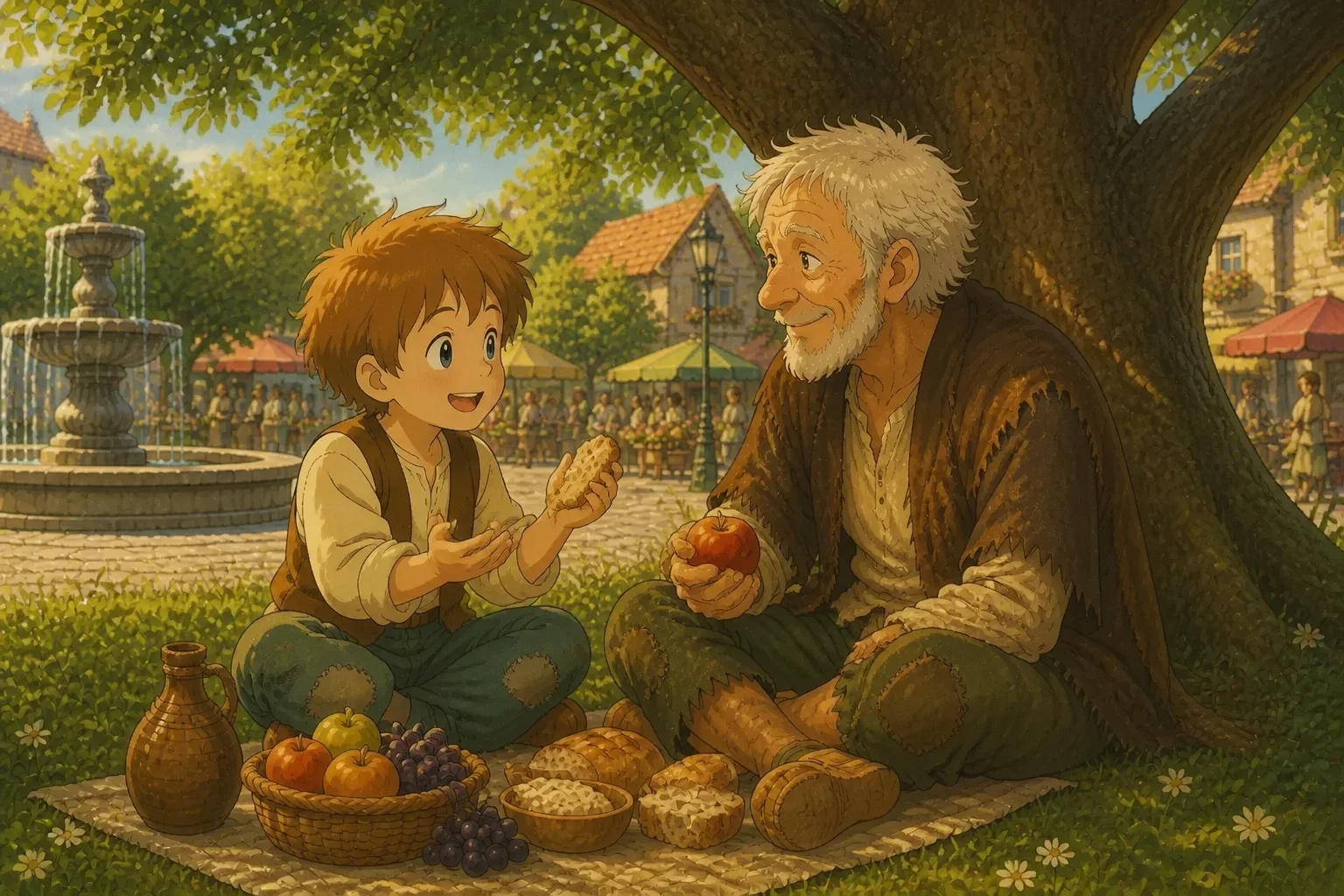
One golden afternoon, Morris brought a slice of apple pie wrapped in paper. It was still warm.
Jonas’s face lit up. "Now this," he declared, "is a feast fit for a king."
They shared it slowly, breaking off little pieces while sparrows hopped nearby, hopeful for crumbs.
"Jonas," Morris asked, licking cinnamon from his thumb, "what makes a person truly rich?"
Jonas did not answer right away.
He watched the square—the mothers carrying babies, the old friends greeting each other, the baker handing a roll to a hungry child.
Then he said, "Not coins. Not grand houses. Not full cupboards alone. A person is rich in the love they give, the kindness they receive, and the friends who remember them."
Morris looked up at him. "Then you’re rich."
Jonas smiled. "And so are you."
For the first time, Morris understood that some treasures could not be held in your hand.
The Empty Place by the Fountain
Then one morning, Jonas was gone.
His mat was missing.
His tin cup was gone.
Only a dry leaf skittered across the stones where he usually sat.
Morris’s heart thumped hard.
He searched the square, then the baker’s lane, then the shady bench near the well.
"Have you seen Jonas?" he asked the fruit seller.
She shook her head.
"Have you seen the old man by the fountain?" he asked the flower seller.
She pointed toward the far end of town. "I heard he was taken to a shelter where they can care for him."
A shelter.
Morris had never been to one, but he ran all the same.
He hurried past the mill, past the tailor’s shop, past the row of little houses with blue shutters, until he reached a plain building with a red door and clean windows.
Inside, the air smelled of soup and soap. Blankets were folded neatly on chairs. Voices murmured softly.
And there, seated by the window with sunlight on his face, was Jonas.
"Morris," he said, smiling so warmly that all the fear rushed out of the boy at once. "I hoped you would come."
Morris ran to him and threw his arms around him.
"I thought you’d disappeared!" he said.
"No," Jonas replied, patting his shoulder. "Just moved to a gentler place."
Morris pulled back and looked around. Jonas had a bed, a blanket, and a bowl of hot soup waiting on the table.
It was not fancy, but it was safe.
And somehow, seeing Jonas cared for made Morris’s chest feel light.
Jonas reached for his hand.
"You gave me more than bread, Morris," he said softly. "You gave me company when others gave only glances. You reminded me that I was not forgotten."
Morris swallowed the lump in his throat.
"You gave me something too," he whispered.
"What was that?"
Morris smiled. "You taught me what wealth really is."
Jonas squeezed his hand. "Then we have both been blessed."
Why This Story Stays in Children’s Hearts
This gentle kindness story for kids reminds readers that small acts of care can mean more than we imagine. A coin, a piece of bread, a scarf, or simply sitting beside someone can brighten a lonely day and build a real friendship.
Key Takeaways for Kids
- Kindness matters, even when the gift seems small.
- People who look poor may still have great wisdom and dignity.
- Friendship can be one of the greatest treasures in life.
- It is important to notice people who are lonely or hurting.
- True wealth is not just about money, but about love, empathy, and human connection.
Moral of the Story
True wealth is found not in money or possessions, but in kindness, friendship, and the love we share with others.
Watch the Animated Story
Watch on YouTube
Related Stories
The Most Loving Princess Story: A Tale of Kindness
The Most Loving Princess At the top of a green hill, where morning light touched the castle windows like melted gold,…
Thanksgiving: A Heartwarming Story of Sharing and Kindness
The True Meaning of Thanksgiving On Thanksgiving morning, the Thompson house smelled like butter, cinnamon, and…
The Seed of Kindness Story: How Lily Helped Mr. Grumble
The Seed of Kindness At the very edge of a cheerful little village, where laundry danced on clotheslines and ducks…
Sam's Kind Heart: A Moral Story for Kids About Courage
Sam’s Kind Heart In a small village tucked between green hills and a bright, winding river, everyone knew Sam. Not…

The Good Samaritan Story: A Powerful Lesson in Kindness
The Good Samaritan: A Lesson in Humanity and Empathy The road from Jerusalem to Jericho was not a friendly road. It…
The Selfish Giant Story: A Beautiful Tale of Kindness
The Selfish Giant: A Beautiful Moral Story for Kids Every afternoon, just after school, the village children ran to the…
The Blind Man's Light: A Gentle Moral Story for Kids
The Blind Man’s Light On the edge of a busy little town lived a blind man named Jacob. He was known for his calm smile,…
Old Man and Young Boy: A Heartwarming Christmas Story
The Old Man and the Young Boy On the coldest street in town, where snow rested on rooftops like thick white blankets,…