A Son’s Hard Lesson: A Short Moral Story About Family ❤️
The Boy and the New Shoes
On the edge of a small sunlit village, where dusty paths curled between little houses and the morning air always smelled of bread and earth, lived a boy named Leo.
Leo was quick-footed, bright-eyed, and always moving.
He raced dragonflies by the river. He leaped over tree roots in the woods. He chased his friends across the fields until sunset painted the sky orange and pink.
But every time he ran, his shoes flapped sadly against the ground.
Their soles were worn thin. Their sides were cracked. One lace had been tied so many times that it looked more like a knot than a lace at all.
When the other children laughed and sprinted in sturdy shoes, Leo tried not to mind. Still, deep inside, he wished for a new pair—just one pair that fit well, felt strong, and didn’t make him feel embarrassed.
Soon, the whole village began preparing for the summer festival.
The festival was the happiest day of the year. Colorful ribbons were tied between trees. Bakers made honey cakes and sweet rolls. Musicians tuned their fiddles. Children whispered excitedly about games, prizes, and the great running race in the village square.
Leo wanted to join that race more than anything.
But every time he looked down at his old shoes, his excitement dimmed.
That evening, while his father cleaned mud from his farming tools and his mother folded clothes by the lamp, Leo sat quietly near the door.
“Will you race in the festival?” his mother asked gently.
Leo shrugged. “Maybe.”
His father looked up. “Maybe?”
Leo forced a smile, but it didn’t last. “Everyone will have good shoes.”
The room grew still.
His mother and father exchanged a glance—one of those quiet grown-up glances children notice even when they do not fully understand them.
His father gave a small nod and said, “We’ll see what can be done.”
Leo wanted to believe him. But he had heard enough whispered talks at night to know money was scarce. Seeds cost money. Food cost money. Repairs cost money. Wishes, especially the kind that came in boxes and had laces, often had to wait.
So Leo said nothing more.
A Surprise on the Porch
A few mornings later, Leo woke to the smell of warm bread and the soft clink of dishes.
He hurried downstairs, his hair messy, his eyes still sleepy.
His mother smiled at him, though there was a tiredness behind her eyes he had not noticed before.
“Good morning, my little runner,” she said.
“Morning!” Leo replied.
She pointed toward the front door. “There’s something outside.”
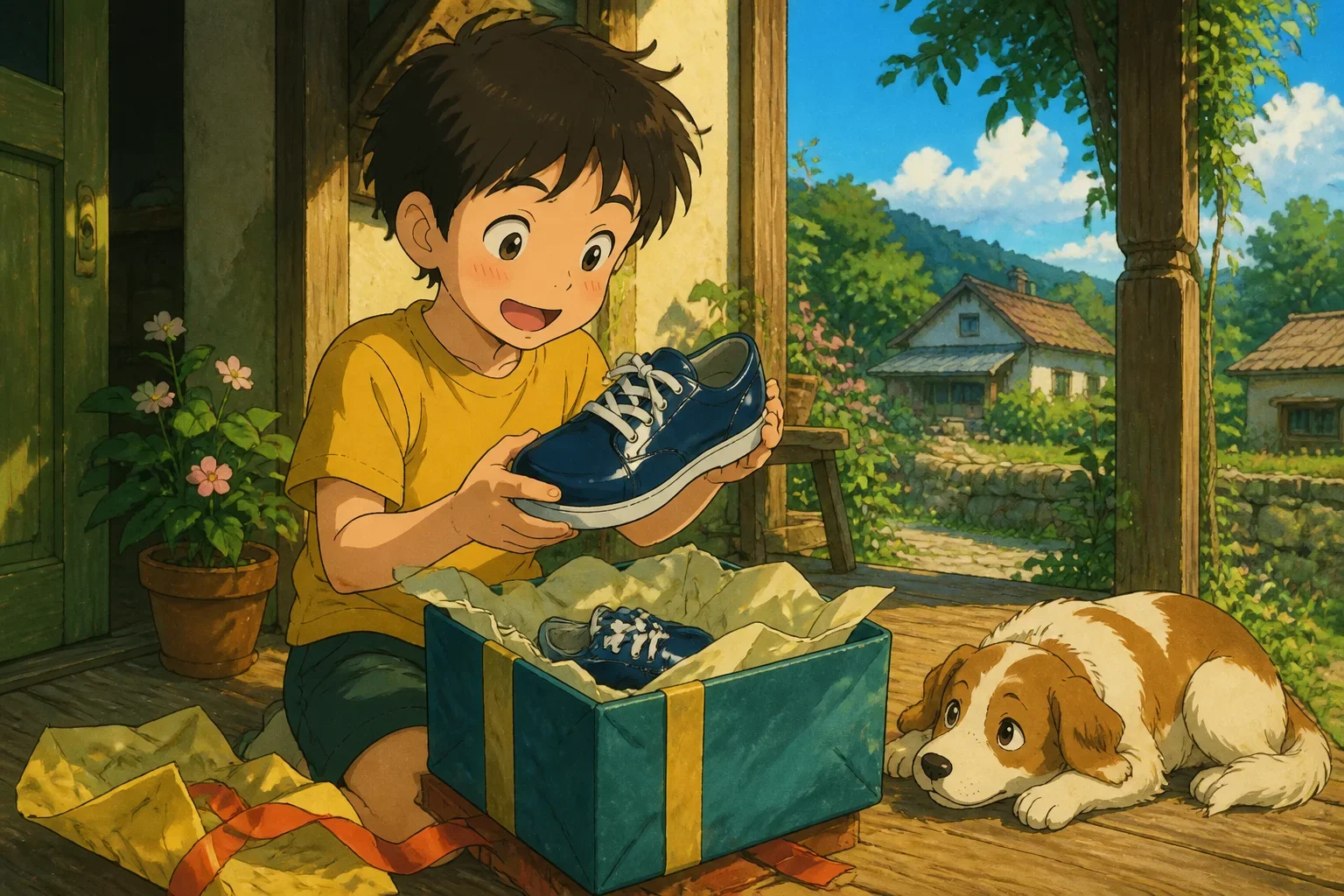
Leo stepped onto the porch.
There, resting in a neat paper box tied with string, was a package just his size.
His heart began to pound.
He knelt down, untied the string with shaking fingers, and lifted the lid.
Inside lay the most beautiful shoes he had ever seen.
They were deep navy blue, smooth and clean, with bright white laces and strong new soles. To Leo, they looked like the kind of shoes that could outrun the wind.
For a moment, he could only stare.
Then he gasped, “They’re mine?”
His mother laughed softly. “Yes, they’re yours.”
Leo grabbed the shoes and hugged them to his chest before throwing his arms around her.
“Thank you! Thank you!” he cried.
He put them on at once and ran across the yard, then back again, then in a circle for no reason except that he could. The shoes fit perfectly. They didn’t flap. They didn’t pinch. They made him feel light and proud and ready for anything.
All day he smiled.
And all day, his parents smiled too.
But theirs were quieter smiles.
The Quiet Truth
In the days before the festival, Leo took great care of his new shoes.
Each evening, he wiped away dust with a cloth. Each morning, he tied the laces carefully. Each time he ran, he felt a thrill of happiness.
Yet little things began to trouble him.
His father came home later than usual, his hands rougher, his shoulders more tired. His mother served simpler meals and said cheerfully, “This is enough,” even when Leo noticed she took less for herself.
One night, the house was dark except for the glow of a small lamp.
Leo had gone to fetch water when he heard his parents talking in low voices.
He stopped in the hallway.
“I can manage,” his father was saying.
“You shouldn’t have had to sell them,” his mother replied softly.
There was a pause.
Then his father said, “He wanted those shoes so badly. I couldn’t bear to see him left out at the festival.”
Leo’s breath caught.
His father continued, “Tools can be replaced someday. Childhood cannot.”
Leo stood frozen.
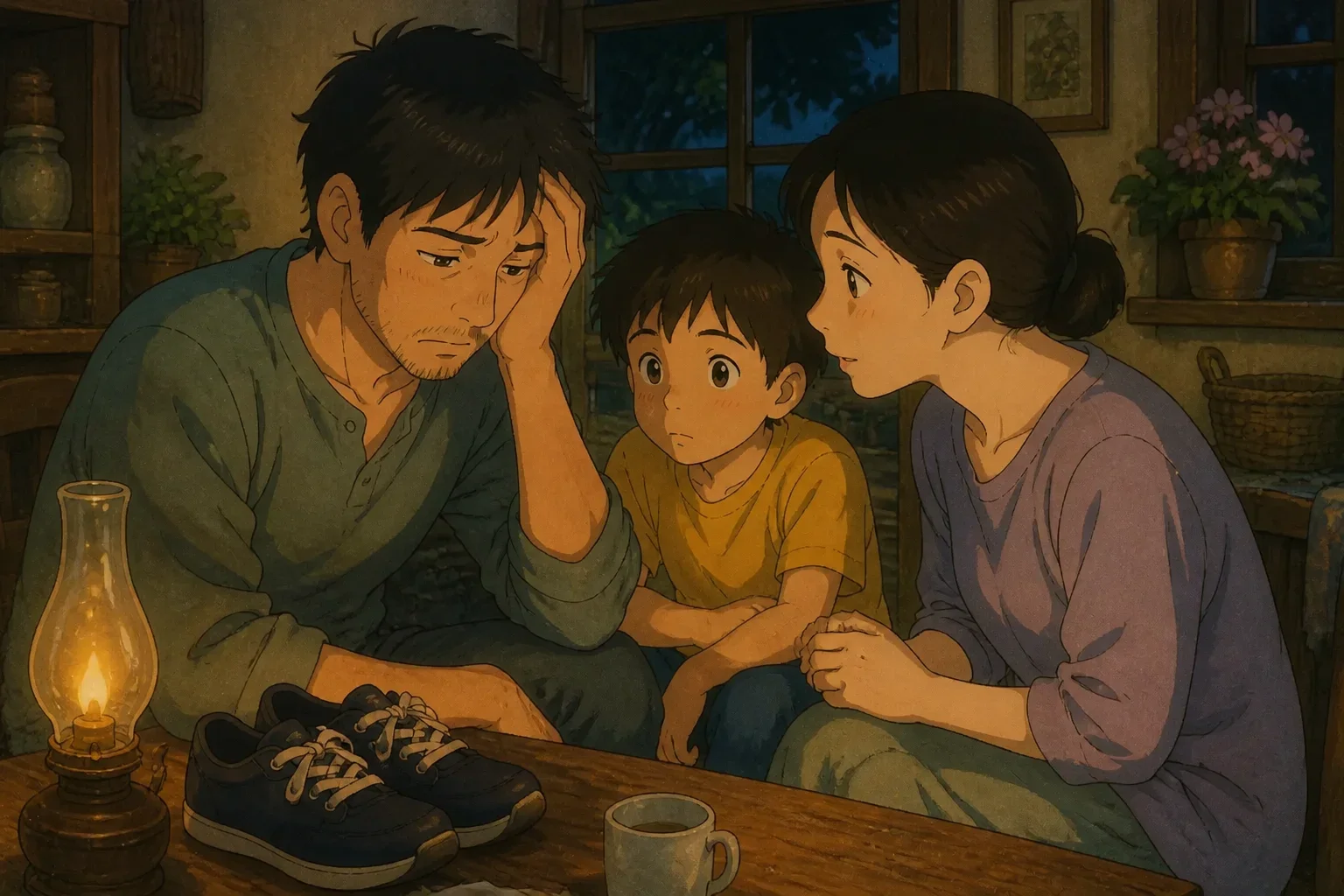
The shoes in his room suddenly felt heavier than stone.
His father had sold his prized tools—the ones he sharpened carefully, the ones he carried every day to the fields, the ones he depended on for work.
All for him.
All for a pair of shoes.
Leo crept back to bed, but sleep would not come.
He stared into the darkness and thought of his father’s cracked hands, his mother’s smaller supper, and the box on the porch that had seemed to appear like magic.
It had not been magic.
It had been love.
And sacrifice.
By morning, Leo was not the same boy who had danced across the yard in delight.
He still loved the shoes.
But now he understood what they had cost.
The Festival Race
Festival day arrived bright and golden.
The village square buzzed with laughter. Banners fluttered overhead. Children skipped between stalls with sticky fingers and shining eyes. Music bounced through the air.
Leo wore his new shoes.
Everyone noticed.
“Nice shoes!” one friend called.
“You’ll fly in those!” said another.
Leo smiled, but this time he did not puff up with pride. Instead, he looked through the crowd until he found his father standing near the fence, clapping for the children, and his mother beside him, her face warm with hope.
When the race was announced, the runners gathered at the starting line.
Leo bent down and touched the toes of his shoes.
He thought of the box. He thought of the whispered voices. He thought of his father’s tools.
The whistle blew.
The children surged forward.
Leo ran fast—faster than he had ever run before.
Dust rose behind him. Wind rushed past his ears. The finish line drew closer and closer.
He could hear people cheering.
“Go, Leo!”
“Run!”
For one shining moment, he was ahead.
Then, just before the line, he turned his head.
He saw his father.
Not the farmer. Not the tired man with worn hands.
Just his father—smiling with pride so full and gentle that it made Leo’s chest ache.
And suddenly Leo understood something bigger than winning.
These shoes were never really about the race.
They were about love.
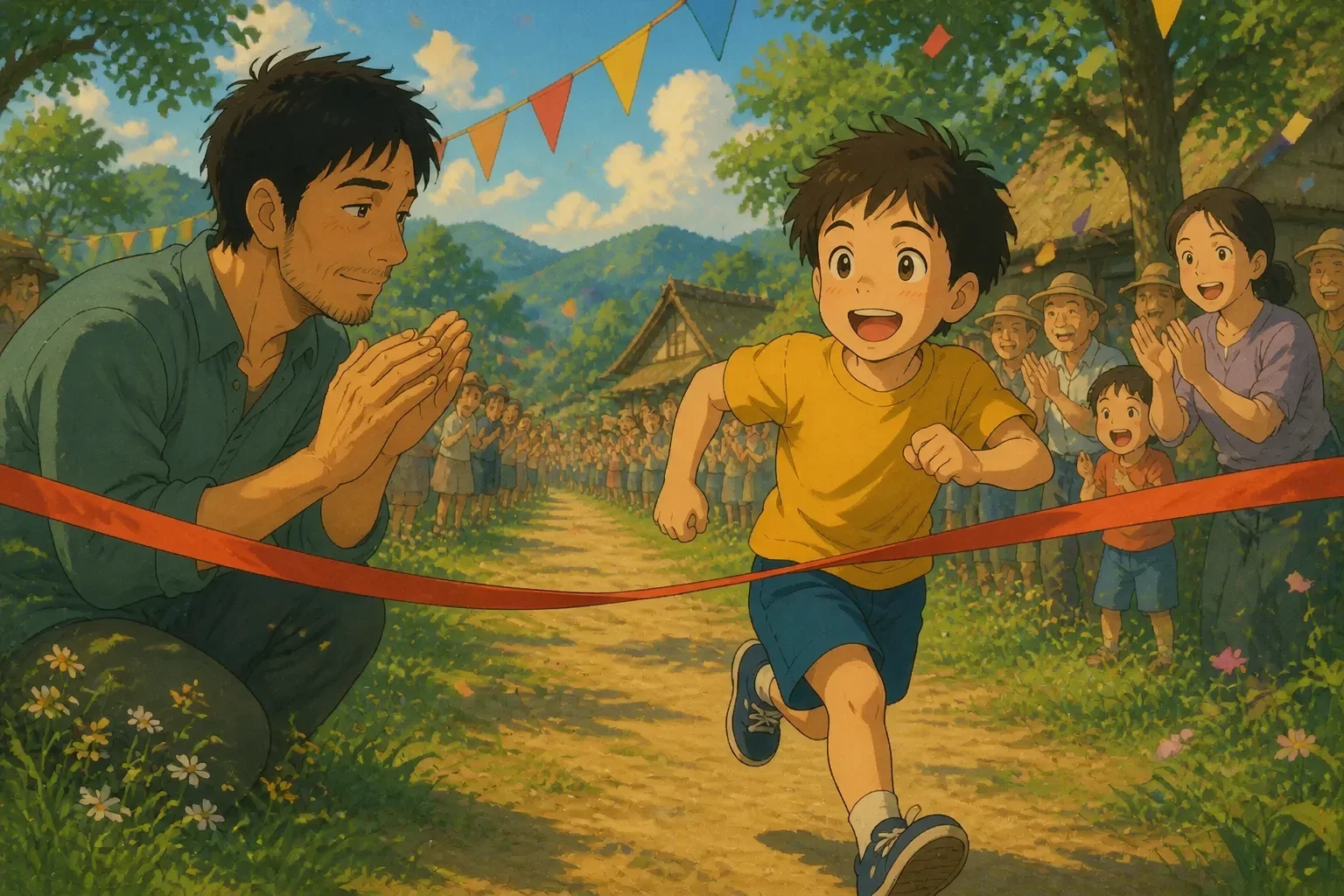
Leo slowed.
One by one, the other children passed him.
He crossed the finish line last.
The crowd gave a surprised murmur, but Leo didn’t care. He spun around and ran straight to his father.
He threw his arms around him so tightly that his father nearly stumbled.
“Dad,” Leo said, his voice shaking, “thank you.”
His father blinked in surprise. “For what?”
Leo looked down at his shoes, then back up with wet eyes.
“For everything.”
His father said nothing at first. He simply knelt and hugged Leo back.
His mother joined them, resting a hand on Leo’s shoulder.
And there, in the middle of music and laughter and festival noise, Leo felt something warmer than victory.
He felt grateful.
What Leo Learned
That night, Leo cleaned his shoes more carefully than ever before.
But now, whenever he looked at them, he did not just see leather and laces.
He saw his father’s sacrifice. He saw his mother’s quiet care. He saw the love that families give without asking for applause.
The shoes were precious to him—not because they were new, but because they were given with love.
And from that day on, Leo tried harder to notice the small things his parents did for him every day.
Because sometimes the greatest love is the kind that speaks the least.
Key Takeaways for Kids
- Be grateful for what you receive. Gifts often come from someone’s hard work and love.
- Family members make sacrifices. Parents and caregivers sometimes give up their own comfort to make children happy.
- Winning is not always the most important thing. Love, kindness, and appreciation matter more.
- Try to notice quiet acts of care. The people who love us often show it in simple, everyday ways.
Moral of the Story
We understand love more deeply when we recognize the sacrifices others make for us.
Watch the Animated Story
Watch on YouTube
Related Stories
Light That Never Left: A Bedtime Story About Love and Hope
The Light That Never Left On the edge of a quiet village, where the hills wore morning mist like soft scarves, there…
The Blue Umbrella Story for Kids About Love, Waiting, and
The Blue Umbrella: A Story of Love, Waiting, and Letting Go On rainy days, Mia always looked for one thing first. Not…
Grandma’s Special Gift: A Bedtime Story About Love and a
Grandma’s Special Gift On winter evenings, when the windows glowed gold against the snow and the kettle hummed on the…
Devoted Sister: A Moral Story About Sibling Love, Sacrifice
The Devoted Sister: A Heartwarming Tale of Love, Sacrifice, and Self-Care At the edge of a quiet village, where the…
Old Wooden Chair: A Gentle Family Story About Love
The Old Wooden Chair On Sunday afternoons, when the sun turned the village lanes honey-gold, Oliver would run up the…
The Forest Spirit’s Gift: A Bedtime Story About Hope
The Forest Spirit’s Gift: A Gentle Story About Hope and Kindness By the end of summer, the village of Eldergrove no…
Tree of Love: A Gentle Story for Kids About Friendship
The Tree of Love: A Gentle Moral Story for Kids About Friendship, Gratitude, and Sacrifice At the edge of a quiet…
The Silent Boy’s Message for His Mother| A Touching Moral
The Silent Boy and the Message in His Pocket In a small village wrapped in green hills and morning birdsong, there…