A Silent Ghibli-Style Story 🌿
The Light That Never Left
On the edge of a quiet village, where the hills wore morning mist like soft scarves, there stood a little cottage with a blue door and a hundred lanterns.
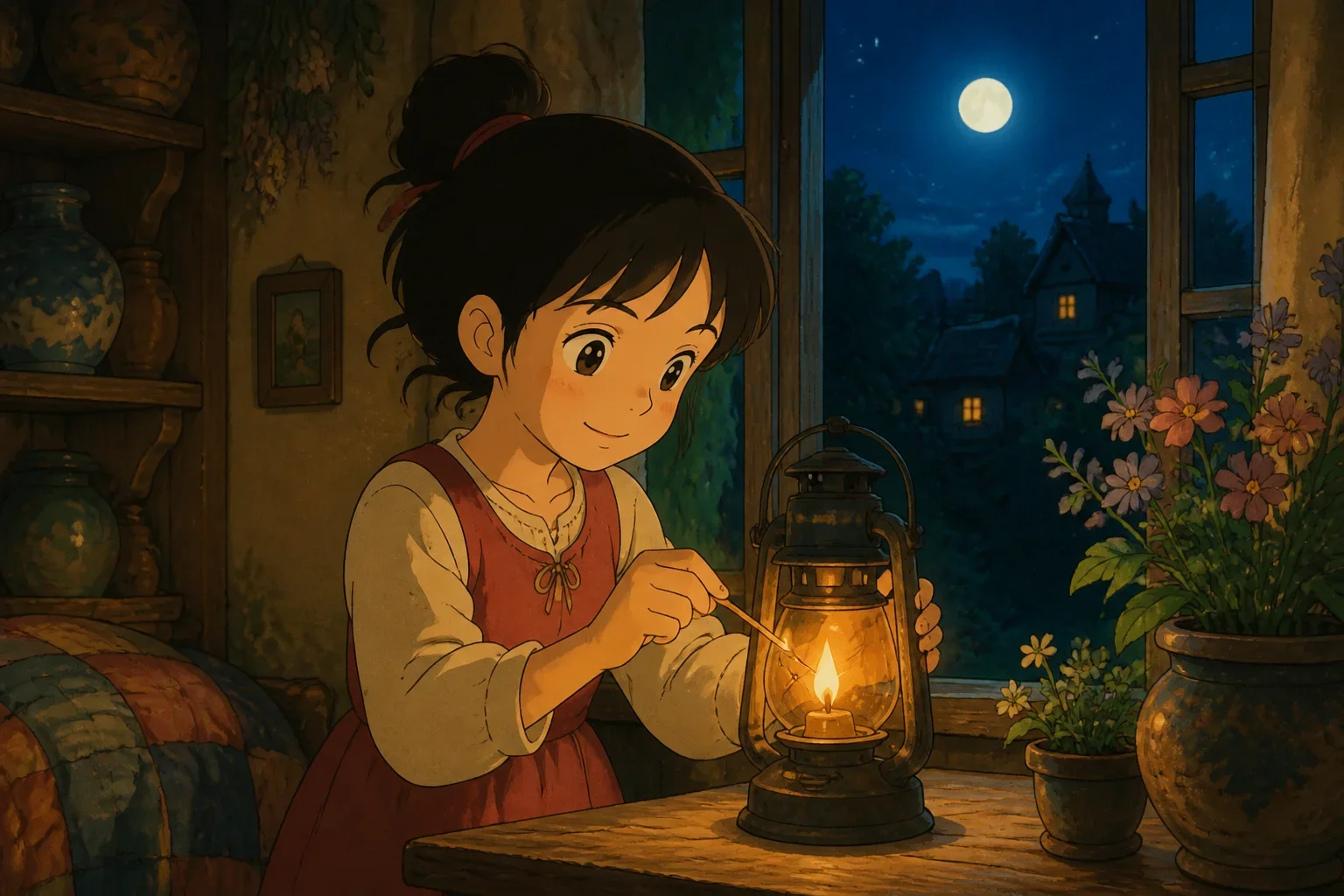
Some lanterns were round as apples. Some were shaped like moons. Some were painted with tiny foxes, ferns, and stars. By day they hung sleeping from wooden beams. By night they woke, one by one, and filled the cottage windows with honey-colored light.
Lila loved them all.
She loved the smell of cedar shavings on the workbench. She loved the click of tiny tools. She loved the way her father tested each lantern by lifting it gently and smiling into its glow, as if light were something alive that needed kindness.
Her father was the village lantern maker. His hands were careful and warm, and even when he said nothing, Lila felt safe beside him.
Each evening, after supper, they sat on the porch steps together. Her father would polish a lantern while the sky turned peach, then violet, then deep blue.
Sometimes he told stories.
Sometimes he pointed to the path winding beyond the trees and said, “A good light does more than help us see. It reminds us we are not alone.”
Lila always listened closely when he said things like that. They sounded simple at first, but they stayed in her heart for a long time.
One afternoon, the wind changed.
The swallows flew low. The trees whispered sharply. Clouds gathered over the mountains in thick gray folds.
Her father wrapped a finished lantern in cloth and tied it with string.
“It must reach the next village before night,” he said gently.
Lila looked at the darkening sky. “Will you be back before the stars come out?”
He bent down and tucked a loose strand of hair behind her ear. Then he placed a small lantern in her hands—plain, round, and warm as bread from the oven.
“This one is for you,” he said. “Keep it by your window. No matter how dark it gets, light remembers the way.”
Lila nodded, though she did not like the sound of the wind.
She stood in the doorway and watched him walk down the path, his cloak lifting in the gusts, the wrapped lantern tucked under one arm. Just before the bend in the road, he turned and waved.
Then the storm came.
Rain rushed across the fields. Thunder rolled over the hills. The windows trembled in their frames. Lila sat by the fire with the little lantern in her lap and waited.
She waited through the evening.
Then through the night.
Then through another day.
The storm passed at last, but her father did not return.
Villagers searched the forest paths and riverbanks. They called his name into the valleys. They carried ropes and blankets and lanterns of their own.
But they came home with wet boots, tired eyes, and quiet voices.
No one said very much after that.
The cottage felt different.
The tools rested where he had left them. Half-finished lanterns stood on the shelves. His cup still hung beside the kettle. Sometimes Lila reached for the door at sunset, expecting to hear his familiar step on the stones.
But the path stayed empty.
At first, her sadness felt too large to carry. It sat beside her at breakfast. It followed her into the garden. It waited for her at bedtime.
One evening, when the house had grown dim and the silence felt especially deep, Lila remembered the lantern he had given her.
She placed it on the windowsill.
Then, with careful hands, she lit the wick.
A small golden flame bloomed inside.
The room changed at once. Not because the sadness disappeared—it did not—but because the darkness no longer filled every corner.
Lila sat beside the lantern and whispered, “Good night, Papa.”
The next evening, she lit it again.
And the next.
Soon it became her ritual.
Every night, she cleaned the glass, trimmed the wick, and set the lantern in the window. Sometimes she spoke aloud.
“I fed the sparrows today.”
“The apricot tree has new blossoms.”
“I tried to fix the latch, but I did it crooked.”
Sometimes she cried while the flame flickered softly.
Sometimes she smiled while remembering the way he used to laugh when flour got on his nose or paint ended up on his sleeve.
As the weeks passed, the villagers began to notice the light in Lila’s window.
An old baker walking home after dusk would pause and look up at it.
A shepherd crossing the hill would spot its glow and feel less lonely.
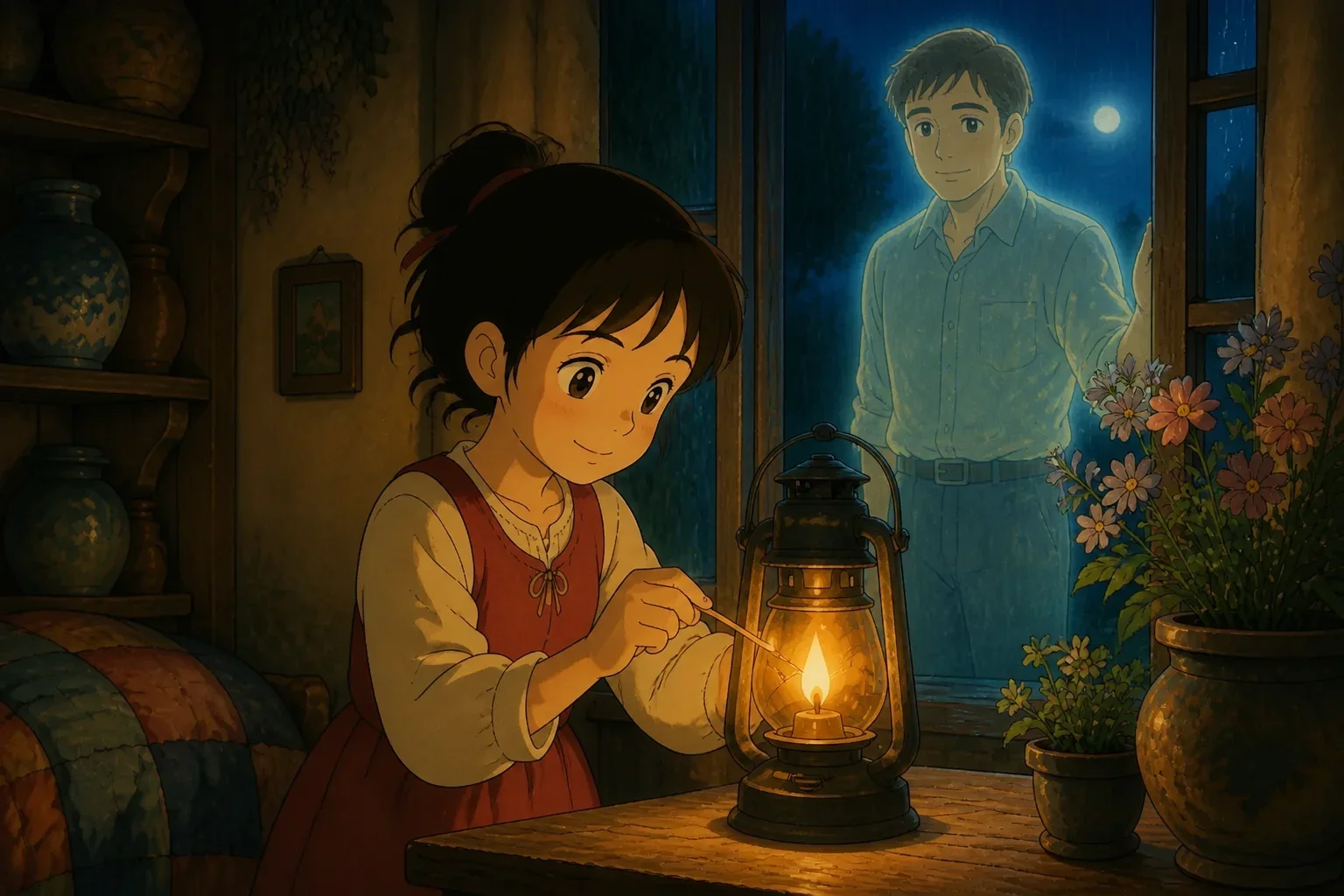
A little boy afraid of the dark once told his mother, “Lila’s lantern is awake. That means everything is all right.”
Lila did not know this at first.
She only knew that lighting the lantern made her feel close to something she could not touch but could still feel—like warmth left in a blanket after someone stands up.
Then, one rainy evening, something unusual happened.
The rain was gentle, not wild like the storm from before. It tapped the roof and slid down the windows in silver lines. Lila had just lit the lantern when the flame suddenly glowed brighter.
Not bigger.
Brighter.
The whole room softened into gold.
Lila stood very still.
The air near the door shimmered, as if moonlight had stepped inside.
And there, in the quiet glow, she saw him.
Her father.
He looked as she remembered him—kind eyes, calm face, familiar hands—but he seemed woven from light, as though the lantern itself had remembered his shape.
Lila’s breath caught. “Papa?”
He smiled, and the room felt warmer.
She ran forward, then stopped, unsure. Tears filled her eyes so quickly she could barely see. “I missed you,” she whispered.
His voice was soft, like wind moving through tall grass.
“I know.”
“I kept the lantern burning,” Lila said, pressing both hands to her chest. “Every night. I didn’t want you to be lost.”
His eyes shone with pride. “My brave girl. I was never lost from your heart.”
A tear slipped down Lila’s cheek. “Will you stay?”
For a moment, he said nothing. The rain kept tapping its gentle rhythm on the roof.
Then he answered with the truth children feel even when they wish for a different one.
“I cannot stay the way I once did.”
Lila lowered her head.
But he continued, “Love does not leave when a person does. It changes its place. It lives in the stories we keep, the kindness we give, the light we pass on.”
Lila looked up.
He nodded toward the lantern in the window. “You thought you were lighting it for me. But you were also lighting it for yourself. And for anyone who needed hope.”
Lila turned and saw the glow stretching across the wet garden, onto the path, through the dark.
She thought of the baker. The shepherd. The little boy.
Her father’s smile deepened. “That is what light does.”
Lila wiped her eyes. “Then I’ll keep it burning.”
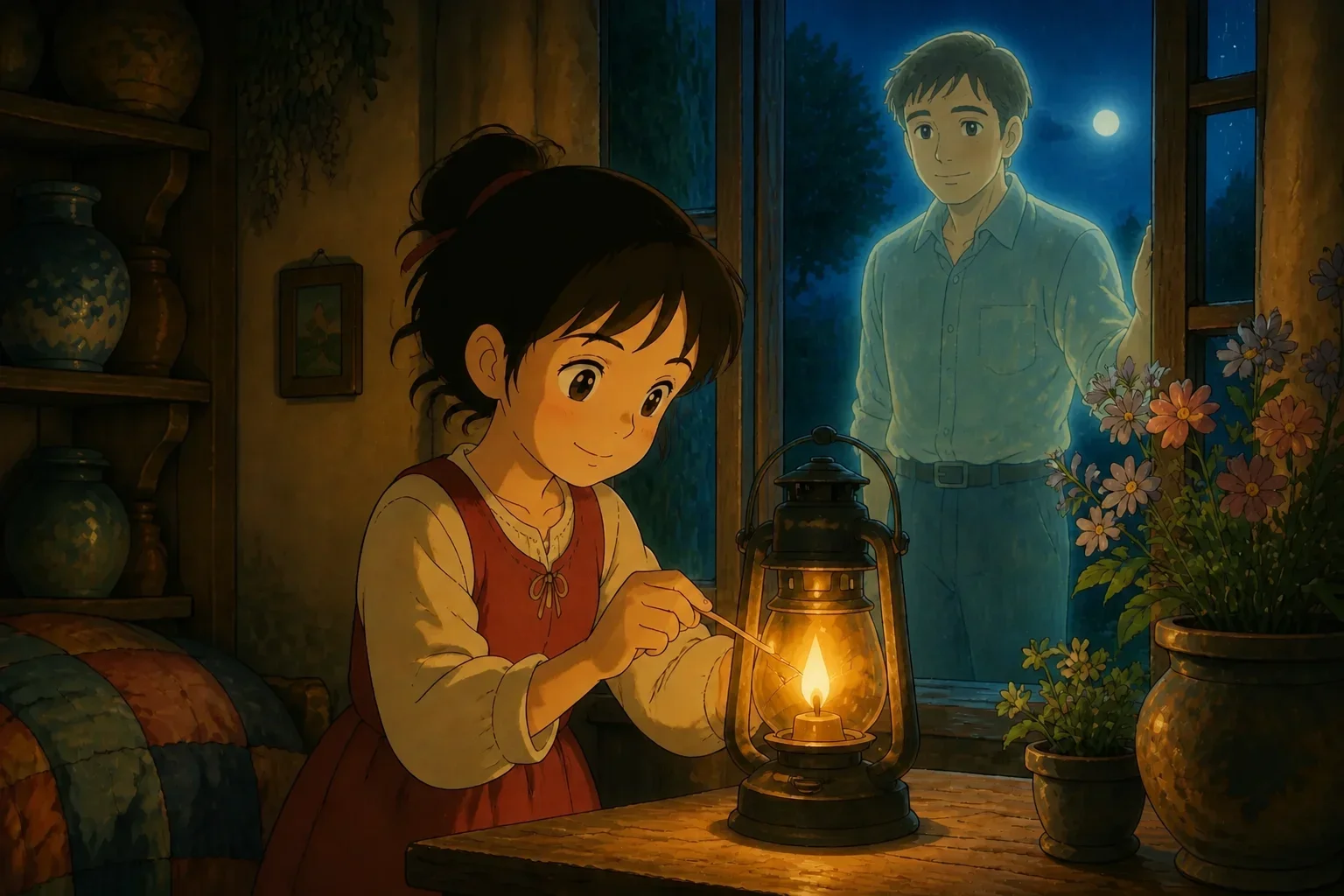
“For as long as you need,” he said.
The lantern gave one soft, steady pulse.
And slowly, gently, like mist lifting from the hills, her father faded.
But this time Lila did not feel the same emptiness as before.
She still missed him. She always would.
Yet beneath the missing was something new and quiet.
Peace.
From that night on, Lila did more than light one lantern.
She learned her father’s craft.
At first her hands were clumsy. Wire bent the wrong way. Paper wrinkled. Paint dripped where it should not. She laughed once when a lantern came out shaped more like a sleepy potato than a moon.
But she kept trying.
She made lanterns for the baker, for the shepherd, for the little boy who feared the dark. She painted them with stars, leaves, rabbits, boats, and bright windows. She listened when people spoke of those they missed. She worked quietly, carefully, kindly—just as her father had.
Before long, the cottage with the blue door glowed again each evening, not with sorrow alone, but with memory shared and hope renewed.
And in the village, people began to say that whenever a lantern was lit with love, its light traveled farther than anyone could see.
As for Lila, she still placed that first little lantern in her window every night.
Not because she was waiting for the past to return.
But because she understood now:
Some lights are too full of love to ever truly go out.
Key Takeaways for Kids
- It is okay to feel sad when you miss someone you love.
- Memories can bring comfort when someone is gone.
- Small acts—like lighting a lantern or sharing a story—can help heal a hurting heart.
- Love can continue through kindness, traditions, and remembering.
Moral of the Story
Love never truly leaves us. Even after loss, it can keep shining in our hearts, our memories, and the kindness we share with others.
Why This Bedtime Story Comforts Children
This gentle moral story for kids speaks about love and loss in a soft, reassuring way. Lila’s lantern becomes a symbol children can understand: even when someone is no longer near, the love they gave can still guide, warm, and comfort us. That makes this a soothing bedtime story for families who want a peaceful tale about hope, remembrance, and family love.
Watch the Animated Story
Watch on YouTube
Related Stories

Boy and New Shoes: A Family Moral Story About Gratitude
The Boy and the New Shoes On the edge of a small sunlit village, where dusty paths curled between little houses and the…

Mia and Ethan Story| A Heartfelt Love and Family Story for
Mia and Ethan Under the Oak Tree In the little town of Havenbrook, the streets were made of old gray stone that clicked…
Grandma’s Special Gift: A Bedtime Story About Love and a
Grandma’s Special Gift On winter evenings, when the windows glowed gold against the snow and the kettle hummed on the…
Power of Love: A Moral Story for Kids About Kindness
The Power of Love In the little town of Harmonyville, people said you could tell how the whole town was feeling just by…

The Mermaid’s True Love Story| A Magical Moral Tale of
The Mermaid’s True Love Story Far beneath the silver-blue sea, where seaweed swayed like ribbons and tiny fish flashed…
Devoted Sister: A Moral Story About Sibling Love, Sacrifice
The Devoted Sister: A Heartwarming Tale of Love, Sacrifice, and Self-Care At the edge of a quiet village, where the…

The Blue Umbrella Story for Kids About Love, Waiting, and
The Blue Umbrella: A Story of Love, Waiting, and Letting Go On rainy days, Mia always looked for one thing first. Not…
Old Wooden Chair: A Gentle Family Story About Love
The Old Wooden Chair On Sunday afternoons, when the sun turned the village lanes honey-gold, Oliver would run up the…