
The Lost Medal
The Lost Medal
On the morning of the city marathon, Noah woke before the sun.
For a moment, he lay still in bed, listening. The town was quiet except for a rooster somewhere far away and the soft rustle of wind at his window. Then he remembered.
Race day.
He sat up so fast that his blanket slid to the floor.
On the chair beside his bed waited his favorite blue running shoes. Their laces were a little frayed, and there was a tiny grass stain on one side that never quite came out, no matter how hard his mother scrubbed. Noah loved them anyway. To him, they were lucky shoes.
He pulled them on, tied the laces tight, and hurried to the kitchen.
His mother smiled as she placed a warm bowl of porridge in front of him. “Big day?” she asked, though she already knew the answer.
Noah grinned. “The biggest.”
He had trained for months—running along dusty paths, racing the breeze through green fields, and practicing even on evenings when his legs felt heavy. He dreamed of only one thing: crossing the finish line first and wearing the gold medal around his neck.
In Noah’s mind, that medal shone brighter than the sun.
The Race Everyone Remembered
By the time Noah reached the town square, it was buzzing with excitement. Bright ribbons fluttered between wooden posts. Families lined the streets. Bakers stood in shop doors dusted with flour, waving at the runners. Little children sat on their parents’ shoulders to get a better view.
At the starting line, Noah bounced on his toes.
Beside him stood runners taller than he was, stronger than he was, and perhaps faster too. For a tiny moment, a nervous flutter stirred in his stomach.
Then he remembered all those afternoons of practice.
He whispered to himself, “One step, then another.”
A whistle pierced the air.
And they were off.
Noah ran past the fountain in the square, past the bakery with the cinnamon smell drifting out the door, past rows of cheering neighbors. His feet tapped the road in a quick steady rhythm.
At first, running felt easy—almost magical. The cool air brushed his cheeks. The world seemed to open in front of him like a long ribbon.
But marathons are not won in the first few minutes.
Soon the road sloped upward. Noah’s breathing grew harder. His legs began to ache. One runner passed him, then another.
For a moment, doubt crept in.
Maybe I’m too tired.
Maybe I can’t do it.
Then, from the crowd, he heard a familiar voice.
“Noah! Keep going!”
It was his mother.
Noah lifted his head. He could see her waving both arms wildly. He almost laughed.
So he kept going.
Step after step.
Past the hill.
Past the bend in the road.
Past the part of himself that wanted to stop.
And when the finish line finally came into view, Noah found one last burst of strength hidden deep inside him.
He ran faster.
Faster.
Faster.
Then—
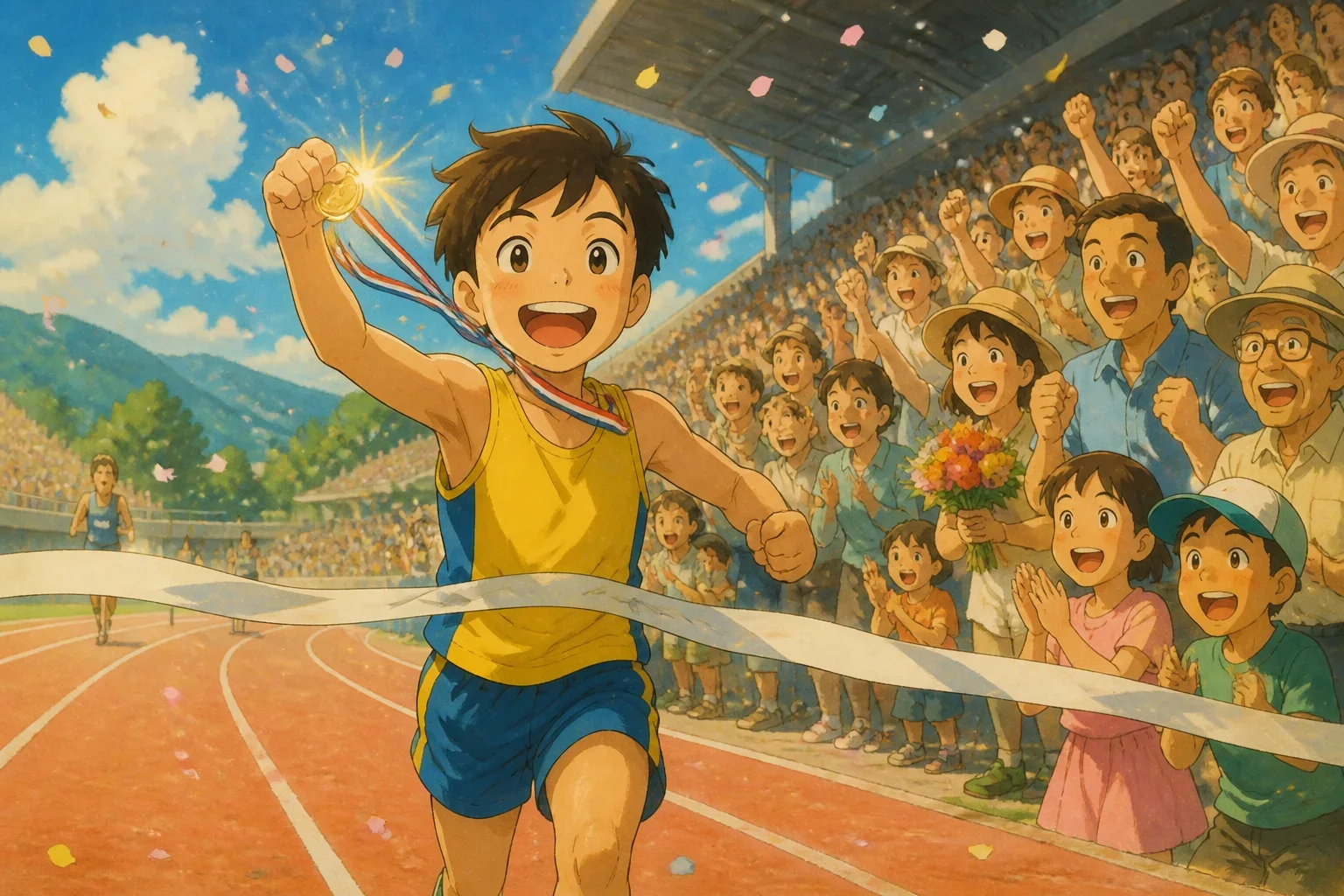
He crossed the line.
First.
The crowd erupted in cheers.
Noah bent over, hands on his knees, chest heaving. He could hardly believe it. He had done it. He had truly done it.
A smiling race official placed a gold medal around his neck. It gleamed in the sunlight, warm and heavy against his shirt.
Noah touched it carefully, almost afraid it might disappear.
“This is it,” he whispered. “My dream.”
The Medal Vanishes
But life has a curious way of surprising us.
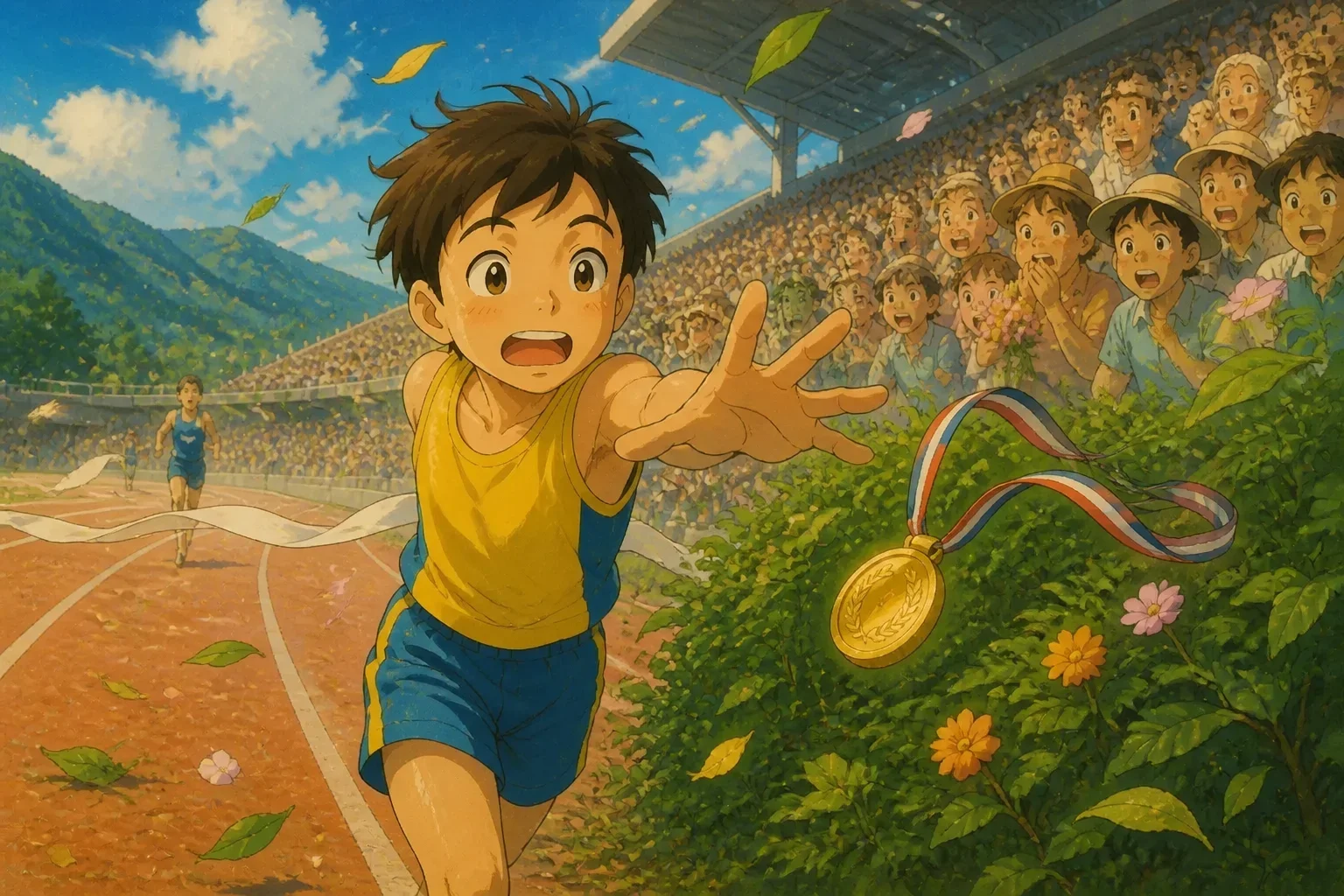
As Noah stood near the field beside the stadium, admiring the medal, a sudden gust of wind rushed through the open space.
The ribbon twisted.
The medal slipped from his fingers.
Before Noah could grab it, it flew sideways, bounced once in the grass, and vanished into a patch of thick bushes.
“No!” Noah cried.
He dropped to his knees and searched frantically. He pushed aside leaves, peered under branches, and crawled through prickly stems that scratched his arms.
His mother came to help. So did two race volunteers. They searched and searched.
But the medal was nowhere to be found.
The cheers from the race still echoed in the distance, yet Noah no longer felt like a winner.
His throat tightened. His eyes stung.
“It’s gone,” he said quietly.
His mother knelt beside him and brushed a leaf from his hair. “You still ran the race,” she said gently.
Noah looked at the empty bushes. At that moment, her words did not help very much.
He had dreamed of the medal for so long.
Now it was gone in a single breath of wind.
What Noah Learned as He Grew
Years passed.
The little boy with the blue shoes grew into a young man with kind eyes and a calm voice. He still loved running, but something in him had changed.
He no longer ran only to win.
Noah became a coach at the community sports field. Every afternoon, children gathered there to practice. Some were quick as rabbits. Some were clumsy and shy. Some gave up the moment things felt difficult.
Noah welcomed every one of them.
When a child stumbled, he helped them up.
When someone came last and looked embarrassed, he said, “Last place is still a finish.”
When tempers flared during practice, he reminded them, “A fast runner with an unkind heart never truly wins.”
The children loved him, not because he had once won a marathon, but because he noticed small things.
He noticed who looked lonely.
He noticed who needed encouragement.
He noticed who had tied their shoes too loosely and might trip.
Sometimes, after practice, the children begged him to tell his famous story.
“The medal story!” they would shout.
So Noah would sit on the old wooden bench, and they would gather around him with grass on their knees and sunlight in their hair.
“I won the biggest race of my life,” he would begin, smiling a little, “and lost the medal before the day was over.”
The children always gasped, even though they had heard it before.
Then Noah would tap his chest and say, “At first I thought I had lost everything. But I hadn’t. The strongest part of victory stayed right here.”
The Discovery Under the Bleachers
One autumn afternoon, Noah took the children to help clean the old stadium before the town’s next marathon.
The place looked smaller than it had in Noah’s childhood memories. The paint on the railings was faded. Dust lay beneath the benches. Dry leaves skittered across the ground.
“Check under the bleachers,” Noah called. “You never know what you’ll find.”
The children scattered eagerly.
A few minutes later, a little girl named Mira gave a sharp cry.
“Coach Noah! Come here!”
Her voice was so excited that everyone came running.
Mira was kneeling in the dust, holding something round and dull beneath a web of cobwebs.
Noah stared.
His heart gave a strange, sudden thump.
Mira rubbed the object with the edge of her sleeve.
A glint of gold shone through.
For a moment, nobody spoke.
Then Noah took a careful breath and crouched beside her.
It was old now, scratched and weathered, but unmistakable.
His medal.
The one the wind had stolen years ago.
The children burst into delighted chatter.
“You found it!”
“It really was real!”
“Now you can keep it forever!”
Noah held the medal in his palm. It felt smaller than he remembered.
So many years he had imagined this moment. He had once believed that finding the medal again would make everything complete.
But as he looked at the children’s bright faces, something else filled his heart—not pride, not triumph, but gratitude.
He thought of every child he had encouraged.
Every race he had watched.
Every trembling beginner he had cheered on.
Every lesson learned after that long-ago loss.
A medal could shine.
But kindness could shine farther.
A Different Kind of Victory
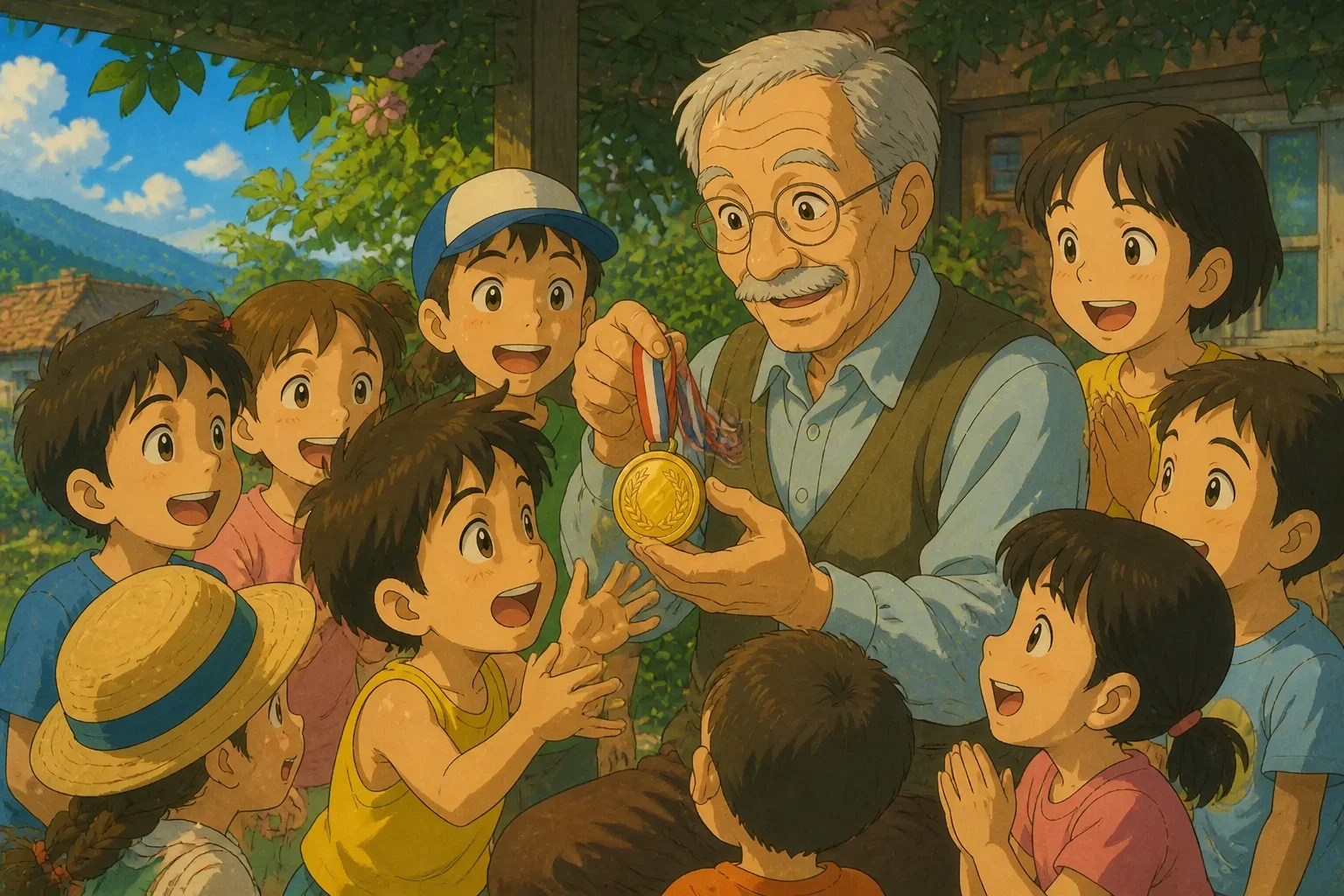
That evening, the children gathered around Noah in the community center.
The medal lay on the table, polished now, its gold surface catching the light from the window.
Mira folded her hands and asked, “Aren’t you happy to have it back?”
Noah smiled. “I am.”
Then he looked around the room at all the children waiting for his answer.
“But not for the reason I expected.”
He picked up the medal and turned it over gently.
“When I was young, I thought this was the most important part of winning,” he said. “I thought the medal proved everything.”
He paused.
“But losing it taught me something I might never have learned otherwise.”
The room grew quiet.
Noah continued, “A medal can remind us of one good day. Kindness can change many days. A race can be over in an hour. But the way we treat people stays with them much longer.”
The children listened closely.
“So what will you do with it?” one boy asked.
Noah looked at the medal one last time, then smiled.
“We’ll place it here in the community center,” he said, “where every child can see it.”
The children blinked in surprise.
“You’re giving it away?” Mira asked.
Noah nodded. “I’m sharing it. That medal belongs to a story now—not just to me.”
Together, they placed the medal in a small glass case near the running track. Beside it, Noah wrote a simple note:
True victory is not in what we keep, but in what we give.
From then on, children would stop and read the note before practice. Some touched the glass for luck. Some asked about the race. Some simply smiled and ran a little kinder than before.
And Noah, watching from the field, knew that the medal had finally found the right place.
Not hidden in bushes.
Not tucked away in a drawer.
But shining where it could inspire others.
Key Takeaways for Kids
- Winning feels wonderful, but kindness matters even more.
- If you lose something important, you may still gain an important lesson.
- Perseverance means keeping going even when things feel hard.
- Sharing your success can inspire other people.
- True champions care about others, not just prizes.
Moral of the Story
The greatest victory is not a medal or a trophy, but the kindness, humility, and encouragement we share with others.
Why This Kindness Story Stays in Children’s Hearts
The Lost Medal is a gentle moral story for kids because it shows that success is not only about coming first. Children understand Noah’s excitement, his disappointment, and his later wisdom. That makes the lesson feel real: the best winners are the ones who lift others up.
If you are looking for children's moral stories, bedtime stories about kindness, or inspiring stories for kids about perseverance and humility, Noah’s journey is a memorable reminder that a good heart shines brighter than gold.
Watch the Animated Story
Watch on YouTube
Related Stories
The Empty Lunch Box | Kindness Story About Sharing
The Empty Lunch Box On the first Monday of the school year, Maplewood Elementary smelled like sharpened pencils,…
Broken Trophy: A Moral Story About Mistakes, Forgiveness
The Broken Trophy On a polished wooden stand in Maplewood School’s front hall stood the trophy everyone noticed. It was…
Old Wooden Chair: A Gentle Family Story About Love
The Old Wooden Chair On Sunday afternoons, when the sun turned the village lanes honey-gold, Oliver would run up the…
Honest Woodcutter and the Magic Basket | Moral Story on Kindness
The Honest Woodcutter and the Magic Basket On the edge of Willow Creek, where the river flashed like silver ribbons and…
The Honest Widow and the Lost Treasure Story| A Moral Tale
The Honest Widow and the Lost Treasure On the edge of a small village, where willow trees leaned over a silver river…
Power of Small Deeds: A Kindness Story for Kids About How Good Deeds Grow
The Power of Small Deeds: A Gentle Kindness Story for Kids In a little town tucked between green hills and a…
The Fox and the Umbrella: A Gentle Kindness Story for Kids
The Fox and the Umbrella The rain began with a whisper. It tapped softly on fern leaves, slid down pine needles, and…
Old Clockmaker and the Broken Toy | Kindness Moral Story
The Old Clockmaker and the Broken Toy At the very end of a cobbled lane, where ivy climbed stone walls and sparrows…
The Bakery Kitten | Moral Story of Kindness and Courage
The Bakery Kitten: A Short Moral Story about Kindness and Courage Before the sun rose over the village, the bakery…
The Baker’s Kindness: A Gentle Story for Kids About Sharing
The Baker’s Kindness: A Short Moral Story About Sharing Before the village roosters crowed, before windows glowed, and…