The Broken Trophy - An Emotional Moral Story @shortmoraltales
The Broken Trophy
On a polished wooden stand in Maplewood School’s front hall stood the trophy everyone noticed.
It was tall and shining, with two curved handles and a gold basketball player frozen in mid-shot at the top. Every morning, sunlight from the high windows touched it first, making it sparkle so brightly that younger children sometimes slowed down just to stare.
To the students, it was more than metal and glass.
It meant effort. It meant teamwork. It meant the years their school had practiced, lost, tried again, and finally won.
And to Ethan, it meant something else too.
Someday, he thought, I want to earn something people are proud of.
Ethan was lively, quick, and full of ideas. He could turn a walk to class into an adventure and a quiet afternoon into a game. His friends liked being around him because he made ordinary moments feel exciting.
But sometimes Ethan loved excitement so much that he forgot to stop and think.
That was how the trouble began.
A Game That Should Not Have Happened
One rainy afternoon, recess was moved indoors. The sky outside was gray, and the windows were dotted with raindrops that raced each other down the glass.
Inside the classroom, everyone felt restless.
“Let’s just shoot a few baskets,” whispered Noah, holding a soft practice ball.
“There’s no basket in here,” said Mia.
Ethan grinned and pointed to the paper recycling bin near the bookshelves. “There is now.”
A few kids laughed.
“We’re not supposed to,” Mia warned, though she was smiling a little.
“Only for a minute,” Ethan said. “We’ll be careful.”
That sentence—we’ll be careful—is often said right before someone is not careful at all.
At first, the game seemed harmless. The ball bounced softly on the floor. Chairs were pushed back. Children giggled as they took turns aiming for the bin.
Then the game got faster.
Ethan dribbled between desks, pretending the classroom was a championship court. “Three seconds left!” he whispered dramatically.
“Pass it!” Noah said.
But Ethan was already in the moment, hearing cheers in his imagination.
He jumped. He twisted. He threw.
The ball missed the bin completely.
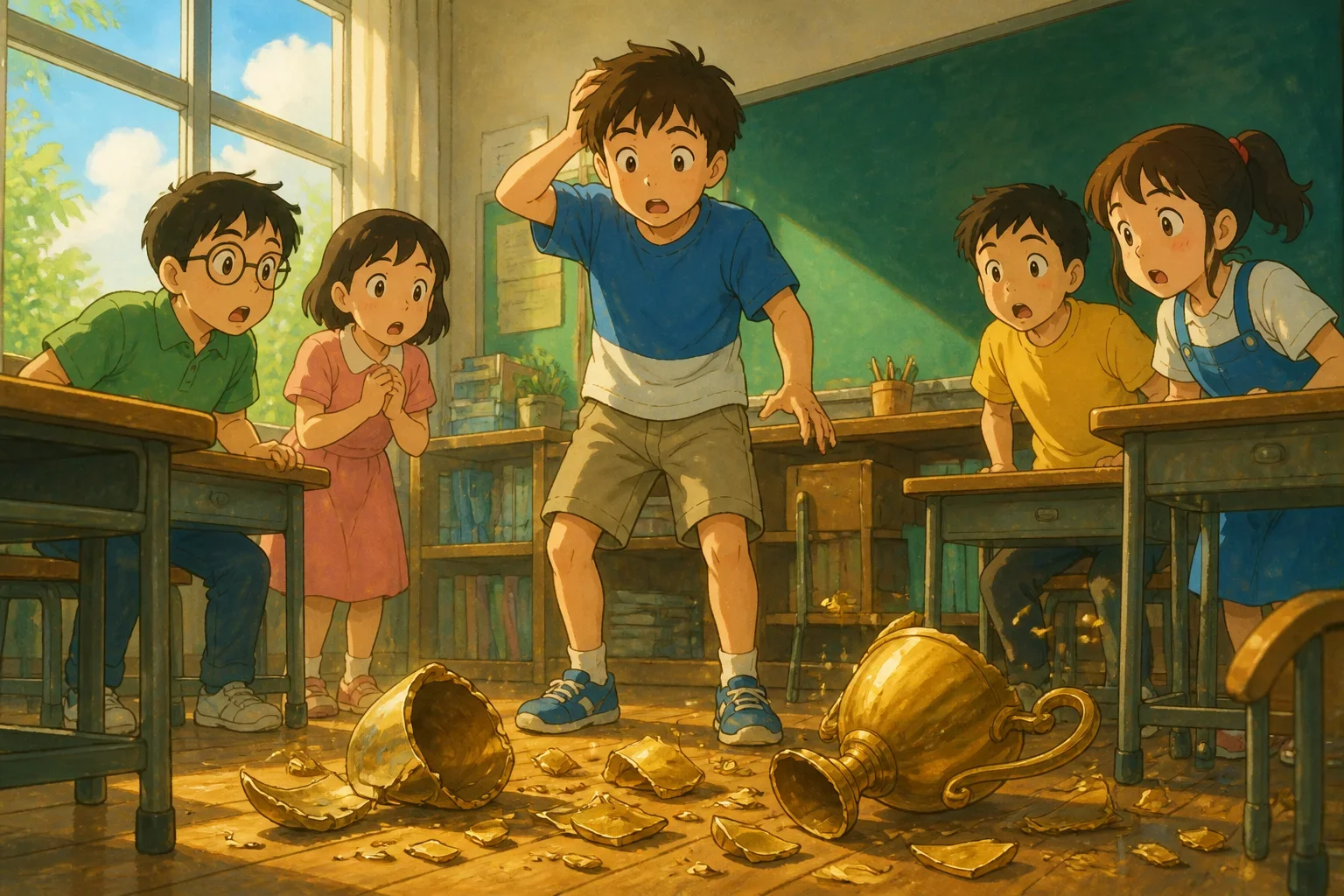
It sailed past the shelf, struck the edge of the display pedestal in the hall just outside the open classroom door, and hit the trophy.
For one tiny second, the trophy wobbled.
Everyone froze.
Then it tipped.
It fell in terrible slow motion.
And shattered.
The crash rang through the hallway like a bell.
Gold pieces, glass, and splinters of wood scattered across the floor, glittering under the lights like a broken star.
No one moved. No one laughed.
Ethan’s stomach dropped so suddenly it felt as if the floor had disappeared.
The Silence After the Crash
“It broke,” Noah whispered, though everyone could see that.
Mia covered her mouth.
Footsteps hurried down the hall.
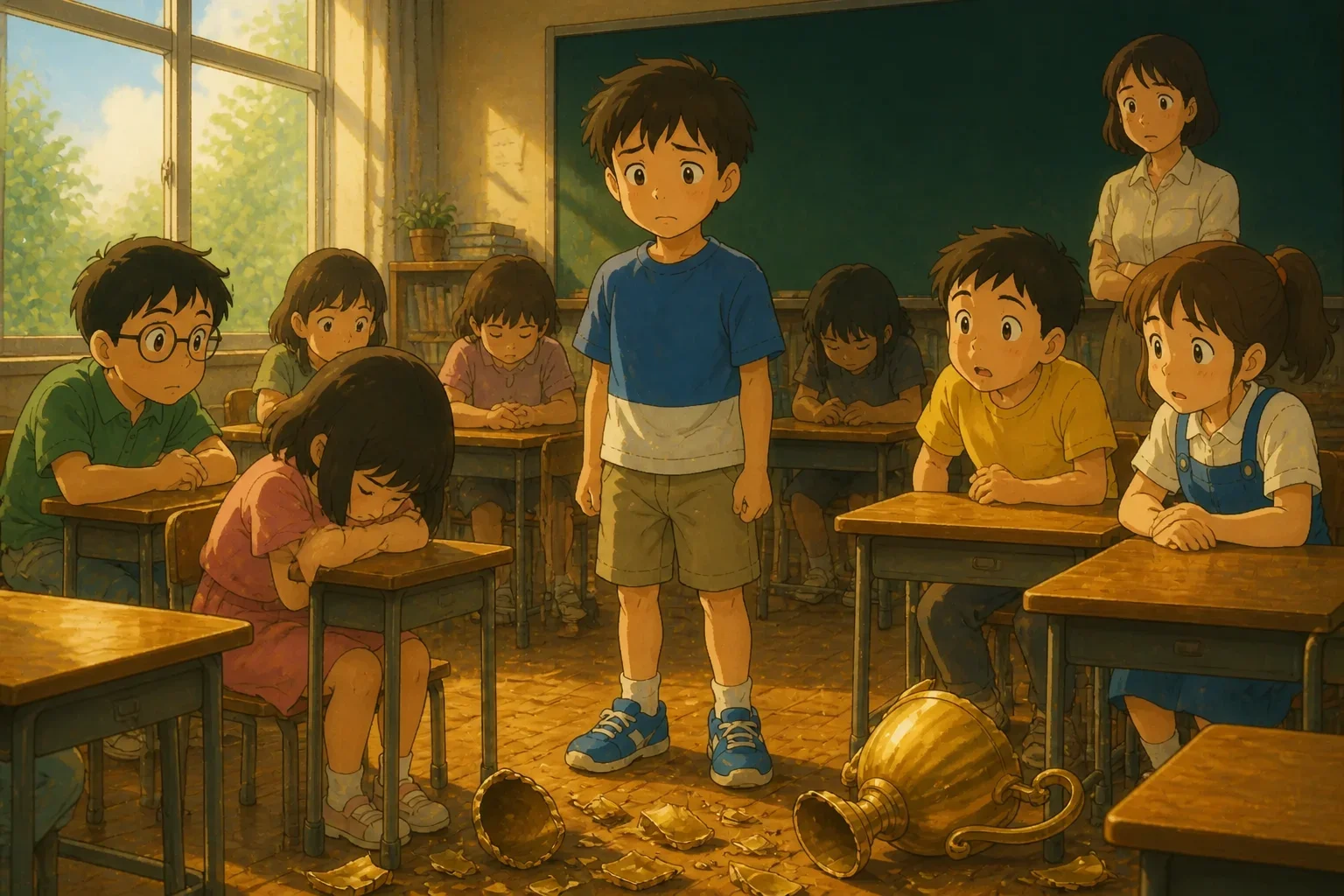
Their teacher, Mrs. Carter, appeared first. Then the principal, Mrs. Bell, came from the office with a face so serious that Ethan could hardly breathe.
“What happened here?” she asked.
The room stayed silent.
Ethan could feel every heartbeat. His cheeks burned. He wanted, more than anything, to disappear behind the coat hooks or melt into the floor.
He could have said nothing. He could have hoped no one would blame him. He could have let the silence carry the truth away.
But the broken trophy lay there between everyone like a question that would not go away.
Ethan swallowed hard.
“I did it,” he said, his voice small. “We were playing in class. I took the shot. I’m sorry.”
Mrs. Carter looked disappointed. Not angry in a loud way—worse than that. Quietly disappointed.
Mrs. Bell nodded once. “Thank you for telling the truth, Ethan.”
But even truthful words did not make the pieces whole again.
By the end of the day, whispers followed him through the halls.
“He broke the trophy.” “That was the school trophy!” “Why would they play inside?”
At lunch, Ethan poked at his food without eating. The cafeteria felt louder than ever, even though no one at his table was speaking.
That evening at home, he sat on the front steps while the rainwater dripped from the roof in slow taps.
His father came and sat beside him.
“You look like you’re carrying a mountain,” he said gently.
Ethan stared at his shoes. “I broke the school trophy.”
His father did not interrupt.
“I said sorry,” Ethan continued, “but it still feels awful. Everyone thinks I’m the kid who ruined it.”
His father was quiet for a moment. Then he said, “A mistake can break trust very quickly. But trust can be rebuilt—piece by piece—if you are brave enough to keep doing what is right after the mistake.”
Ethan blinked. “What if people stay mad?”
“Some might for a while,” his father said. “You cannot control that. What you can control is the kind of person you choose to be next.”
Those words stayed with Ethan.
Doing More Than Saying Sorry
The next morning, Ethan stood in front of his class.
His hands trembled, and his voice almost did too.
“I’m really sorry,” he said. “I knew we weren’t supposed to play in the classroom, and I did it anyway. Breaking the trophy was my fault. I wish I could undo it, but I can’t. I just want to say I’m sorry.”
The room was still.
A few children looked down. A few looked stern. Mia gave him a small, sad nod.
An apology was important, but Ethan soon learned something even more important:
Saying sorry is the beginning. Not the ending.
So he began helping.
He stayed after school to stack library books and wipe tables in the art room. He helped the custodian carry supplies. He organized sports equipment in the gym so younger students could find what they needed. When the kindergarten class painted posters for Field Day, Ethan tied tiny aprons, rinsed brushes, and cleaned bright puddles of paint from the sink.
He did not do these things to be praised. He did them because he wanted his actions to say what words alone could not.
At first, some students were suspicious.
“He’s just trying to make everyone forget,” one boy muttered.
Ethan heard it, and it stung. But he kept helping.
Week after week, he kept showing up.
One afternoon, Mrs. Bell found him sweeping leaves from the school garden path.
“You’ve been working very hard,” she said.
Ethan leaned on the broom. “I know I can’t fix the trophy.”
“No,” she said kindly. “But you are fixing something else.”
He looked up.
“Character,” she said.
A Different Kind of Winning
As the months passed, the whispers faded.
Children stopped seeing only the accident. They began seeing Ethan again.
The boy who helped carry heavy boxes. The boy who stayed behind to put away balls after practice. The boy who admitted when he was wrong.
One spring day, Maplewood School held a clean-up fair. Families planted flowers, painted benches, and repaired old play equipment. Ethan worked from morning until sunset, his hands muddy and his shirt streaked with green paint.
When a little boy struggled to carry a bag of soil, Ethan knelt and said, “Let’s do it together.”
Mrs. Carter saw that. So did many others.
Later that day, Mia walked over while Ethan was lining up flowerpots.
“You’ve really changed,” she said.
Ethan looked embarrassed. “I’m trying.”
Mia smiled. “I know.”
It was a small moment, but to Ethan it felt enormous.
Because forgiveness often does not arrive all at once. Sometimes it arrives softly, in small signs: A smile. A nod. A place saved for you at lunch. A voice that trusts you again.
Years Later
Time moved on, as it always does.
Ethan grew older.
He never forgot the sound of the trophy shattering, but he also never forgot what came after it—the apology, the work, the patience, the rebuilding.
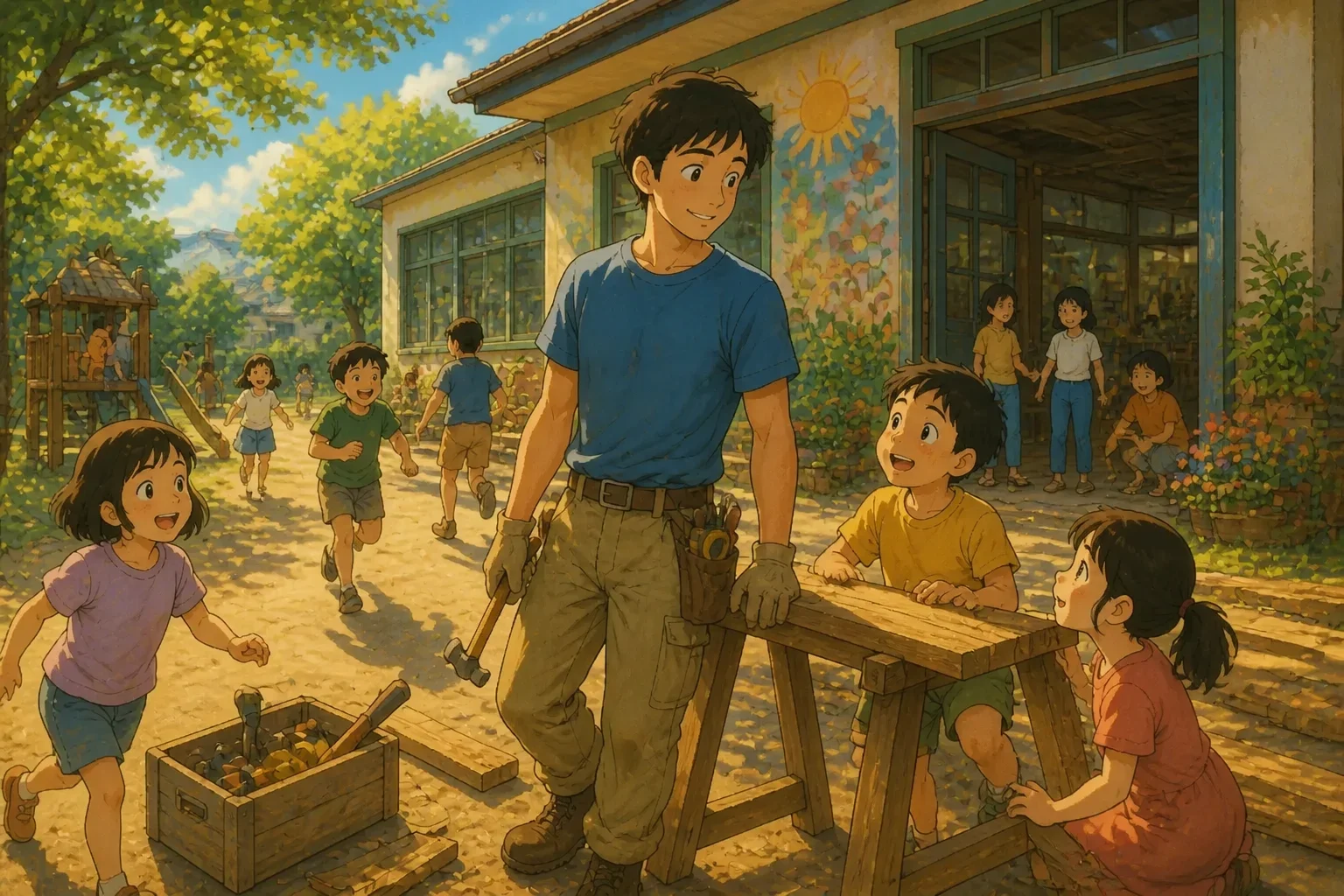
As an adult, he returned to Maplewood with an idea.
The town had many children, but not many safe places for them to gather after school. Some needed a quiet room to read. Some wanted a place to play basketball when it rained. Some simply needed somewhere warm and welcoming to belong.
So Ethan worked with neighbors, teachers, parents, and old friends to create a community center for children.
It had bright windows, shelves of books, a small indoor court, art tables, and walls painted with trees, stars, and flying kites. There was laughter in the hallways and the squeak of sneakers on polished floors. There were chess games in one corner and crayons rolling across tables in another.
Above the entrance hung a simple sign:
Maplewood Children’s Center
On opening day, the whole town came.
Mrs. Bell was older now, but still carried the same calm warmth in her eyes. Mrs. Carter stood beside former students who were now grown. Children ran in and out of the doorway, eager to explore.
Ethan stood at the front, looking at the crowd. For a moment he remembered being a frightened boy in a hallway full of broken pieces.
Then he took a breath and spoke.
“When I was young,” he said, “I made a mistake I thought everyone would remember forever. And maybe some people did remember it. But what mattered most was what happened after. People gave me the chance to learn, to help, and to become better. This place is my way of passing that chance on.”
The crowd grew quiet.
“Mistakes are real,” Ethan continued. “They can hurt people. But one mistake does not have to be the end of someone’s story. With honesty, effort, and kindness, a person can grow into something stronger than before.”
For a second, no one spoke.
Then the applause came—full, warm, and proud.
Mrs. Bell wiped her eyes. Mia cheered loudly from the second row. And somewhere nearby, a basketball bounced on the new indoor court.
Ethan smiled when he heard it.
This time, it sounded like hope.
Key Takeaways for Kids
- Everyone makes mistakes. Even big mistakes can become chances to learn.
- Telling the truth matters. Honesty is hard sometimes, but it is the first step toward making things right.
- Saying sorry is important, but actions matter too. Real change is shown by what we do afterward.
- Forgiveness can take time. Trust is rebuilt little by little.
- A mistake does not define your whole life. Good choices after a bad moment can shape a better future.
Why This Moral Story Connects With Kids
Children understand the sinking feeling of doing something wrong and wishing they could undo it. That is what makes The Broken Trophy such a meaningful moral story for kids: it shows that guilt can lead to growth, and that second chances are earned through honesty, responsibility, and kindness.
This is also a comforting bedtime story for children who worry about mistakes, school trouble, or disappointing others. It reminds them that while wrong choices have consequences, they are still capable of becoming better.
Moral of the Story
A single mistake does not define your future—what you choose to do afterward does.
Watch the Animated Story
Watch on YouTube
Related Stories
Empty Lunch Box: A Kindness Story for Kids About Sharing and
The Empty Lunch Box On the first Monday of the school year, Maplewood Elementary smelled like sharpened pencils,…

Lost Medal: A Heartwarming Kindness Story for Kids
The Lost Medal On the morning of the city marathon, Noah woke before the sun. For a moment, he lay still in bed,…
Old Wooden Chair: A Gentle Family Story About Love
The Old Wooden Chair On Sunday afternoons, when the sun turned the village lanes honey-gold, Oliver would run up the…
The Honest Woodcutter and the Magic Basket: A Heartwarming
The Honest Woodcutter and the Magic Basket On the edge of Willow Creek, where the river flashed like silver ribbons and…
The Power of Forgiveness: A Short Moral Story for Kids
The Power of Forgiveness In a quiet village tucked between green hills and a silver stream, everyone knew James. He was…
Devoted Sister: A Moral Story About Sibling Love, Sacrifice
The Devoted Sister: A Heartwarming Tale of Love, Sacrifice, and Self-Care At the edge of a quiet village, where the…
The Honest Widow and the Lost Treasure Story| A Moral Tale
The Honest Widow and the Lost Treasure On the edge of a small village, where willow trees leaned over a silver river…
Stone That Kept Rolling: A Patience and Consistency Story
The Stone That Kept Rolling Every afternoon, when the village shadows grew long and the swallows dipped through the…
The Silent Boy’s Message for His Mother| A Touching Moral
The Silent Boy and the Message in His Pocket In a small village wrapped in green hills and morning birdsong, there…
Jack and the Lost Coins: An Honest Bedtime Story for Kids
Jack and the Lost Coins On the edge of a quiet village, where white geese waddled across dusty lanes and sunflowers…