
The Power of Positive Thinking
The Power of Positive Thinking
Until late that night, everything in Sukhpur seemed fine. The village pond shimmered under the moon, a flute played softly in the distance, and the last coals of hearth fires glowed in courtyards. Then the sky changed. Clouds thundered as if mountains were cracking. Wind bent the trees, and rain swallowed the village whole.

By morning Sukhpur barely looked like itself. Lanes were thick with mud, rooftops had blown away, broken branches blocked the paths, and the pond had spilled beyond its banks. Laughter had vanished. Worry sat on every face.
Sukhpur was a warm little village where people knew one another by heart. In that village lived Sita—quick-eyed, thoughtful, and kind. She was brave, yet fear touched her too. The difference was this: fear never made her drop hope.
Her dearest guide was Grandma Dadi, with white hair, laughter tucked in her wrinkles, and a voice as calm as neem shade in summer. Dadi often said,
"No matter how thick the dark, one small lamp can show the way. Positive thinking is that lamp."
On the day after the storm, Sita stood in the doorway watching the damage. Her mother cried out,
"What will we do? The grain is wet, the yard is broken—"
Her father said heavily,
"The loss is huge. Repairing all of this won't be easy."
Fear prickled Sita's skin too, yet Dadi's words returned: Be the lamp. Don't count the dark.
She spoke gently,
"Mother, Father… if we give up now, everything will feel impossible. But if we take small steps together, we will see a path. Let's begin with the homes that were hurt the worst."
Her mother stared as if seeing a new strength in her daughter.
Sita visited Dadi's home. The little garden was flooded; holy basil leaves dripped with rain. Dadi sat on the threshold.
"What is it, child? Your eyes are carrying a storm of their own."
Sita told her everything—broken houses, frightened neighbors, her parents' despair.
Dadi took her hand.
"Sita, positive thinking doesn't mean pretending the storm never came. It means the storm came, yet we refuse to break. We think, we plan, and we walk forward together."
"But Dadi," Sita asked, "if everyone is scared, how do they find courage?"
"Courage spreads, dear. One hopeful heart can light many frightened ones."
Sita hurried home with renewed purpose and told her parents,
"We are not alone. The whole village faces this. If we help others, our own work will become lighter. Let's start with the families who need us most."
Her father asked,
"And our own tasks?"
"When the village stands together, our work goes faster too. If we only stare at the damage, our hearts grow heavy. If we begin, hope returns."
He nodded. Her mother tied her scarf and said,
"Then let's begin."
When Hope Woke the Village
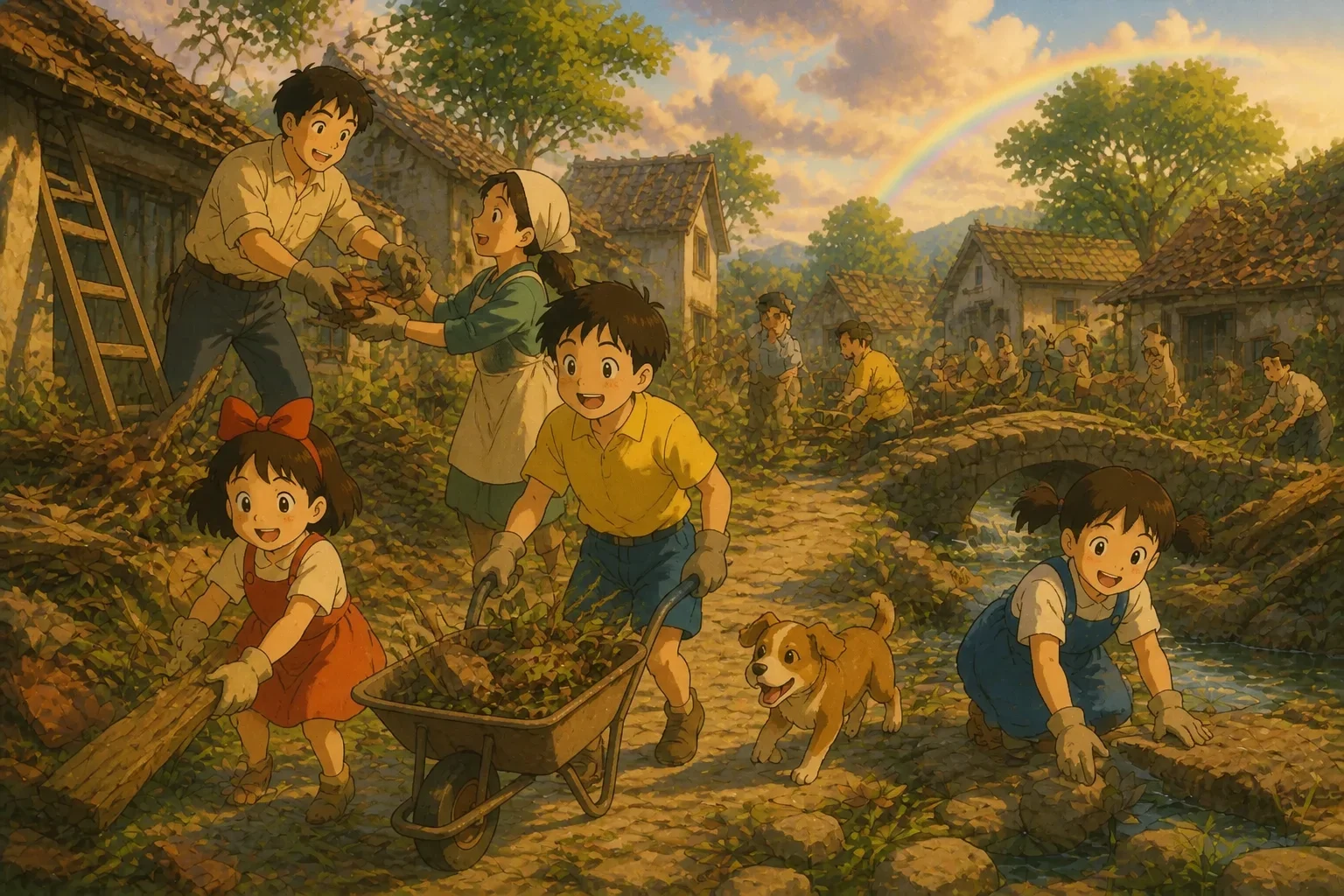
Soon Sita stood at the village square with her parents. People had gathered, yet no one knew where to start. Some stared at ruined roofs, some at soaked belongings, some only at the gray sky.
Sita stepped forward. Her voice was not loud, but clear.
"If we divide the work, much can be mended today. Some can clear paths, some can drain water, some can build dry spaces for elders and children."
Ramu uncle said, "The girl speaks sense."
Another woman agreed, "Let's handle the most urgent needs first."
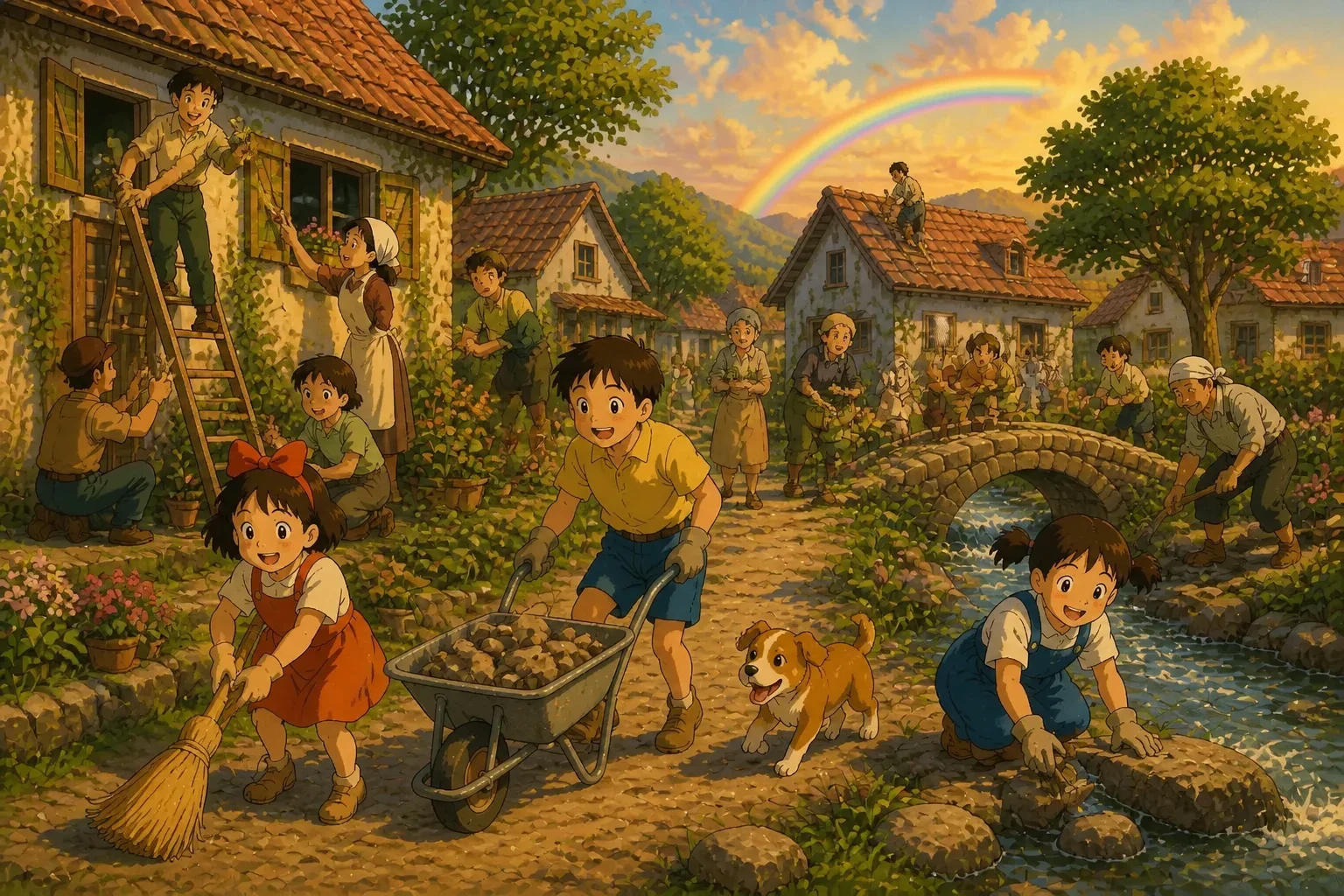
The silence broke. Someone brought a shovel, another a rope, another dry wood. Women cooked so workers could eat. Older boys cleared fallen branches. Small children carried cups and bowls with tiny, earnest hands.
Sita darted everywhere—comforting a crying child, fetching a mat for an elderly neighbor, calling,
"Slowly, steadily—we will finish!"
Her worried mother now worked beside other women, drying grain. Her tired father teamed with neighbors to brace a broken roof with fresh bamboo.
Warmth spread through Sita. Dadi was right, she thought. Hope really does travel.
A Small Shift, a Strong Village
The day passed in labor. By evening Sukhpur was not fully repaired, yet it no longer looked defeated. Paths were clearer, the worst houses had temporary shelter, children had dry places to sit, and—most important—conversation had returned.
At the pond's edge, Sita watched sunset paint the water gold. The same pond had frightened her that morning. Now it rested quietly.
Dadi approached and smiled at the working village, then at Sita.
"You see, child? The storm was large, but your spirit grew larger."
Sita answered humbly, "I only remembered your words, Dadi."
"Remembering is hard work too," Dadi said. "Those who hold the right thought in hard times are the bravest among us."
That night hearths burned again. People were tired, many tasks remained, but despair had left. They trusted tomorrow could improve.
Before sleep Sita asked her mother,
"Are you still afraid?"
Her mother kissed her forehead.
"A little, my girl. But now courage sits beside the fear—and you reminded us of that."
Outside, frogs sang, and the air smelled of sweet wet soil. The storm was gone. What remained, shining quietly, was hope.
Key Takeaways for Kids
- Positive thinking means searching for solutions, not ignoring problems.
- Feeling afraid is natural; giving up because of fear is not.
- Helping others often makes our own troubles feel lighter.
- One child's good attitude can inspire a family and a whole village.
- Working together can soften even the heaviest hardship.
Moral of the Story
With positive thinking, patience, and unity, we can face even the hardest times. A hopeful mind strengthens itself—and lights the way for others.
Why Kids Enjoy This Story
It blends real fear with real courage, offers a grandmother's gentle wisdom, and shows how a young girl's steady heart can move an entire community—an inspirational moral story families can read again at bedtime.

Watch the Animated Story
Watch on YouTube
Related Stories

Value of Time: Ravi's Heart-Touching Moral Story
The Value of Time Morning had arrived. Dew still glittered on the village path like tiny pearls. Ox bells rang…

Value of Time | Moral Story About Family and Priorities
The Father, the Piggy Bank, and Five Minutes of Sunset In the shining city of Silverstone, people often said that Elias…

True Happiness Is in Hard Work: Mohan's Moral Story
True Happiness Is in Hard Work Morning light spread over the village. Dew beaded the fields like pearls. Mohan's…
Hindu-Muslim Brotherhood: Moral Story of Unity and Love
Hindu-Muslim Brotherhood The village was small, but its lanes were rich with stories. Each morning the temple bell…