
Hindu-Muslim Brotherhood
Hindu-Muslim Brotherhood
The village was small, but its lanes were rich with stories. Each morning the temple bell rang; a little later, the call to prayer floated through the air. Under the banyan tree, elders sipped tea, children raced down dusty paths, and the market smelled of spice, jaggery, tamarind, and rain-washed earth.
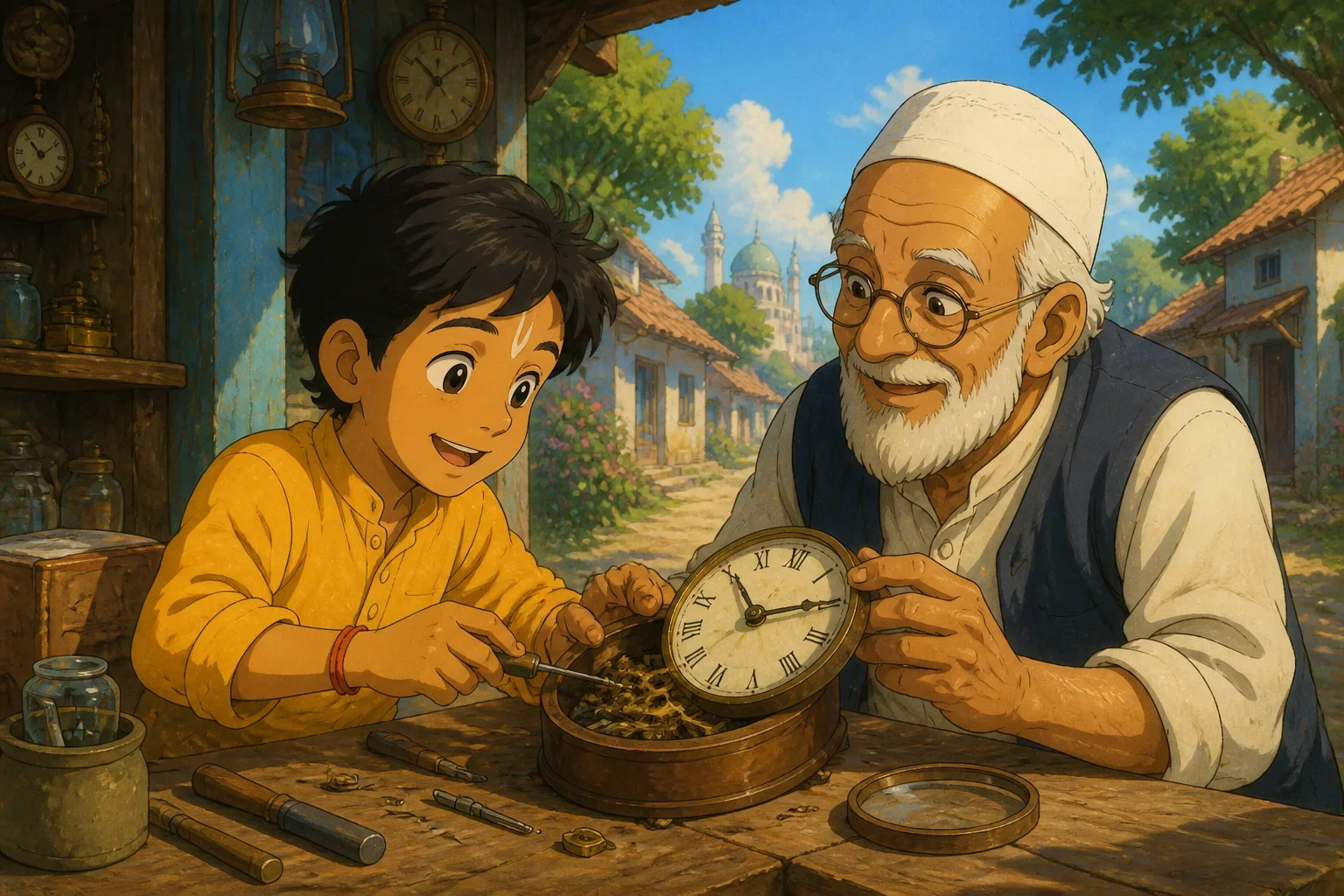
Aryan lived there—a curious, playful, tender-hearted boy. He loved to study broken objects as if each one held a secret. Kites with torn paper, old books, toys in pieces—he believed everything could speak if listened to closely. His mother often laughed,
"Aryan, you don't hunt for things. You hunt for the hearts inside them."
He believed that was true.
The Old Clock in the Market
One bright afternoon Aryan wandered through the market. Outside a tiny shop hung a faded sign. Inside, wooden shelves held clocks, glasses, radios, locks, and countless forgotten treasures.
In the corner sat a round clock. Its glass was scratched, the strap worn, and its hands frozen—as if time had decided to pause and rest.
Aryan lifted it and stared.
"Do you like it?" a gentle voice asked behind him.
He turned. White beard, bright eyes, calm lines on a weathered face—Rahman Chacha, the repairman everyone trusted. People said he fixed objects, but many whispered he could mend hearts as well.
"It's beautiful," Aryan said softly, "but it doesn't tick."
Rahman Chacha smiled. "What stops moving is not always lost, son. Sometimes it only needs patience, care, and a little love."
Hope flashed in Aryan's eyes. "Can it work again?"
"If you help me."
"Me? Really?"
"Yes. One rule, though—no rushing. Work done with love should never be done in a hurry."
Aryan agreed at once.
Friendship Behind the Workbench
Rahman Chacha spread a soft cloth and opened the clock. Tiny gears, slim hands, small screws—Aryan felt he had stepped into a hidden world.
"See," said the elder, "the life of a clock lives inside. Outside it may look fine, yet one small flaw inside can stop everything."
Aryan watched closely. He held tweezers, cleared dust, and guarded each piece. Often his hands trembled.
"What if I break it?" he whispered.
The old man answered calmly, "Those who learn are not afraid of mistakes."
As they worked, they talked. Aryan shared school stories, his mother's laddoos, and his dream of becoming a doctor someday. Rahman Chacha told of childhood lessons in his father's workshop, of distant cities, and of one truth he had found everywhere:
"When the heart is clean, roads open on their own."
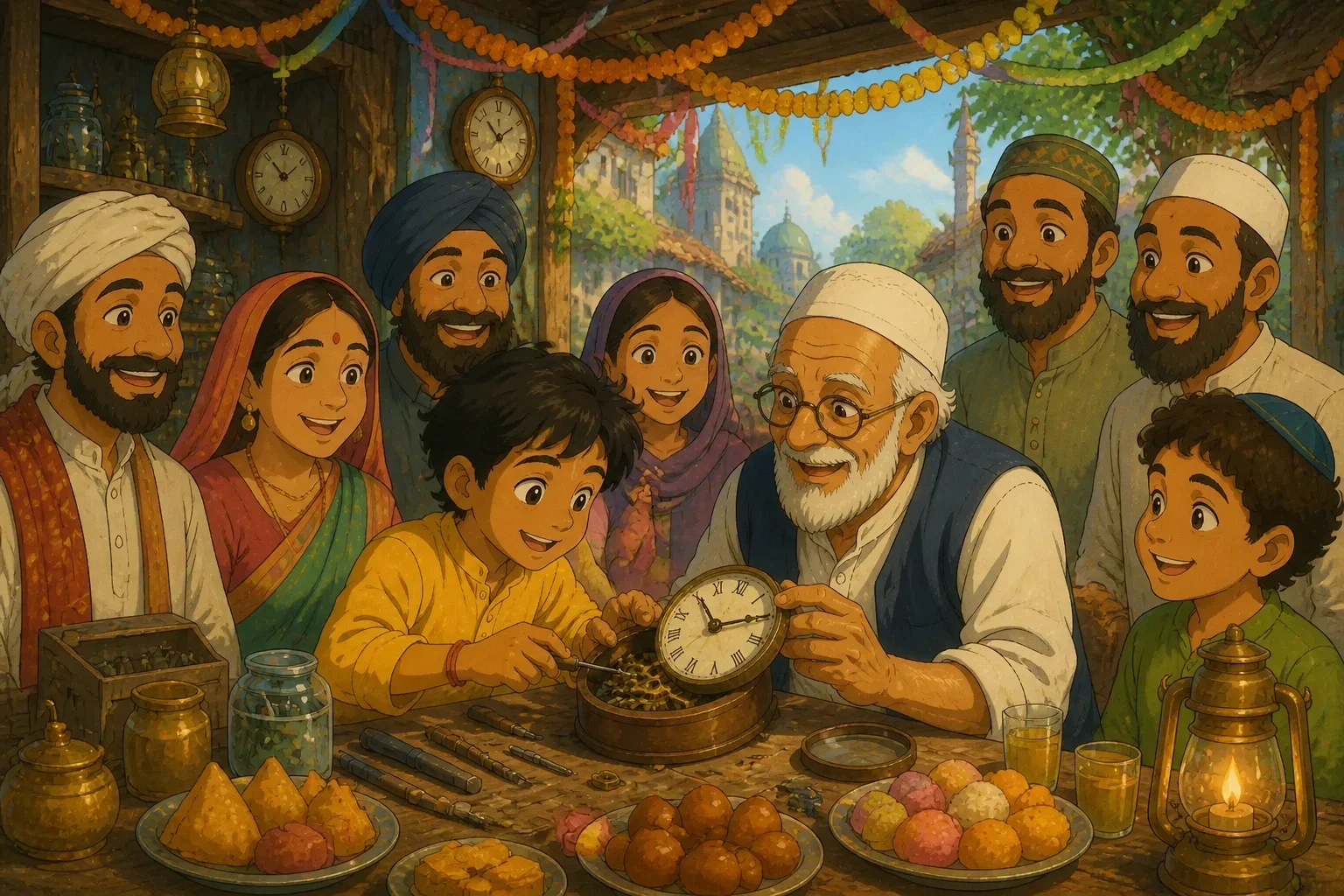
Evening painted the sky orange. Rahman Chacha closed the clock, wound the key, and both held their breath.
A moment passed.
Then—tick… tick… tick…
Aryan jumped. "It works, Chacha, it works!"
Light sparkled in the elder's eyes. "Yes, son. When small parts work together, time moves forward again."
Aryan hugged the clock to his chest. That day he carried home more than a machine—he carried a friendship.
Every Week, a Shared Bench
After that, Aryan visited often. Sometimes he brought food from home; sometimes Rahman Chacha taught him over cardamom tea. They repaired old things, swapped tales, laughed, and sat in comfortable silence.
He learned:
- "Think before you speak."
- "Do not judge people by name or dress alone."
- "If your heart has room, the world no longer feels small."
Aryan felt the shop held more wisdom than clocks.
When Invisible Walls Rose
Months later, the village air changed. Neighbors who once shared benches began to whisper apart. Rumors spread. Some said distance was safer. Even children's games showed new lines.
Aryan found the shop quiet. Dust settled faster. The little bell over the door rang less often.
One day Rahman Chacha sat with an old eyeglass frame, his shine dimmed.
"Chacha," Aryan said softly, "you seem sad."
After a pause the elder spoke. "When people stop seeing one another, sadness follows. Once I was Rahman Chacha to everyone. Now a few see only my faith."
Aryan's throat tightened. "But you're still you—the one who fixes things, tells stories, and helps everyone."
Rahman Chacha looked at him. "You see that. That hope is what keeps me standing."
That night Aryan could not sleep. The stopped clock returned to his mind. If a clock could move again, could hearts?
A Small Plan, a Big Courage
The next morning Aryan made a plan. He went door to door. "Meet under the banyan tree this evening," he told elders. "Bring your children and one story to share," he told families. "We are having a gathering."
When Rahman Chacha asked what would happen, Aryan smiled. "We are going to wind the village's heart again."
The Evening Under the Banyan
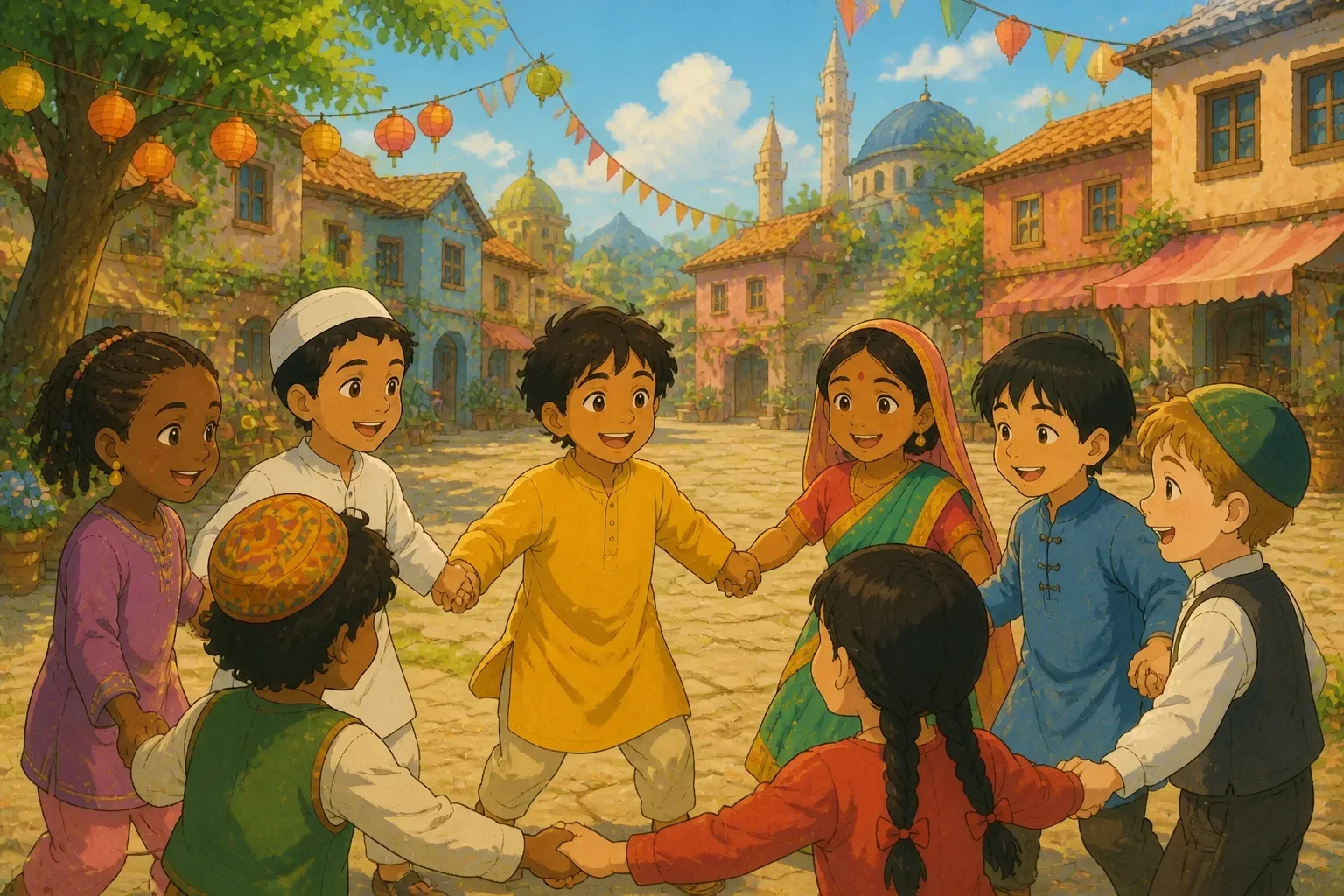
Mats were laid beneath the great tree. Some came eagerly, some shyly, some only to watch. Children formed a circle. The breeze was cool. Somewhere, sweets and samosas scented the air.
Aryan stood in the center, holding the old clock.
"You see this clock?" he said. "It used to be silent. I thought it was gone forever. But Rahman Chacha taught me that what stops is not always lost—it needs patience, understanding, and love."
People listened.
He raised the clock. "Inside are tiny pieces. If even one refuses to move with the others, the whole clock stops. Our village is the same. If we turn away from one another, can our village truly go forward?"
Silence deepened.
"I'm Hindu," Aryan continued. "Rahman Chacha is Muslim. When I was sad, he taught me the value of time. When I wanted to learn, he taught me patience. When I was afraid, he held my hand. So tell me—should I call him stranger, or family?"
An elder stepped forward. "Family," he said.
Another voice joined. "Family."
Soon many voices echoed—"Family… family…"
Rahman Chacha's eyes glistened. Aryan ran to him and seized his hand.
Women opened baskets of food. Children told stories. Someone sang a hymn, someone offered a prayer of thanks, someone shared childhood mischief until laughter rolled under the branches. Those who had stood apart slowly drew closer.
That night they shared more than meals. They set down fear, loosened misunderstanding, and made room again in their hearts.
The Clock That Reminded a Village
Afterward, Rahman Chacha's shop filled with life again. Aryan came as before, often with friends. The elder reminded them often:
"Humanity is the oldest bond we share."
Aryan pinned a paper beside the door in large letters:
"When hearts join, the world keeps moving."
Below it hung the same old clock—ticking steadily, reminding everyone that respect and love are stronger than any label.
Key Takeaways for Kids
- True friendship is greater than religion, language, or clothing.
- Judge people by their actions and character, not by rumors.
- Fear can divide communities, but kindness and conversation can reunite them.
- A small act of courage can start a big change.
- Humanity is the deepest faith we can practice together.
Moral of the Story
Brotherhood grows not from walls between religions, but from the goodness in our hearts. Love, respect, and understanding keep a community alive.
Why Children Love This Story
It offers a tender, unlikely friendship, a memorable clock that becomes a symbol, and a simple message of unity children can carry into real life. Read it when you want a friendship moral story that is gentle in tone and deep in meaning.

Watch the Animated Story
Watch on YouTube
Related Stories
Power of Positive Thinking: Inspirational Moral Story
The Power of Positive Thinking Until late that night, everything in Sukhpur seemed fine. The village pond shimmered…

Value of Time: Ravi's Heart-Touching Moral Story
The Value of Time Morning had arrived. Dew still glittered on the village path like tiny pearls. Ox bells rang…

Value of Time | Moral Story About Family and Priorities
The Father, the Piggy Bank, and Five Minutes of Sunset In the shining city of Silverstone, people often said that Elias…
Unfinished Portrait | Friendship Moral Story for Kids
The Unfinished Portrait On the edge of a quiet little town, where the hills rolled like green blankets and the trees…
Locket by the River: A True Friendship Story for Kids
The Locket by the River On the edge of a small village, where the river skipped over smooth stones and the willow…
Poor Mother's Sacrifice: Moral Story of Love and Success
A Poor Mother's Sacrifice At the edge of the village, beside a narrow dirt path, stood a small hut. Rain dripped…